
Radio Control: Pylon Racing
Ed Rankin
IF YOU DIDN'T come to the Nats this year you missed a good one with relatively good weather and lots of racing. Being an experienced F‑1 pilot helped very much because I knew what the fliers wanted. While arranging the frequency groupings, I shuffled fliers in a frequency group who were calling for each other as much as possible, so that they wouldn't have back‑to‑back heats. In addition, I arranged the heat matrix where no two fliers would have to fly each other more than once.
The course layout was arranged within the safety code at a runway and taxi‑way intersection to give the minimum walking distance from the ready line to the flight line. Also, the pit area was conveniently located behind the desks alongside the taxi strip with the vehicles parked 550 feet from the course. Pilots' meetings were held before each event where ground rules were stated which fully stressed the AMA rules and the NMPRA Race Procedure. These included strict enforcement of all safety rules with zeros given for infractions; fast movement to the flight line; no talking to the lap counters and flagmen (talk only to starter and head lap counter); no changes of heat results after flier left the flight line; starting procedure; and use of the lap‑counter stand. Most callers do not use the lap‑counter stand to inform the flier of cuts and the lap that they are in.
Equipment proved to be another key factor for running an efficient race. This included large visible wooden pylons, NMPRA lap‑counter stand, NMPRA clock, visible flags at #1 pylon (pilots prefer flags to lights), cut boards at #1 pylon, wire‑mesh safety barriers at all pylons and lap counter station. Our thanks to Jay Lewis and Dave Alter, owners of the Hobby Market, for furnishing a van to transport equipment and personnel. In addition, they furnished the materials for the lap‑counter stand, clock and permanent score boards. The most important equipment required was the five‑way communications between #1, 2, 3 pylons, head lap counter and the event director which proved to expedite the heats, clarify cuts, and relay instructions promptly.
To reduce the errors made by workers and speed up the time between heats, I assigned people to each task, rather than doubling up on tasks. At the #1 pylon there was a head flagman with a two‑way radio and four flagmen. At the flight line there was a head lap counter with two‑way radio, starter, flight‑line recorder and four lap counters. A man was stationed at each of the #2 and #3 pylons with two‑way radios. At the main desk there were four recorders, two pit bosses (one on the P.A. to call fliers to the ready line and announce results of races), one frequency monitor, one weigh‑in, one transmitter impound, one runner and two refuel men for QM. This system requires a total of 26 people with 14 on the course and 12 at the desk, not including the relief crew of five people.
The proof that this system works is the number of heats flown. There were 51 entries in QM and 14 hours consumed in nine rounds (2 hours lost due to rain and pilots' meetings), including heat reruns, not including fly‑offs. This averages 7.05 minutes per heat with 13 heats per round. There were 49 entries in F‑1, and 13.5 hours consumed in 10 rounds including four heat reruns and fly‑offs, which averages 6.04 minutes per heat with 13 heats per round. The first heat was in the air promptly at 8:00 a.m. each day except Monday, which helped to utilize all of the time available.
An event director is no better than the workers that run the race, and we had an expert crew whom I would like to recognize. The QM and F‑1 pilots, and AMA Headquarters have asked me to thank them and congratulate them for a job well done.
Jan Sakert, AMA Executive Council representative, did a tremendous job in relieving me of all the administrative duties associated with headquarters, processing help, supervising equipment set up and break down each day, verifying final tabulations and advisement to me on key decisions. Without this fine dedicated man, I could not have survived the seven days of processing and racing. John Emery and Ned Barnes headed‑up the LARKS manpower, and believe me they did a tremendous job in helping move equipment and provide all of the necessities for running this race. Twelve LARKS were at the race site, and worked at all of the worker positions both full time and relief. Bob Talley spent all six days at the spectrum analyzer monitoring frequencies, and I counted five occasions where he saved airplanes from crashes. Paul Bartell from Atlanta, Ga., volunteered his services at the race and he was assigned the pit boss position for QM. He enjoyed working so well he stayed an extra day to help in F‑1. Many other people volunteered at the race site, but I was unable to use them.
The Ft. Worth, Dallas and Austin crew reported for duty as promised and their names are as follows: John Harris, President of The Ft. Worth Thunderbirds (F‑1 Pit Boss); Paul Fon and David McKensie, Peggy Jensen, Donna Parks, Nancy Barrett, Jan Helms (Desk Recorders); Jimmy Harris, Johnnie Eddyhausen, Chris Bedwell (Refuel Pit); Steve Barrett (Runner); Don Downing (Desk Supervisor); John Eddyhausen (Head Flagman); Dwyane Brown and Jim Simpson (Starter and Flight Recorder); Jon Rynd (Head Lap Counter); Roger Cerillie, Tom Blakney, Tex Schmitt, Bill Slater, Larry Jensen, Jim Harris, Frank Harris, Vernon Miles, Eddie Carr, John Kidwell, George Pakes (Lap Counters and Flagmen). A special thanks to Mr. Richmond from Fla. (father of Bryan and Dave Richmond) who volunteered to run the transmitter impound area.
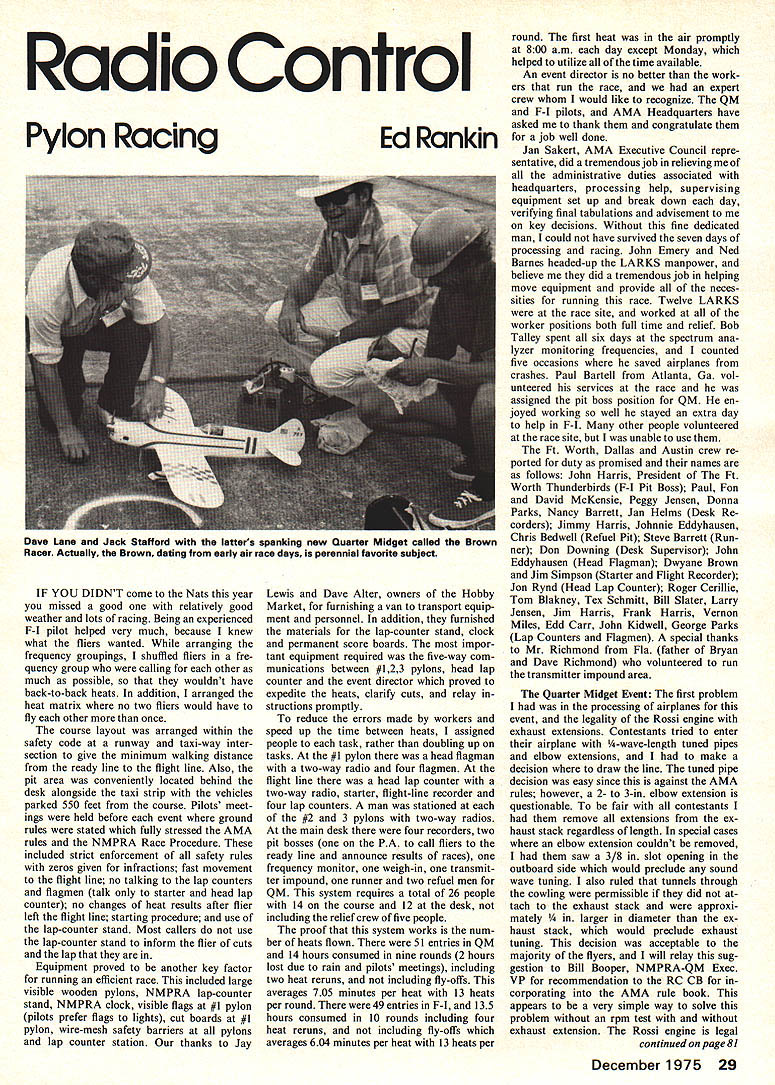
The Quarter Midget Event: The first problem I had was in the processing of airplanes for this class, and the legality of the Rossie engine with the extended exhaust extensions. Contestants tried to enter their airplane with 1/4‑wave length tuned pipes and elbow extensions, and I had to make a decision whether to allow them. The tuned pipe decision was easy since this is against the AMA rules; however, the 2‑ to 3‑in. elbow extension is questionable. To be fair with all contestants I did not remove all extensions from the exhaust stack regardless of length. In special cases where an elbow extension couldn't be removed, I had them saw a 3/8 in. slot open in the outboard side which would reduce any sound wave tuning. I also ruled that tunnels through the cowling were permissible if they did not attach to the exhaust stack and were approximately 3/4 in. larger in diameter than the exhaust stack, which would preclude exhaust tuning. This decision was acceptable to the majority of the fliers, and I will relay this suggestion to Bill Boober, NMPRA‑QM Exec. VP for recommendation to the RC Bob C for incorporation into the AMA rule book. This appears to be a very simple way to solve the problem without an rpm test with and without exhaust extension. The Rossie engine is legal
Radio Control: Pylon Racing
with the Perry cab, and I had a letter from John Worth listing all of the engines legal for QM. Also, the Rossi head with a standard glow plug is legal with over 2,000 units available. Bill McGravy, the importer, and Jim Finley, the distributor, verified this. Also, Jim Finley had a box of these heads available at the Nats.
The Rossi engine revolutionized QM racing with the majority of pilots using it, and took all of the top ten places except two. In addition, Bob Reuther took first place and the fastest time trophy with a 1:40 using the Rossi. Other fast times with the Rossi were: Austin Leftwich, 1:40.5; Paul Verger, 1:42; Bob Royal, 1:42; Jim Moorehead, 1:42; Steve Sica, 1:42; George Parks, 1:42; Dave Pearce turned a 1:44 with a K&B. The race ran very smoothly with many close heats, and the majority of the fliers agreed with the idle rule used. Engine idle capability was called for in the first round only by retarding the transmitter control to full idle for each motor for 10 seconds. A penalty of 1/2 point was deducted if the airplane landed dead-stick per AMA rules.
The Formula I Event: No problems existed during processing, and all contestants complied with our rigid safety, weight, dimensions, and wing area checks. Scale judging started at 6 p.m. with 82 airplanes entered. A scoring system of one through six was used, and a trophy was given for the best in F-I. Scale judging: Win Stockwell won this honor with his beautiful Prather Toni and ST-40. There was a close second with his Bob Violett LDKL. There were some contestants that presented their airplanes without cowlings and without props, and were placed on the 6th row. After I announced this problem, some did rectify this mistake, but two airplanes were not corrected and were left on the 6th row.
The predominant airplane and engine was the Prather Toni and ST-X40. We had a very difficult time in distinguishing between airplanes because all airplanes looked alike. Everyone was very anxious to see how the new K&B rear exhaust engine would perform in its first contest. I received a copy of a letter from K&B to AMA Headquarters stating over 1,000 units had been distributed. The new K&B had the fastest time of the meet with a 1:19.3 by Bob Violett up until the last hour. The humidity went down, and then the ST-X40 came on strong with John McDermitt winning the fastest time trophy with a 1:18.9, and also a well deserved 5th place. In my opinion, John flew the best course of all the pilots. Bill Peirson turned a 1:19.9 with his ST-X40 and took 3rd place. Bill has become one of the top pilots in the country with a 2nd place in the '74 Nats and a 2nd place in the '75 Bakersfield meet. Doug Doble turned a 1:19 with his ST-X40, winning 6th place and also the Best Senior trophy. This is Doug's first year in F-I and he has really been doing well in the Calif. races. Congratulations to Tommy Baker (charter member of the Over-the-Hill-Gang) for winning 4th place with his new K&B. His fastest time was 1:27, but consistency paid off in the end.
Honorable mention goes to Keith Davidson for turning a 1:21.7 with his ST-X40. Bob Violett came in second with his Little Toni and new K&B. Bob was tied for first place until the 9th round when he placed second with a 1:24. Also, in the 10th round he placed third with a 1:21 and tangled with a bunch of Tigers. Irwin Funderburk won the top honors with his El Bandito and K&B rear exhaust engine. He was beaten only by Bob Violett in the 6th round. In this race Irwin turned a 1:27 for 11 laps, and clocked a 1:22 for his fastest time of the contest.
The NMPRA Meeting: A general meeting was held on Thursday night, and all members and nonmembers were invited with 54 in attendance. Subjects discussed were: NMPRA Championship Race, QM rules, and changes to the Race Procedure Guide.
Don Downing gave a complete status report for this great tournament of champions. Added attractions since our last report is the securing of Mike Clark, pro football player, as speaker at the banquet and presentation of trophies. Also a full-size F-I airplane will be on display with a possible full-scale acrobatic demonstration. Art Chambers offered a good suggestion for pre-processing which we will incorporate. This will require the contestant to simply sign a statement that his model meets all of the AMA and NMPRA rules pertaining to safety, dimensions, wing area, weight and engine. All winners will then be processed at the end of the contest. This will speed up the time-consuming process. To aid the long-distance travelers who will be arriving late, registration will end at approximately 10:00 p.m. on Friday, and they can register by telephone before this time. Phone number of race headquarters will be on the entry blank. Scale judging will be scheduled to start at 7 a.m. and racing will start at 8 a.m. Saturday.
Workers are needed to the NMPRA Race Procedure Guide. For both QM and F-I events at the Nats, race time was started for each airplane as it was flagged off the line per the Guide. It was suggested that this be changed to: race time starts for all airplanes on the first flag which would include their handicap in the race time. It was also suggested that the Guide be sent out to all NMPRA members at membership renewal time. In addition, it should be sent to AMA CD's applying for a race contest. This Guide is now available at AMA headquarters for the asking. Glen Spickler had previously stated that he should add minimum requirements for check cowl and pilots.
Many discussions were held on the field and at all of the meeting concerning the impact of the Rossi engine on the QM event. From my observations at the Nats, local contests, reports from all over the USA, the Rossi engine has been very well received and accepted by the majority of the fliers. Most people have welcomed the availability of a well-made, long-lasting high-performance engine. Simple arithmetic shows that a $100 initial investment for this type of engine is better than buying four or five inferior engines at $40 each to last the racing season. Some say that this engine will make the event too competitive. I have stated many times that once the event was nationalized as an AMA event, you will no longer have a "Sunday afternoon, low-key, low investment event" for the beginner. Quoting Jan Sakert: "There is no such thing as a beginner, only those who haven't won in a contest." Two classes have been discussed with a $50 engine limit in one class, and unlimited in the other class. Bill Cooper has called for an opinion on this and other issues for QM in the July NMPRA newsletter.
(My address is: 6072 Wonder Dr., Ft. Worth, Tex. 76133.)
Transcribed from original scans by AI. Minor OCR errors may remain.

