
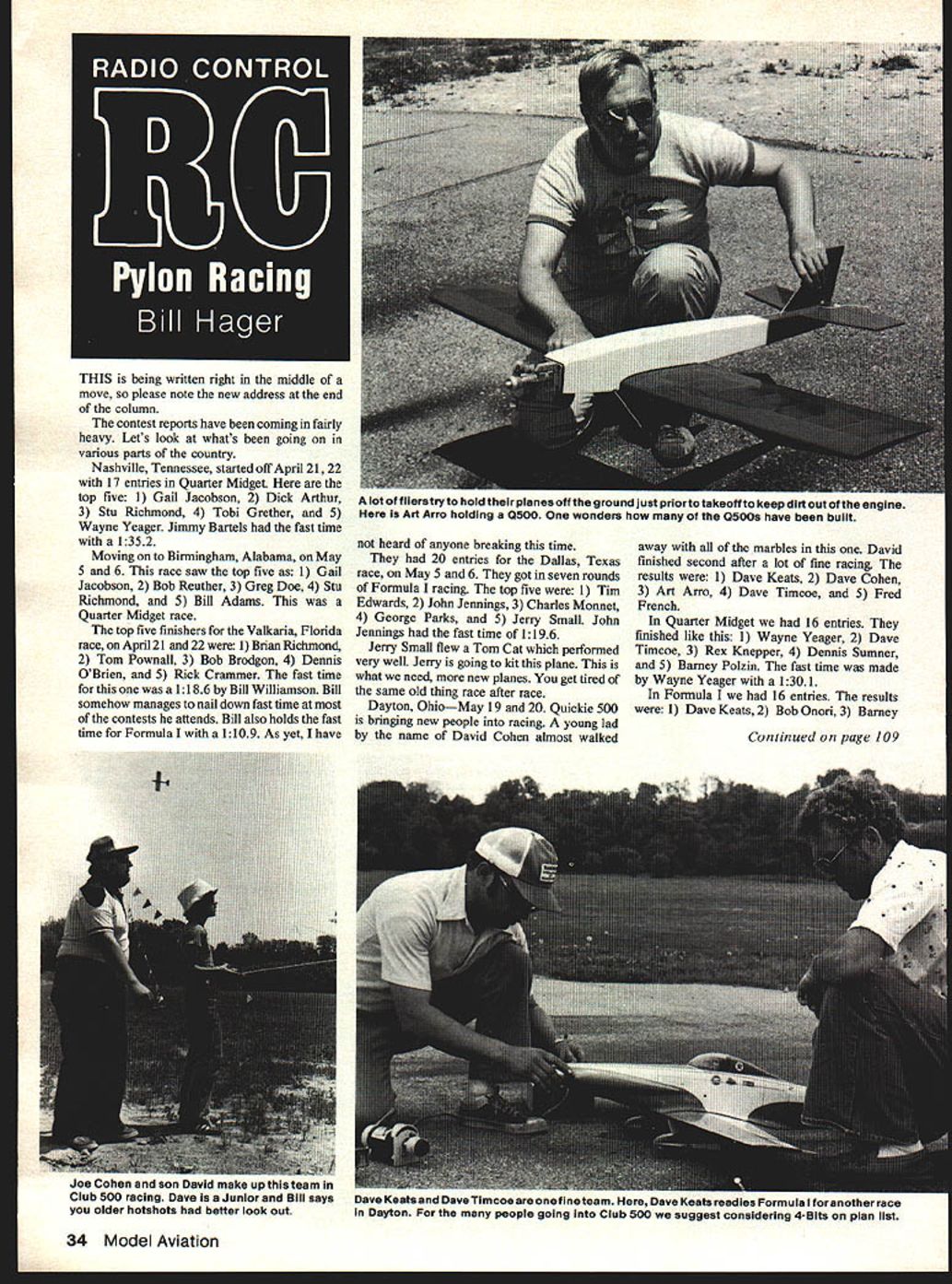
Radio Control: Pylon Racing
Bill Hager
This column is being written in the middle of a move — please note the new address at the end of the column.
Contest reports
#### Nashville, Tennessee — April 21–22
- Class: Quarter Midget (17 entries)
- Gail Jacobson
- Dick Arthur
- Stu Richmond
- Tobi Grether
- Wayne Yeager
- Fast time: Jimmy Bartels, 1:35.2
#### Birmingham, Alabama — May 5–6
- Class: Quarter Midget
- Gail Jacobson
- Bob Reuther
- Greg Dore
- Stu Richmond
- Bill Adams
#### Valkaria, Florida — April 21–22
- Brian Richmond
- Tom Pownall
- Bob Brodgon
- Dennis O'Brien
- Rick Crammer
- Fast time: Bill Williamson, 1:18.6
- Bill Williamson also holds the Formula I fast time at 1:10.9 (not yet broken).
#### Dallas, Texas — May 5–6
- Formula I (20 entries, seven rounds)
- Tim Edwards
- John Jennings
- Charles Monnet
- George Parks
- Jerry Small
- Fast time: John Jennings, 1:19.6
- Note: Jerry Small flew a Tom Cat that performed very well; he plans to kit this plane. We need more new designs — you get tired of the same old models race after race.
#### Dayton, Ohio — May 19–20
- Quickie 500 results:
- Dave Keats
- Dave Cohen
- Art Arro
- Dave Timcoe
- Fred French
- Quarter Midget (16 entries)
- Wayne Yeager
- Dave Timcoe
- Rex Knepper
- Dennis Sumner
- Barney Polzin
- Fast time: Wayne Yeager, 1:30.1
- Formula I (16 entries)
- Dave Keats
- Bob Onori
- Barney Polzin
- Bill Hager
- Ken Hulik
- Fast time: Dave Keats, 1:21.6
#### Bakersfield, California — May 19–20
- Formula I (59 entries; down a bit from past years — likely due to the gas crunch). Competition was fierce.
Top ten finishers and times:
- Dave Shadel — 1:17.0
- Tom Christopher — 1:18.9
- Jerry Boyce — 1:15.3
- Clay Barrett (team; Steve Barrett flying) — 1:17.8
- John McDermott — 1:15.6
- Harley Condra — 1:18.4
- Ron Gilman — 1:19.9
- Rusty Van Baren — 1:17.0
- Andrew McIndoe — 1:24.8
- Lenard Walker — 1:27.9
#### U.P.R.C. — May 20
- First Formula I race (20 entries)
- Dave Kelly
- Hal DeBolt
- Chuck Boyer
- Bob Ball
- Mike Burg
- Note: This was Mike Burg's first Formula I race.
I plan to keep readers informed about racing across the country. I will print as many contest reports as space allows — so keep the reports coming in.
Notes on Formula I judging
In Formula I it has been customary to judge airplanes on appearance and workmanship, with the best-looking plane taking off first. While this adds work for contest management, I think it is an important part of Formula I. Our racers typically present the best-built and nicest-looking planes in the hobby.
Some areas are doing away with appearance judging and are using random draws for takeoff positions to make it easier for newer fliers. The idea is that if newcomers don't have to spend as much time finishing their planes, they might be more likely to start flying the event.
I believe scale judging and finish quality are important. A flier takes pride in the finish of his plane, and that same care generally shows up in construction. We don't need quickly built Formula Is. The thing that keeps the new flier out of events is not the finishing of the planes — Formula I is simply the most competitive event we have, and there are few events intended specifically as entry-level racing.
Tips from the field
A few practical suggestions passed along from Club 500 and other flyers:
- Mark polarity on molded-case batteries — it can be hard to read otherwise. This makes clipping charger or power-panel leads easier; matching clip insulator color is a simple guide.
- Mark proper switch positions on transmitters (takeoff/low rate aileron, elevator, gear-down dot, etc.). Throttle-trim can act as a reminder (low trim kills the engine).
- Keep levers centered. This allows quick preflight checks and helps after a plane has been impounded in a box and might have been bumped.
- Use durable markings that stick well; a clean surface can be scraped with a fingernail if necessary.
- If two planes have different setups, use two sets of dots in different colors or color-key the spot/switch.
- A good way to punch spots is with an anvil, paper punch, or Mylar punch — inexpensive and useful.
Thanks to those who contributed these ideas.
Whether "Pattern Problem Month" continues in this column depends on reader interest. Send in suggestions, store ideas, or notes about run-dry.
Correspondence
Send correspondence to: Ron Van Putte 12 Connie Drive Shalimar, FL 32579
Transcribed from original scans by AI. Minor OCR errors may remain.

