
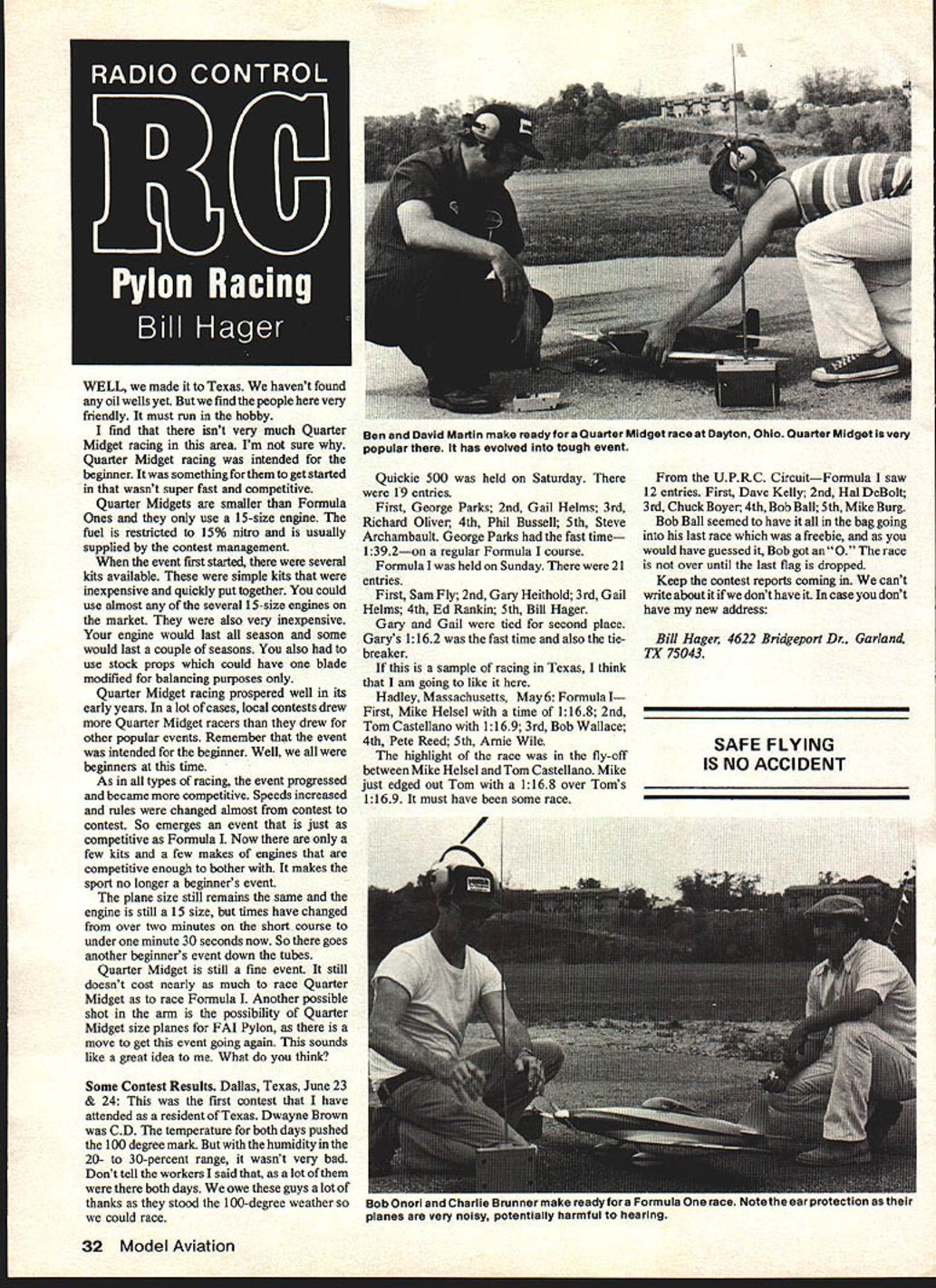
Radio Control: Pylon Racing
By Bill Hager
Well, we made it to Texas. We haven't found any oil wells yet, but we find the people here very friendly. It must run in the hobby.
I find that there isn't very much Quarter Midget racing in this area. I'm not sure why. Quarter Midget racing was intended for the beginner. It was something for them to get started in that wasn't super fast and competitive.
Quarter Midgets are smaller than Formula I and they only use a 15-size engine. The fuel is restricted to 15% nitro and is usually supplied by the contest management.
When the event first started, there were several kits available. These were simple kits that were inexpensive and quickly put together. You could use almost any of the several 15-size engines on the market. They were also very inexpensive. Your engine would last all season and some would last a couple of seasons. You also had to use stock props which could have one blade modified for balancing purposes only.
Quarter Midget racing prospered well in its early years. In a lot of cases, local contests drew more Quarter Midget racers than they drew for other popular events. Remember that the event was intended for the beginner. Well, we all were beginners at this time.
As in all types of racing, the event progressed and became more competitive. Speeds increased and rules were changed almost from contest to contest. Thus emerges an event that is just as competitive as Formula I. Now there are only a few kits and a few makes of engines that are competitive enough to bother with. It makes the sport no longer a beginner's event.
The plane size still remains the same and the engine is still a 15-size, but times have changed from over two minutes on the short course to under one minute 30 seconds now. So there goes another beginner's event down the tubes.
Quarter Midget is still a fine event. It still doesn't cost nearly as much to race Quarter Midget as to race Formula I. Another possible shot in the arm is the possibility of Quarter Midget–size planes for FAI Pylon, as there is a move to get this event going again. This sounds like a great idea to me. What do you think?
Keep the contest reports coming in. We can't write about it if we don't have it.
Contest Results
Dallas, Texas — June 23 & 24
This was the first contest that I have attended as a resident of Texas. Dwayne Brown was C.D. The temperature for both days pushed the 100-degree mark, but with the humidity in the 20–30 percent range, it wasn't very bad. Don't tell the workers I said that, as a lot of them were there both days. We owe these guys a lot of thanks as they stood the 100-degree weather so we could race.
Quickie 500 (Saturday) — 19 entries:
- George Parks
- Gail Helms
- Richard Oliver
- Phil Bussell
- Steve Archambault
- Fast time: George Parks — 1:39.2 on a regular Formula I course.
Formula I (Sunday) — 21 entries:
- Sam Fly
- Gary Heithold
- Gail Helms
- Ed Rankin
- Bill Hager
- Gary and Gail were tied for second place. Gary's 1:16.2 was the fast time and also the tiebreaker.
If this is a sample of racing in Texas, I think that I am going to like it here.
Hadley, Massachusetts — May 6
Formula I:
- Mike Helsel — 1:16.8
- Tom Castellano — 1:16.9
- Bob Wallace
- Pete Reed
- Arnie Wile
- The highlight of the race was the fly-off between Mike Helsel and Tom Castellano. Mike just edged out Tom with a 1:16.8 over Tom's 1:16.9. It must have been some race.
From the U.P.R.C. Circuit
Formula I — 12 entries:
- Dave Kelly
- Hal DeBolt
- Chuck Boyer
- Bob Ball
- Mike Burg
- Bob Ball seemed to have it all in the bag going into his last race, which was a freebie, and as you would have guessed it, Bob got an "O." The race is not over until the last flag is dropped.
In case you don't have my new address:
Bill Hager 4622 Bridgeport Dr. Garland, TX 75043
Transcribed from original scans by AI. Minor OCR errors may remain.

