
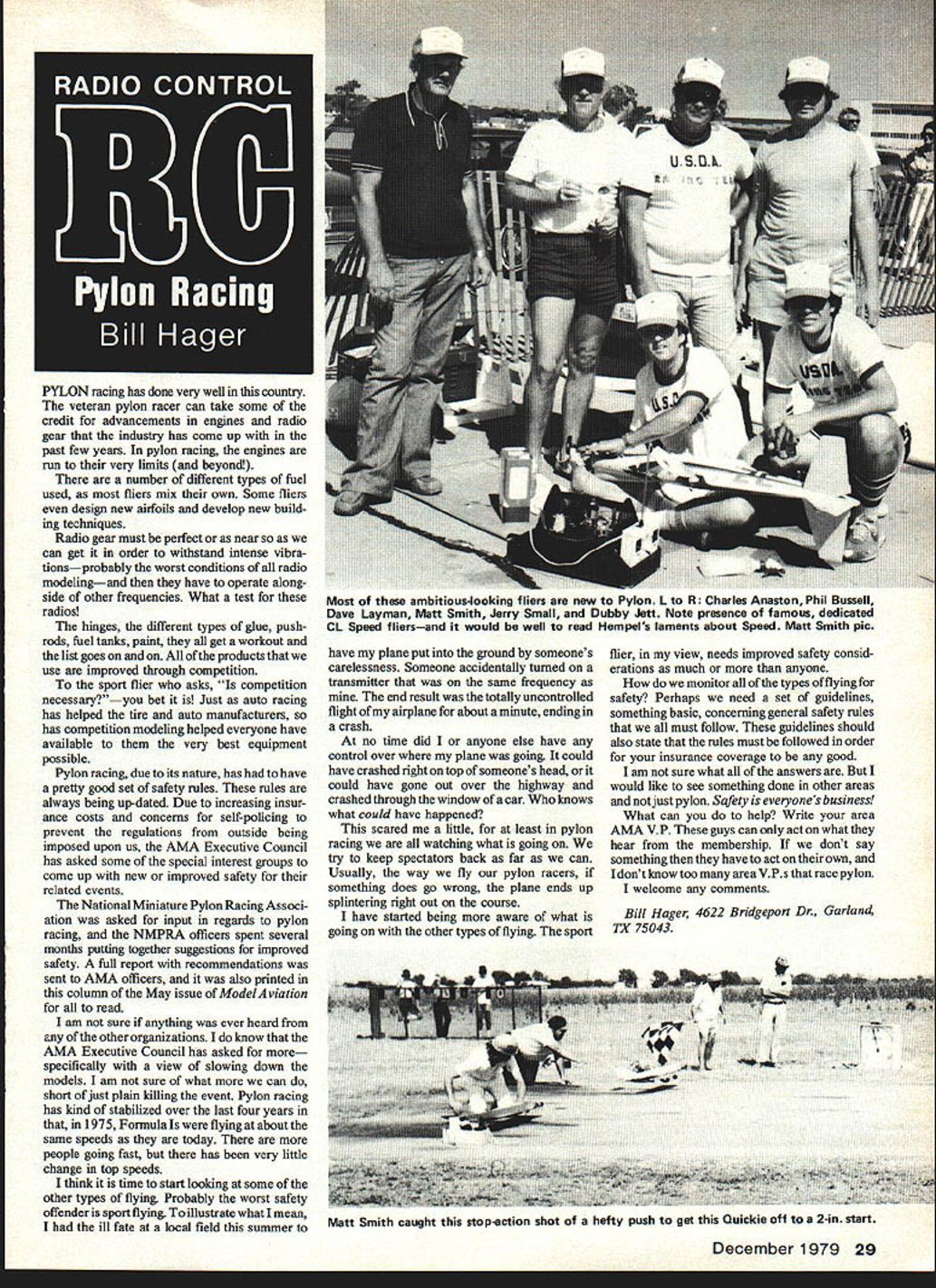
Radio Control: Pylon Racing
Bill Hager
Pylon racing has done very well in this country. The veteran pylon racer can take some of the credit for advancements in engines and radio gear that the industry has produced in the past few years. In pylon racing, the engines are run to their very limits (and beyond).
Equipment and Innovation
There are a number of different types of fuel used, as most fliers mix their own. Some fliers even design new airfoils and develop new building techniques.
Radio gear must be perfect—or as near so as we can get it—in order to withstand intense vibrations, probably the worst conditions of all radio modeling; and then they have to operate alongside other frequencies. What a test for these radios!
Hinges, the different types of glue, pushrods, fuel tanks, paint—these all get a workout, and the list goes on and on. All of the products that we use are improved through competition.
To the sport flier who asks, “Is competition necessary?”—you bet it is! Just as auto racing has helped tire and auto manufacturers, so has competition modeling helped everyone have available to them the very best equipment possible.
Safety and Rules
Pylon racing, due to its nature, has had to adopt a pretty good set of safety rules. These rules are always being updated. Due to increasing insurance costs and concerns for self-policing to prevent regulations from being imposed from the outside, the AMA Executive Council has asked some of the special interest groups to come up with new or improved safety measures for their related events.
The National Miniature Pylon Racing Association (NMPRA) was asked for input regarding pylon racing. The NMPRA officers spent several months putting together suggestions for improved safety. A full report with recommendations was sent to AMA officers, and it was also printed in this column of the May issue of Model Aviation for all to read.
I am not sure if anything was ever heard from any of the other organizations. I do know that the AMA Executive Council has asked for more—specifically with a view to slowing down the models. I am not sure what more we can do, short of just plain killing the event. Pylon racing has kind of stabilized over the last four years; in 1975, Formula I were flying at about the same speeds as they are today. There are more people going fast, but there has been very little change in top speeds.
Concerns about Sport Flying
I think it is time to start looking at some of the other types of flying. Probably the worst safety offender is sport flying. To illustrate what I mean: I had the ill fate at a local field this summer to have my plane put into the ground by someone’s carelessness. Someone accidentally turned on a transmitter that was on the same frequency as mine. The end result was the totally uncontrolled flight of my airplane for about a minute, ending in a crash.
At no time did I or anyone else have any control over where my plane was going. It could have crashed right on top of someone’s head, or it could have gone out over the highway and crashed through the window of a car. Who knows what could have happened?
This scared me a little, for at least in pylon racing we are all watching what is going on. We try to keep spectators back as far as we can. Usually, the way we fly our pylon racers, if something does go wrong, the plane ends up splintering right out on the course.
I have started being more aware of what is going on with the other types of flying. The sport flier, in my view, needs improved safety considerations as much or more than anyone.
Recommendations and Call to Action
How do we monitor all types of flying for safety? Perhaps we need a set of guidelines—something basic—concerning general safety rules that we all must follow. These guidelines should also state that the rules must be followed in order for your insurance coverage to be valid.
I am not sure what all of the answers are. But I would like to see something done in other areas and not just pylon. Safety is everyone’s business!
What can you do to help?
- Write your area AMA Vice President. These officers can only act on what they hear from the membership.
- Support the development of basic safety guidelines and insist rules be followed for insurance purposes.
- Participate in or provide feedback to your special interest groups, such as the NMPRA.
If we don't say something, the AMA officers have to act on their own—and I don't know too many area V.P.s that race pylon.
I welcome any comments.
Bill Hager 4622 Bridgeport Dr. Garland, TX 75043.
Transcribed from original scans by AI. Minor OCR errors may remain.

