
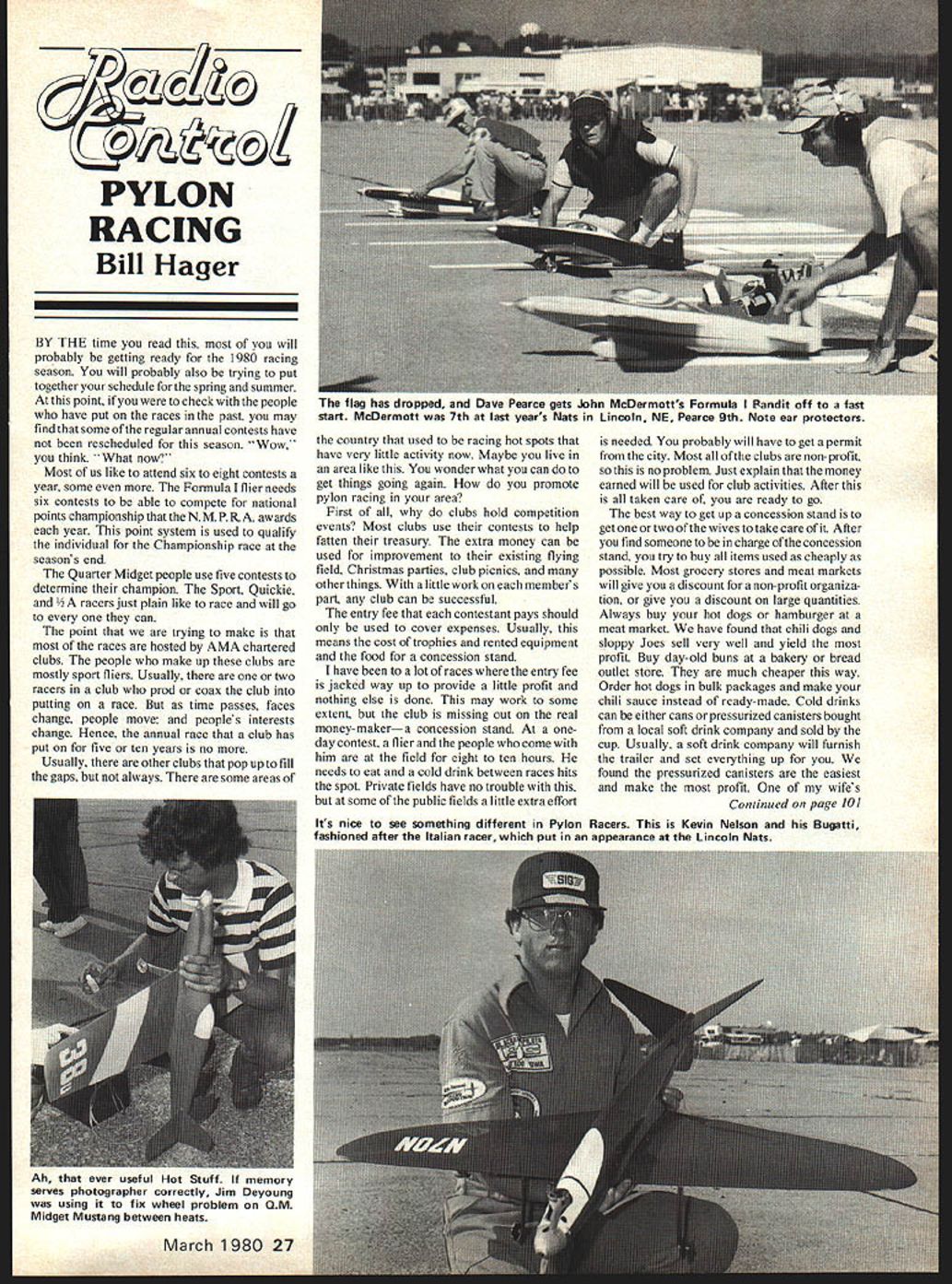
Radio Control: Pylon Racing
By Bill Hager
BY THE time you read this, most of you will probably be getting ready for the 1980 racing season. You will probably also be trying to put together your schedule for the spring and summer. At this point, if you were to check with the people who have put on the races in the past, you may find that some of the regular annual contests have not been rescheduled for this season. "Wow," you think. "What now?"
Most of us like to attend six to eight contests a year, some even more. The Formula I flier needs six contests to be able to compete for the national points championship that the N.M.P.R.A. awards each year. This point system is used to qualify the individual for the Championship race at the season's end.
The Quarter Midget people use five contests to determine their champion. The Sport Quickie and 1/2A racers just plain like to race and will go to every one they can.
The point that we are trying to make is that most of the races are hosted by AMA-chartered clubs. The people who make up these clubs are mostly sport fliers. Usually, there are one or two racers in a club who prod or coax the club into putting on a race. But as time passes, faces change, people move, and interests change. Hence, the annual race that a club has put on for five or ten years is sometimes no more.
Usually, there are other clubs that pop up to fill the gaps, but not always. There are some areas of the country that used to be racing hot spots that have very little activity now. Maybe you live in an area like this. You wonder what you can do to get things going again. How do you promote pylon racing in your area?
Why clubs hold contests
Most clubs use their contests to help fatten their treasury. The extra money can be used for improvements to their existing flying field, Christmas parties, club picnics, and many other things. With a little work on each member's part, any club can be successful.
The entry fee that each contestant pays should only be used to cover expenses. Usually this means the cost of trophies, rented equipment, and the food for a concession stand.
I have been to a lot of races where the entry fee is jacked way up to provide a little profit and nothing else is done. This may work to some extent, but the club is missing out on the real money-maker — a concession stand.
Permits and planning
At a one-day contest, a flier and the people who come with him are at the field for eight to ten hours. He needs to eat and a cold drink between races hits the spot. Private fields have no trouble with this, but at some public fields a little extra effort is needed. You probably will have to get a permit from the city. Most clubs are non-profit, so this is no problem. Just explain that the money earned will be used for club activities. After this is all taken care of, you are ready to go.
Running a concession stand
The best way to staff a concession stand is to get one or two of the wives to take care of it. After you find someone to be in charge of the concession stand, try to buy all items used as cheaply as possible.
- Most grocery stores and meat markets will give you a discount for a non-profit organization or for large-quantity purchases.
- Always buy your hot dogs or hamburger at a meat market.
- Chili dogs and sloppy Joes sell very well and yield the most profit.
- Buy day-old buns at a bakery or bread outlet store — they are much cheaper.
- Order hot dogs in bulk packages and make your chili sauce instead of using ready-made.
- Cold drinks can be either cans or pressurized canisters bought from a local soft drink company and sold by the cup. Usually, a soft drink company will furnish the trailer and set everything up for you. We found that pressurized canisters are the easiest and make the most profit.
- 100% profit ideas: get each member's wife to bake cookies, cupcakes, or brownies. These items sell very well and are nearly all profit.
- Always buy large-size jars of ketchup, mustard, relish, creamer, sugar, and coffee. Buy your cups by the case. What isn't used can be saved for another contest.
Don't sell your items for too high a price. You want to make a profit, but don't overdo it. A club can make several hundred dollars just with a well-run concession stand.
Promoting the race
A good example of a well-planned race is the annual Fort Wayne Flying Circuits Pylon Races, run by Jim Gager. Jim and his club spend a lot of time before race day promoting. As a non-profit club you can usually get free publicity on local radio stations and even on television. This helps promote our sport and gets the public out to the flying. These people also spend money.
This club also gives out several hundred dollars in prize money. This seems to be working, as each year the turn-out is up.
Example — 1979 Fort Wayne results
The '79 contest had 28 entries in Formula 1 and 36 entries in Quarter Midget. Here are the results:
Formula 1:
- Jim Moorhead
- Bob Reuther
- Dave Keats
- Bill Johnston
- Bob O'Neil
- William Peets
- Wayne Yeager
- Eric Meyers
- Al Grover
- Art Arno
Quarter Midget:
- Doug Bebensee
- Duane Gall
- Gail Jacobson
- Dennis Sumner
- Brian Richmond
- Floyd Fitzgerald
- Ken Heastie
- John Kilsdonk
- Dave Timcoe
- Allen Booth
Any of you who might have some ideas or tips on running a successful race, send them in and we will pass them on.
Bill Hager 4622 Bridgeport Dr. Garland, TX 75043
Transcribed from original scans by AI. Minor OCR errors may remain.

