
Radio Control: Pylon Racing
Bill Hager
Safety
SAFETY is very important in all aspects of model aviation. In any form—cars, boats, or airplanes—there must be added safety measures to protect the people running the race, the fliers, and the spectators.
In 1979 the National Miniature Pylon Racing Association made recommendations to the AMA for improved safety. These recommendations were approved by emergency action and were effective January 1, 1980. These safety rules were printed in the February 1980 issue of Model Aviation on page 86.
The most important changes concern worker and spectator safety. Spectators are generally kept at a safe distance and most are watching the race, so they are aware of what is going on and will notice a problem right away. The flier has a caller whose job is to be aware of everything that is happening during and immediately after a race. The caller is responsible for making sure the pilot stays on course and does not fly over spectators, and should also know where the other planes are during the race.
Workers, however, are the most vulnerable. Lap counters and the people at the number one pylon often watch only one plane and may not be aware of other activity on the course. Cut judges at the number two and three pylons are very close to the action. Because the worker is at highest risk, extra protective measures are required.
Protective gear
All workers should wear hard hats at all times on the race course. Follow the AMA safety rules and have a safe summer in racing.
Hardware
The new safety rules make adequate protection mandatory. Clubs that already sponsor races may have equipment that needs only modest modification to meet recommended specifications. For those just getting started, protective equipment can be built simply and inexpensively.
Pylons 2 and 3
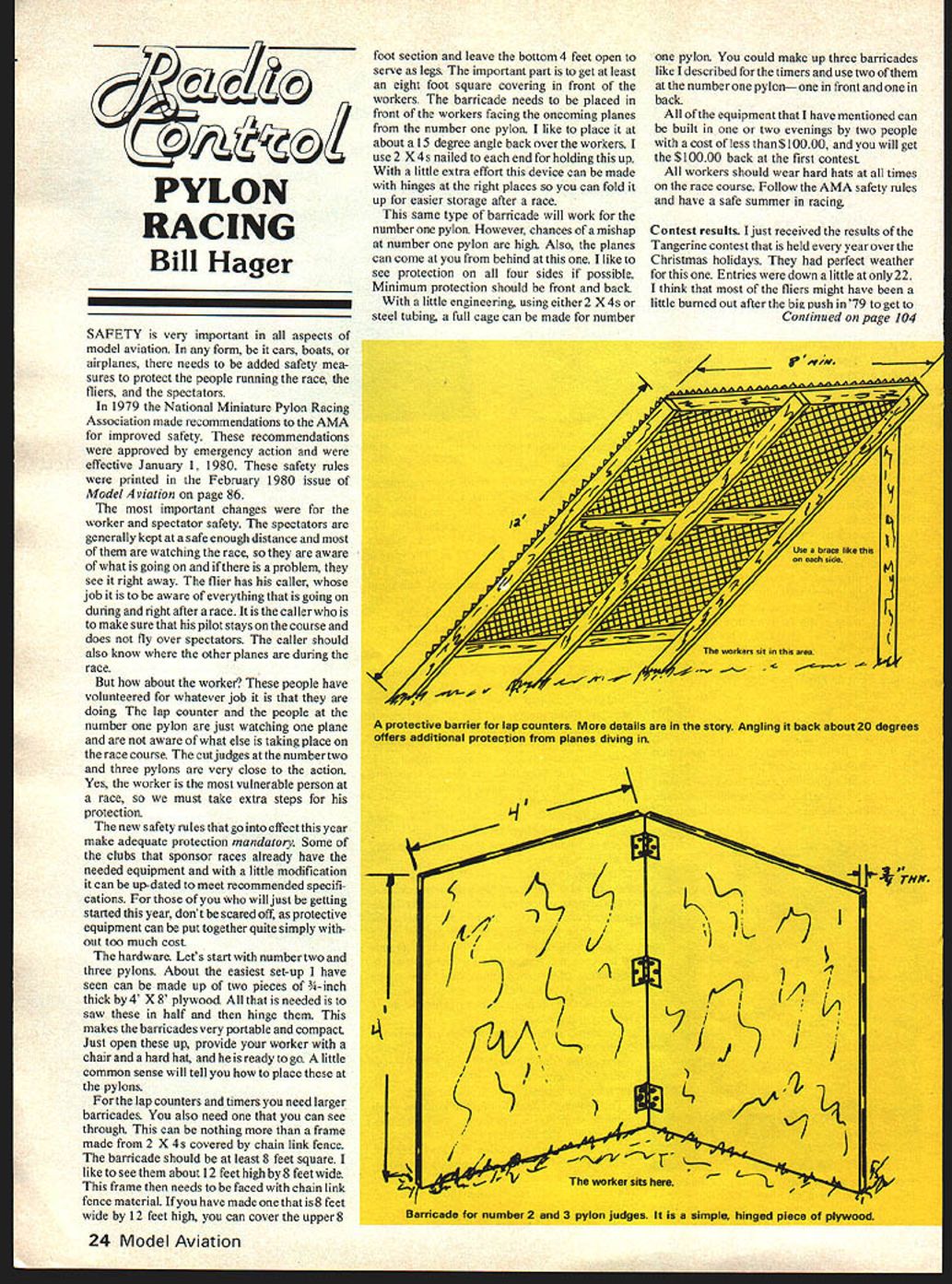
One of the easiest barricade setups uses two pieces of 3/4‑inch thick 4' x 8' plywood. Saw each sheet in half and hinge the halves to make portable, compact barricades. Open the barricades, provide the worker with a chair and a hard hat, and position them sensibly at the pylons.
Lap counters and timers
Lap counters and timers need larger, see‑through barricades. A suitable design is a frame made from 2 x 4s faced with chain link fencing. Recommendations:
- Minimum covering: an 8‑foot square in front of the workers.
- Preferred size: 12 feet high by 8 feet wide. If built 8' wide by 12' high, cover the upper 8‑foot section and leave the lower 4 feet open to serve as legs.
- Placement: in front of the workers facing the oncoming planes from the number one pylon, angled back about 15 degrees.
- Support: use 2 x 4s nailed to each end; add hinges so the unit can fold for storage.
Number one pylon
The number one pylon has a higher chance of mishap and can be approached from behind. Protection on all four sides is desirable; minimum protection should be front and back. With some engineering, a full cage can be built from 2 x 4s or steel tubing. An alternative is to use three of the timer barricades and place two of them at number one—one in front and one in back.
Cost and construction time
All of the equipment described can be built in one or two evenings by two people for less than $100.00, and the cost is typically recovered at the first contest.
Contest results
I received the results of the annual Tangerine contest held over the Christmas holidays. They had perfect weather. Entries were down to 22—likely many fliers were worn out after the big push in 1979 to get to Las Vegas—but those who attended had a great time. A trip to sunny Florida is a perfect way to break up the long, dull winter.
With 22 entries they were able to get in 10 full rounds of racing. Top five finishers:
- Jim Moorhead
- Bob Brogdon
- Bill Preis
- [illegible]
- [illegible]
See you next month.
Bill Hager 4622 Bridgeport Dr. Garland, TX 75043
Transcribed from original scans by AI. Minor OCR errors may remain.

