
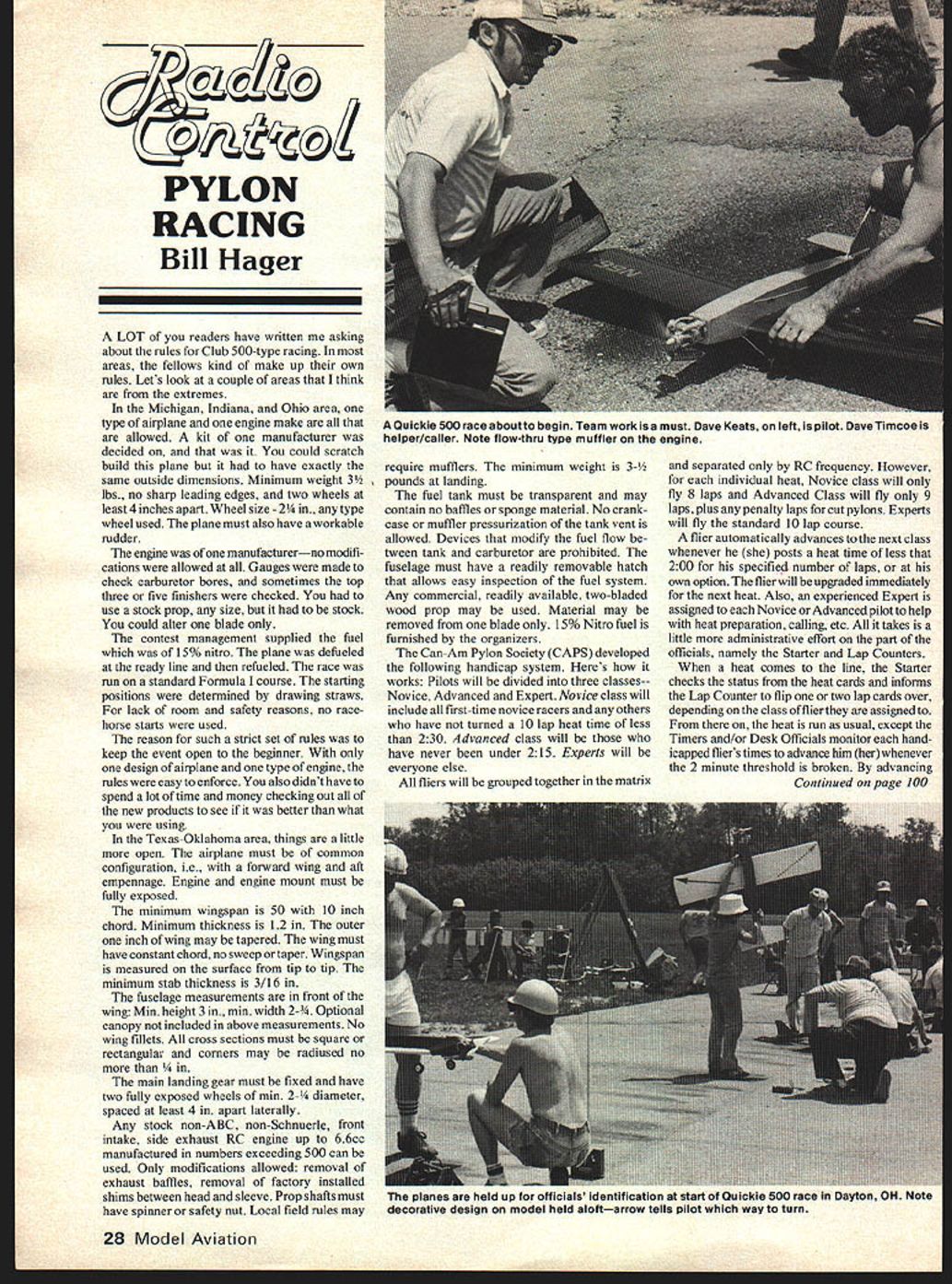
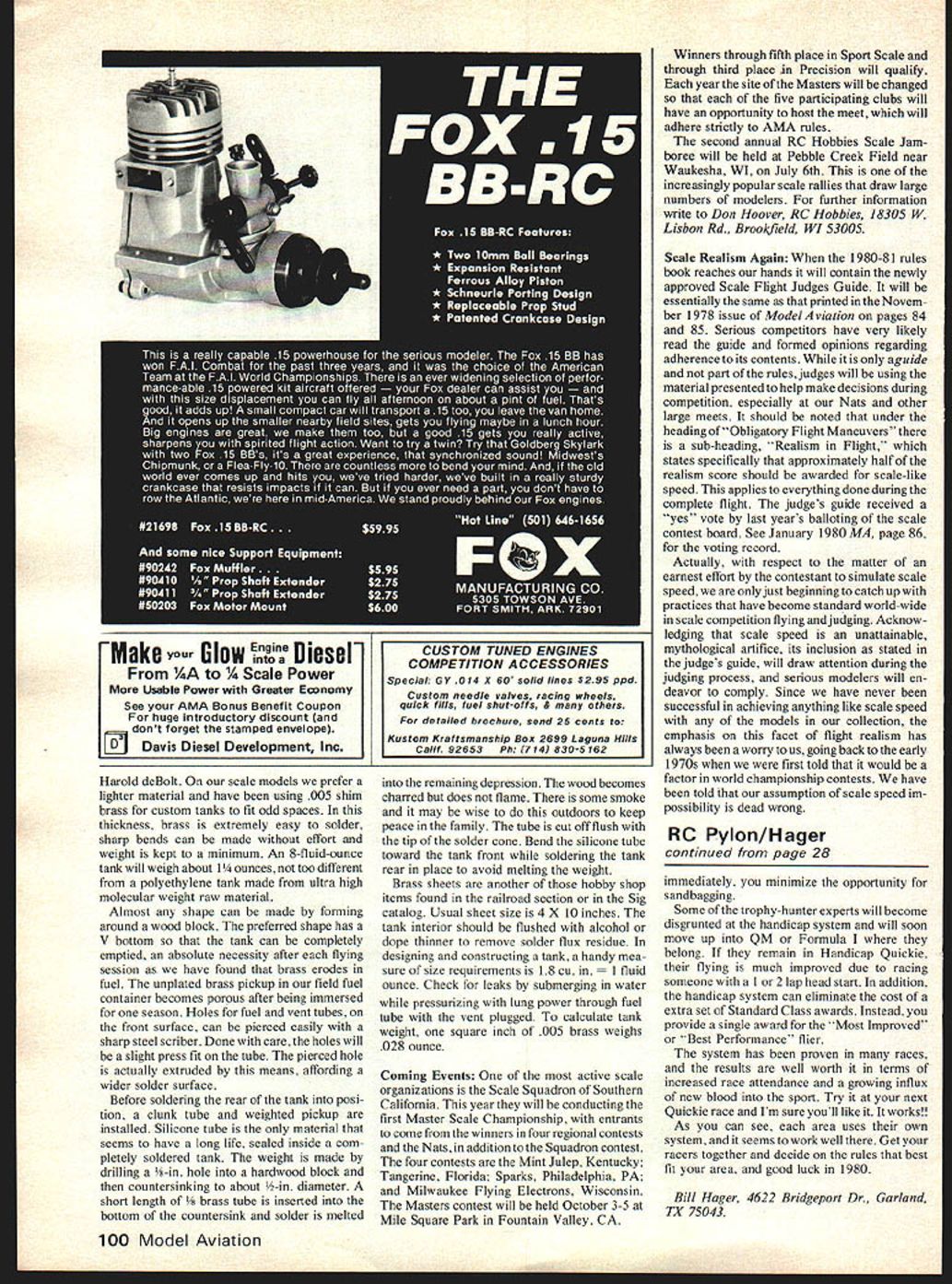
Radio Control: Pylon Racing
Byline
Bill Hager
A lot of you readers have written asking about the rules for Club 500–type racing. In most areas, the fellows kind of make up their own rules. Below are a couple of area rule sets that represent opposite extremes.
Michigan / Indiana / Ohio area rules
- Only one type of airplane and one engine make are allowed.
- A kit from a single manufacturer was selected; you may scratch-build the plane but it must have exactly the same outside dimensions.
- Minimum weight: 3½ lb.
- No sharp leading edges.
- Two wheels at least 4 in. apart laterally.
- Wheel size: 2¼ in., any type of wheel used.
- The plane must have a workable rudder.
- The engine must be of the one specified manufacturer—no modifications allowed.
- Gauges are used to check carburetor bores; sometimes the top three or five finishers are checked.
- You must use a stock prop (any size) but it must be stock; you may alter only one blade.
- Contest management supplies the fuel: 15% nitro.
- Planes are defueled at the ready line and then refueled.
- Races are run on a standard Formula I course.
- Starting positions are determined by drawing straws.
- For lack of room and safety reasons, no race-horse starts are used.
The reason for such strict rules is to keep the event open to the beginner. With only one design of airplane and one type of engine, the rules are easy to enforce. Clubs also don't have to spend a lot of time and money evaluating every new product.
Texas / Oklahoma area rules
- Airplane configuration: common layout with a forward wing and aft empennage; engine and engine mount must be fully exposed.
- Wing:
- Minimum span: 50 in.
- Minimum chord: 10 in.
- Minimum thickness: 1/2 in.
- Outer 1 in. of wing may be tapered.
- Wing must have constant chord—no sweep or taper (span measured on the surface tip to tip).
- Stabilizer:
- Minimum thickness: 3/16 in.
- Fuselage (in front of the wing):
- Minimum height: 3 in.
- Minimum width: 2¼ in.
- Optional canopy not included in these measurements.
- No wing fillets.
- All cross sections must be square or rectangular; corners may be radiused no more than 1/4 in.
- Landing gear:
- Main gear must be fixed and have two fully exposed wheels.
- Wheel diameter minimum: 2¼ in.
- Wheels must be spaced at least 4 in. apart laterally.
- Engine:
- Any stock non-ABC, non-Schnuerle, front-intake, side-exhaust RC engine up to 6.6 cc manufactured in quantities exceeding 500 may be used.
- Allowed modifications: removal of exhaust baffles and removal of factory-installed shims between head and sleeve.
- Prop shafts must have a spinner or safety nut.
- Local field rules may require mufflers.
- Weight:
- Minimum weight at landing: 3½ lb.
- Fuel system:
- Fuel tank must be transparent and may contain no baffles or sponge material.
- No crankcase or muffler pressurization of the tank vent is allowed.
- Devices that modify fuel flow between tank and carburetor are prohibited.
- Fuselage must have a readily removable hatch allowing easy inspection of the fuel system.
- Propeller:
- Any commercial, readily available, two-bladed wood prop may be used.
- Material may be removed from only one blade.
- Fuel:
- 15% nitro fuel is furnished by the organizers.
Can-Am Pylon Society (CAPS) handicap system
How it works:
- Pilots are divided into three classes:
- Novice — includes all first-time novice racers and anyone who has not turned a 10-lap heat time of less than 2:30.
- Advanced — those who have never been under 2:15.
- Expert — everyone else.
- All fliers are grouped together in the matrix and separated only by RC frequency.
- For each heat:
- Novice class flies only 8 laps (plus any penalty laps for cut pylons).
- Advanced class flies only 9 laps (plus penalties).
- Experts fly the standard 10-lap course.
- Advancement:
- A flier automatically advances to the next class whenever he or she posts a heat time of less than 2:00 for his or her specified number of laps.
- At the flier’s option, the flier can be upgraded immediately for the next heat.
- Support and administration:
- An experienced Expert is assigned to each Novice or Advanced pilot to help with heat preparation and calling.
- The Starter checks the heat cards and tells the Lap Counter to flip one or two lap cards over depending on the class of the flier.
- From there the heat is run as usual, except Timers and Desk Officials monitor each handicapped flier’s times and advance him or her whenever the 2:00 threshold is broken.
- By advancing the flier immediately, you minimize the opportunity for sandbagging.
Some trophy-hunter experts may become disgusted with the handicap system and migrate into OM or Formula I classes. If they remain in Handicap Quickie racing, their flying should improve because they will be racing against pilots with a one- or two-lap head start. The handicap system can also eliminate the need for an extra set of Standard Class awards; instead, give a special award for "Most Improved" or "Best Performance."
This system has been proven in many races, producing increased attendance and attracting new blood into the sport. Try it at your next Quickie race — it works!
As you can see, each area uses its own system, and both seem to work well locally. Get your racers together, decide on the rules that best fit your area, and good luck in 1980.
Bill Hager 4622 Bridgeport Dr., Garland, TX 75043.
Transcribed from original scans by AI. Minor OCR errors may remain.

