
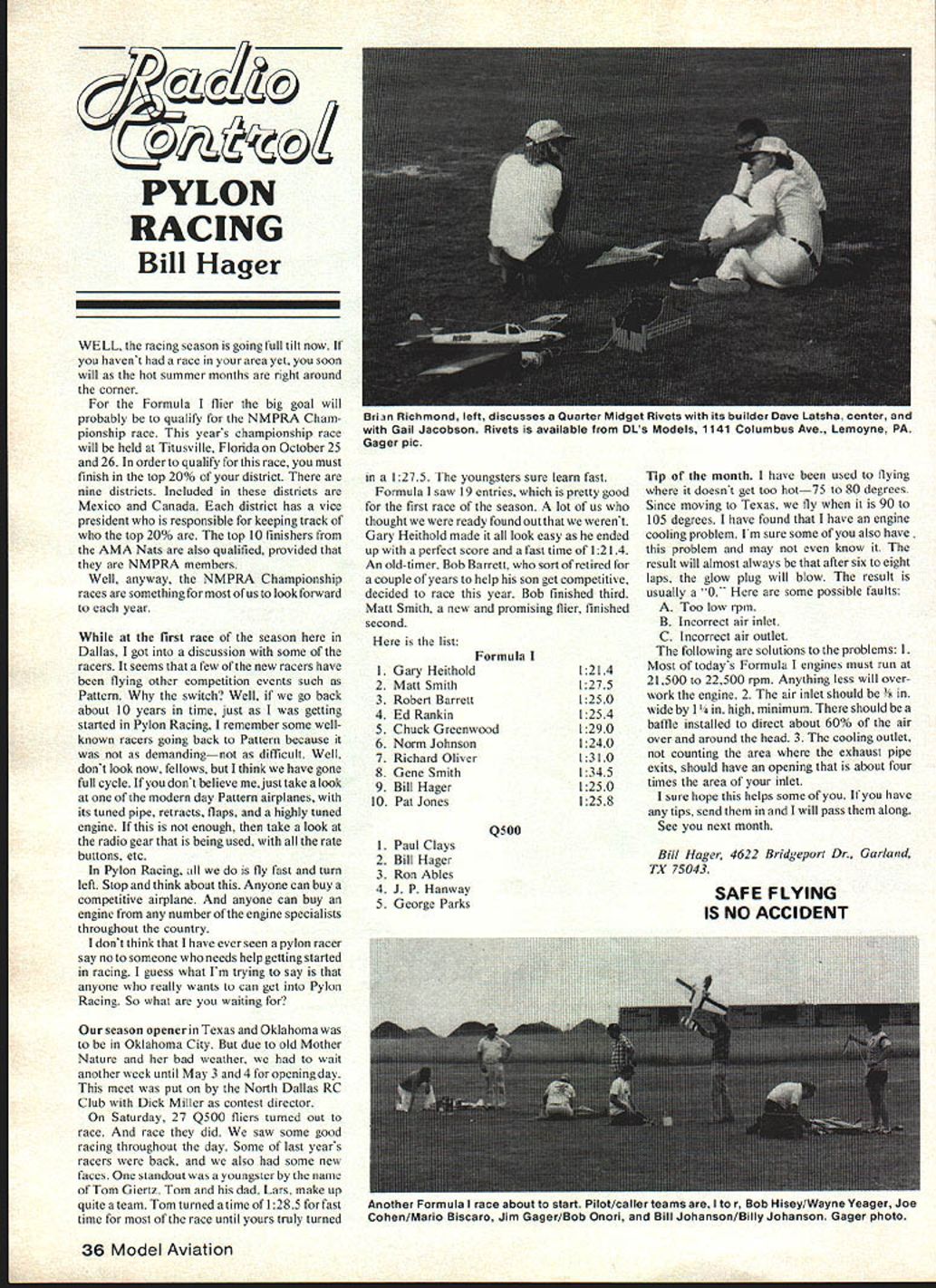
Radio Control: Pylon Racing
Bill Hager
Well, the racing season is going full tilt now. If you haven't had a race in your area yet, you soon will as the hot summer months are right around the corner.
For the Formula I flier the big goal will probably be to qualify for the NMPRA Championship race. This year's championship race will be held at Titusville, Florida on October 25 and 26. In order to qualify for this race, you must finish in the top 20% of your district. There are nine districts. Included in these districts are Mexico and Canada. Each district has a vice president who is responsible for keeping track of who the top 20% are. The top 10 finishers from the AMA Nats are also qualified, provided that they are NMPRA members.
The NMPRA Championship races are something for most of us to look forward to each year.
While at the first race of the season here in Dallas, I got into a discussion with some of the racers. It seems that a few of the new racers have been flying other competition events such as Pattern. Why the switch? If we go back about 10 years, just as I was getting started in Pylon Racing, I remember some well-known racers going back to Pattern because it was not as demanding—not as difficult. Well, don't look now, fellows, but I think we have gone full cycle. If you don't believe me, just take a look at one of the modern-day Pattern airplanes, with its tuned pipe, retracts, flaps, and a highly tuned engine. If this is not enough, then take a look at the radio gear that is being used, with all the rate buttons, etc.
In Pylon Racing, all we do is fly fast and turn left. Stop and think about this. Anyone can buy a competitive airplane. And anyone can buy an engine from any number of the engine specialists throughout the country.
I don't think that I have ever seen a pylon racer say no to someone who needs help getting started in racing. I guess what I'm trying to say is that anyone who really wants to can get into Pylon Racing. So what are you waiting for?
Our season opener in Texas and Oklahoma was to be in Oklahoma City. But due to old Mother Nature and her bad weather, we had to wait another week until May 3 and 4 for opening day. This meet was put on by the North Dallas RC Club with Dick Miller as contest director.
On Saturday, 27 Q500 fliers turned out to race. And race they did. We saw some good racing throughout the day. Some of last year's racers were back, and we also had some new faces. One standout was a youngster by the name of Tom Giertz. Tom and his dad, Lars, make up quite a team. Tom turned a time of 1:28.5 for fast time for most of the race until yours truly turned in a 1:27.5. The youngsters sure learn fast.
Formula I saw 19 entries, which is pretty good for the first race of the season. A lot of us who thought we were ready found out that we weren't. Gary Heithold made it all look easy as he ended up with a perfect score and a fast time of 1:21.4.
An old-timer, Bob Barrett, who sort of retired for a couple of years to help his son get competitive, decided to race this year. Bob finished third. Matt Smith, a new and promising flier, finished second.
Results
Formula I
- Gary Heithold — 1:21.4
- Matt Smith — 1:27.5
- Robert (Bob) Barrett — 1:25.4
- Ed Rankin — 1:25.4
- Chuck Greenwood — 1:29.0
- Norm Johnson — 1:24.0
- Richard Oliver — 1:34.5
- Gene Smith — 1:34.5
- Bill Hager — 1:25.8
- Pat Jones — 1:25.8
Q500
- Paul Clays
- Bill Hager
- Ron Ables
- J. P. Hanway
- George Parks
Tip of the Month
I have been used to flying where it doesn't get too hot—75 to 80 degrees. Since moving to Texas, we fly when it is 90 to 105 degrees. I have found that I have an engine cooling problem. I'm sure some of you also have. This problem may not be obvious. The result will almost always be that after six to eight laps, the glow plug will blow. The result is usually a "0". Here are some possible faults:
- Too low RPM.
- Incorrect air inlet.
- Incorrect air outlet.
The following are solutions to the problems:
- Most of today's Formula I engines must run at 21,500 to 22,500 RPM. Anything less will overwork the engine.
- The air inlet should be 3/8" wide by 1/4" high minimum. There should be a baffle installed to direct about 60% of the air over and around the head.
- The cooling outlet, not counting the area where the exhaust pipe exits, should have an opening that is about four times the area of your inlet.
I sure hope this helps some of you. If you have any tips, send them in and I will pass them along. See you next month.
Contact
Bill Hager 4622 Bridgeport Dr. Garland, TX 75043
Transcribed from original scans by AI. Minor OCR errors may remain.

