
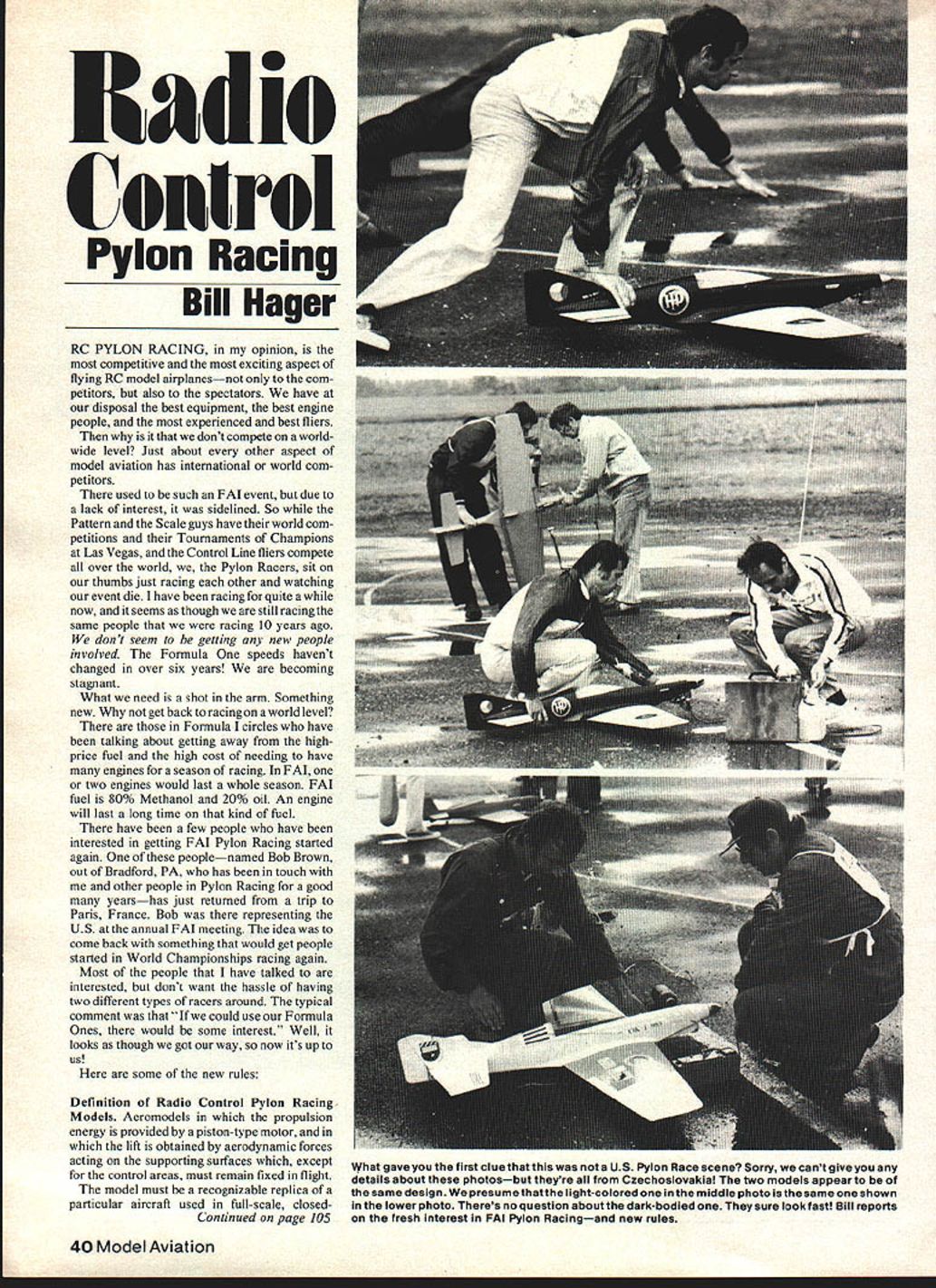

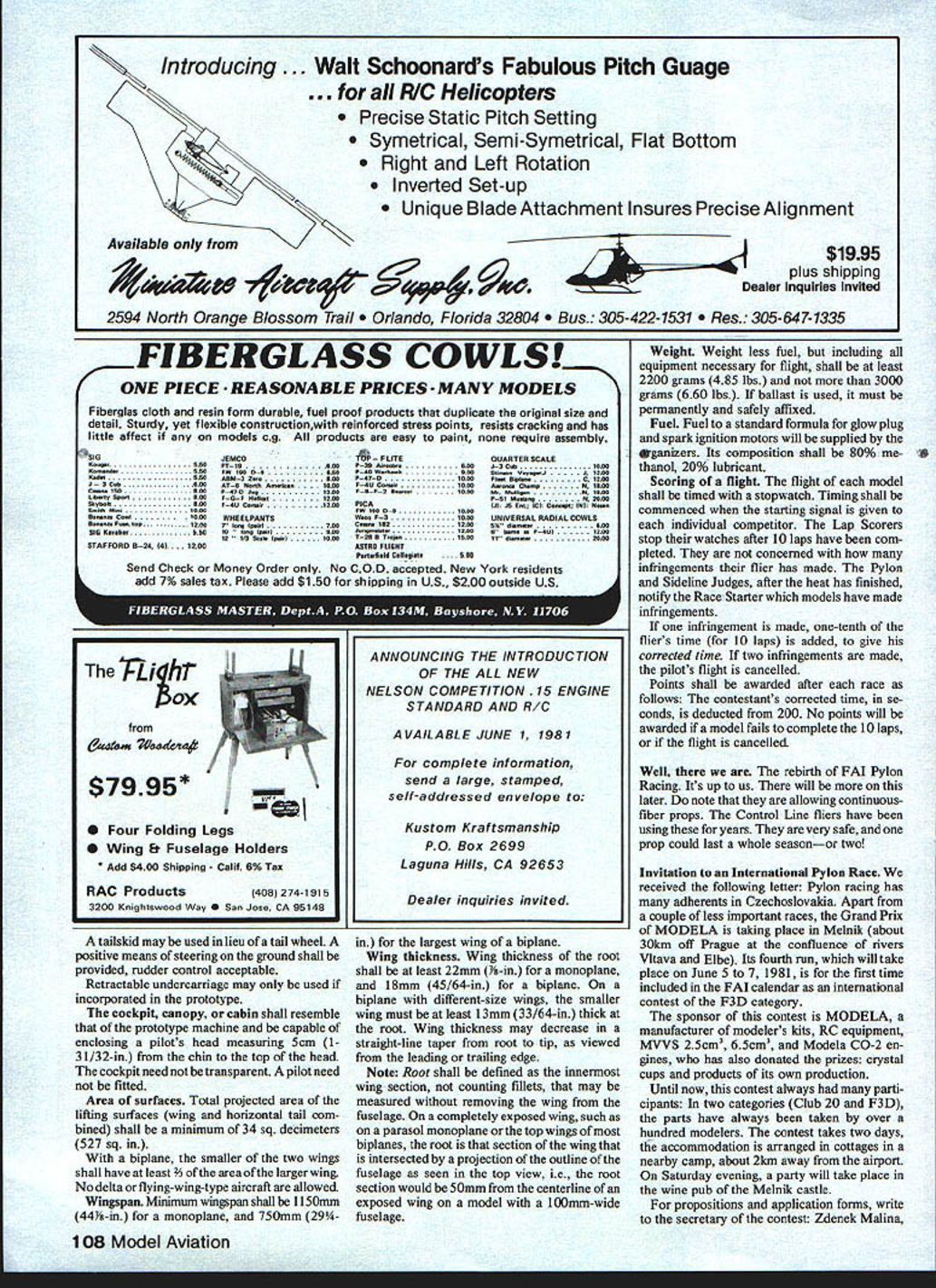
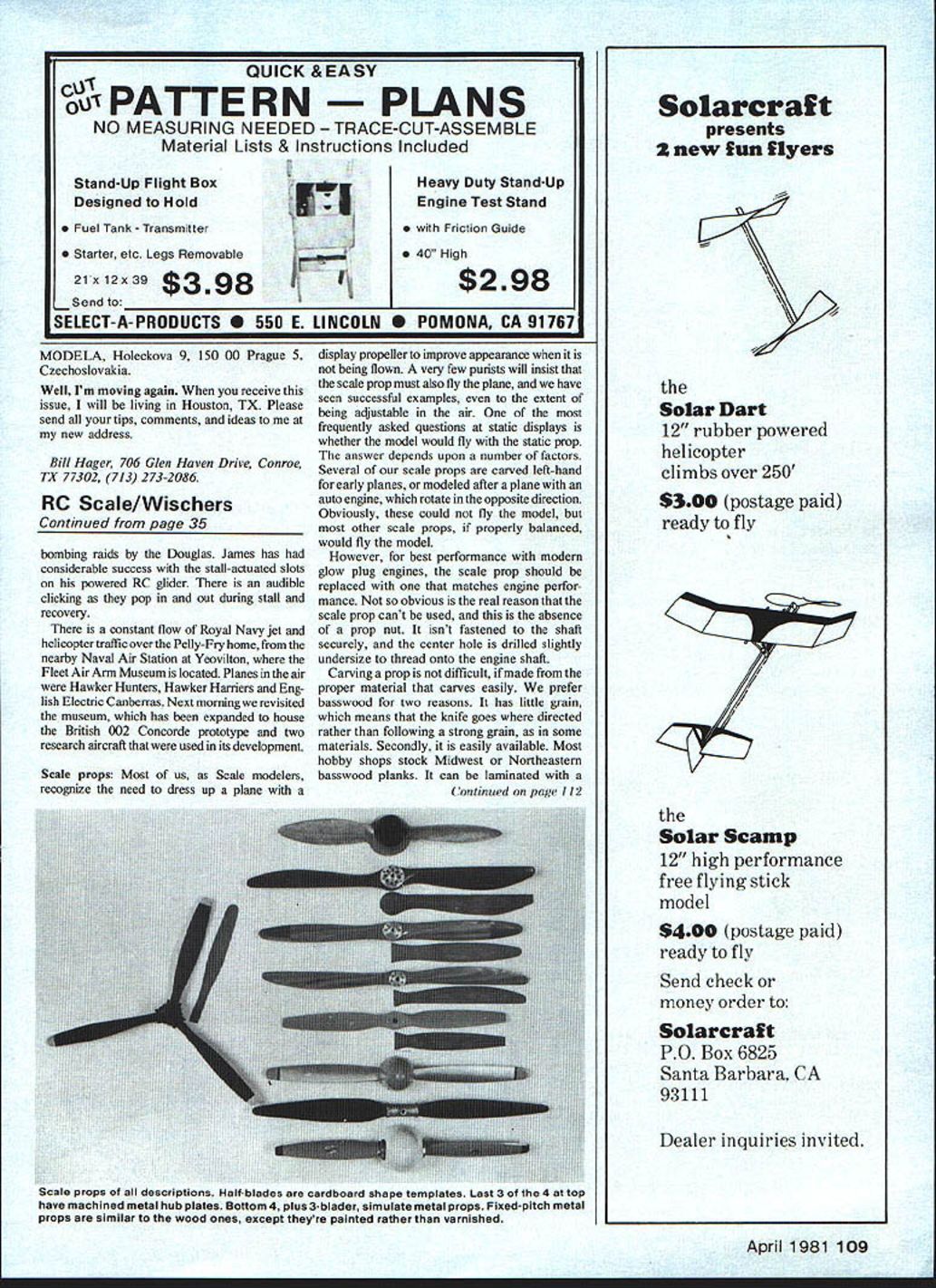
Radio Control: Pylon Racing
Bill Hager
RC pylon racing, in my opinion, is the most competitive and the most exciting aspect of flying RC model airplanes—not only to the competitors, but also to the spectators. We have at our disposal the best equipment, the best engine people, and the most experienced and best fliers.
Then why is it that we don't compete on a worldwide level? Just about every other aspect of model aviation has international or world competitors.
There used to be such an FAI event, but due to a lack of interest it was sidelined. So while the Pattern and Scale guys have their world competitions and their Tournaments of Champions at Las Vegas, and the Control Line fliers compete all over the world, we, the pylon racers, sit on our thumbs just racing each other and watching our event die. I have been racing for quite a while now, and it seems as though we are still racing the same people that we were racing 10 years ago. We don't seem to be getting any new people involved. The Formula One speeds haven't changed in over six years! We are becoming stagnant.
What we need is a shot in the arm. Something new. Why not get back to racing on a world level!
There are those in Formula I circles who have been talking about getting away from the high‑price fuel and the high cost of needing to have many engines for a season of racing. In FAI, one or two engines would last a whole season. FAI fuel is 80% methanol and 20% oil. An engine will last a long time on that kind of fuel.
There have been a few people who have been interested in getting FAI pylon racing started again. One of these people—named Bob Brown, out of Bradford, PA, who has been in touch with me and other people in pylon racing for a good many years—has just returned from a trip to Paris, France. Bob was there representing the U.S. at the annual FAI meeting. The idea was to come back with something that would get people started in World Championship racing again.
Most of the people I have talked to are interested, but don't want the hassle of having two different types of racers around. The typical comment was that "If we could use our Formula Ones, there would be some interest." Well, it looks as though we got our way, so now it's up to us!
Here are some of the new rules:
Definition of Radio Control Pylon Racing Models
Aeromodels in which the propulsion energy is provided by a piston‑type motor, and in which the lift is obtained by aerodynamic forces acting on the supporting surfaces which, except for the control areas, must remain fixed in flight. The model must be a recognizable replica of a particular aircraft used in full‑scale, closed‑course air racing. Unusual or unconventional features of the model must be substantiated by documentary proof of the full‑sized aircraft, i.e., photographs or three‑view drawings.
Motors
Motor(s) must be of the reciprocating piston type, with a maximum total swept volume of 6.6 cm³ (0.40 cu. in.).
Shut‑off
The engine shall be equipped with a positive, radio‑controlled engine shutoff. The pilot must be able to shut off his engine by radio control, on the ground or in the air, within five seconds of command, irrespective of the aircraft attitude. A competitor will be disqualified from the heat if unable to land his model promptly on instruction from the starter.
Silencer
The motor(s) shall be fitted with a silencer. Within its length there shall be an expansion chamber of not less than 30 mm (1‑3/16 in.) diameter, 100 mm (3‑29/32 in.) length, having a single orifice of maximum diameter 10 mm (13/32 in.).
Propeller
Only fixed‑pitch, two‑blade propellers of either wood or composite resin/fiberglass construction may be used. Injection‑molded propellers are not acceptable.
Propeller spinner
A scale‑like, rounded‑nose spinner shall be used on all models. If the prototype aircraft used no spinner, a rounded‑nose spinner of at least 2.5 cm (1 in.) diameter shall be used.
Cross‑section
The fuselage shall have a minimum height of 175 mm (6‑13/16 in.) and a minimum width of 85 mm (3‑5/16 in.). Both minimum dimensions must occur at the same cross‑section location. The fuselage at this point will have a minimum cross‑sectional area of 100 cm² (15.5 sq. in.), excluding fillets, and contestants will be required to provide templates to prove this. Fillets are not considered parts of the fuselage or lifting surfaces.
Cowl
The motor or motors must be enclosed, with the exception of the silencer, cylinder head, and controls which must be manipulable during operation of the motor. The cylinder head for this purpose is defined as the top (or outer) 1 cm (25/64 in.) of the motor, excluding ignition plug or compression screw.
Landing gear
The landing gear shall resemble that of the prototype machine, as to location on the airframe and the number of wheels used. The minimum diameter of the main wheels shall be 57 mm (2‑1/4 in.) and the minimum width shall be 12 mm (31/64 in.) for at least 1/3 of the diameter. A tailskid may be used in lieu of a tail wheel. A positive means of steering on the ground shall be provided; rudder control is acceptable.
Retractable undercarriage may only be used if incorporated in the prototype.
Cockpit
The cockpit, canopy, or cabin shall resemble that of the prototype machine and be capable of enclosing a pilot's head measuring 5 cm (1‑3/32 in.) from the chin to the top of the head. The cockpit need not be transparent. A pilot need not be fitted.
Area of surfaces
Total projected area of the lifting surfaces (wing and horizontal tail combined) shall be a minimum of 34 sq. decimeters (527 sq. in.).
With a biplane, the smaller of the two wings shall have at least 25% of the area of the larger wing. No delta or flying‑wing type aircraft are allowed.
Wingspan
Minimum wingspan shall be 1150 mm (44‑1/2 in.) for a monoplane, and 750 mm (29‑1/2 in.) for the largest wing of a biplane.
Wing thickness
Wing thickness at the root shall be at least 22 mm (7/8 in.) for a monoplane, and 18 mm (45/64 in.) for a biplane. On a biplane with different‑size wings, the smaller wing must be at least 13 mm (33/64 in.) thick at the root. Wing thickness may decrease in a straight‑line taper from root to tip, as viewed from the leading or trailing edge.
Note: "Root" shall be defined as the innermost wing section, not counting fillets, that may be measured without removing the wing from the fuselage. On a completely exposed wing, such as on a parasol monoplane or the top wings of most biplanes, the root is that section of the wing that is intersected by a projection of the outline of the fuselage as seen in the top view, i.e., the root section would be 50 mm from the centerline of an exposed wing on a model with a 100 mm‑wide fuselage.
Weight
Weight less fuel, but including all equipment necessary for flight, shall be at least 2200 grams (4.85 lbs.) and not more than 3000 grams (6.60 lbs.). If ballast is used, it must be permanently and safely affixed.
Fuel
Fuel to a standard formula for glow plug and spark ignition motors will be supplied by the organizers. Its composition shall be 80% methanol, 20% lubricant.
Scoring of a flight
The flight of each model shall be timed with a stopwatch. Timing shall be commenced when the starting signal is given to each individual competitor. The lap scorers stop their watches after 10 laps have been completed. They are not concerned with how many infringements their flier has made. The Pylon and Sideline Judges, after the heat has finished, notify the Race Starter which models have made infringements.
- If one infringement is made, one‑tenth of the flier's time (for 10 laps) is added to give his corrected time.
- If two infringements are made, the pilot's flight is cancelled.
Points shall be awarded after each race as follows: the contestant's corrected time, in seconds, is deducted from 200. No points will be awarded if a model fails to complete the 10 laps, or if the flight is cancelled.
Well, there we are. The rebirth of FAI pylon racing. It's up to us. There will be more on this later. Do note that they are allowing continuous‑fibre props. The Control Line fliers have been using these for years. They are very safe, and one prop could last a whole season—or two!
Invitation to an International Pylon Race
Pylon racing has many adherents in Czechoslovakia. Apart from a couple of less important races, the Grand Prix of MODELA is taking place in Melnik (about 30 km off Prague at the confluence of rivers Vltava and Elbe). Its fourth run, which will take place on June 5 to 7, 1981, is for the first time included in the FAI calendar as an international contest of the F3D category.
The sponsor of this contest is MODELA, a manufacturer of modeler's kits, RC equipment, MVVS 2.5 cm³ and 6.5 cm³ engines, and Modela CO‑2 engines, who has also donated the prizes: crystal cups and products of its own production.
Until now, this contest always had many participants. In two categories (Club 20 and F3D), the parts have always been taken by over a hundred modelers. The contest takes two days; the accommodation is arranged in cottages in a nearby camp, about 2 km away from the airport. On Saturday evening, a party will take place in the local pub near the Melnik castle.
For propositions and application forms, write to the secretary of the contest: Zdenek Malina.
Transcribed from original scans by AI. Minor OCR errors may remain.

