
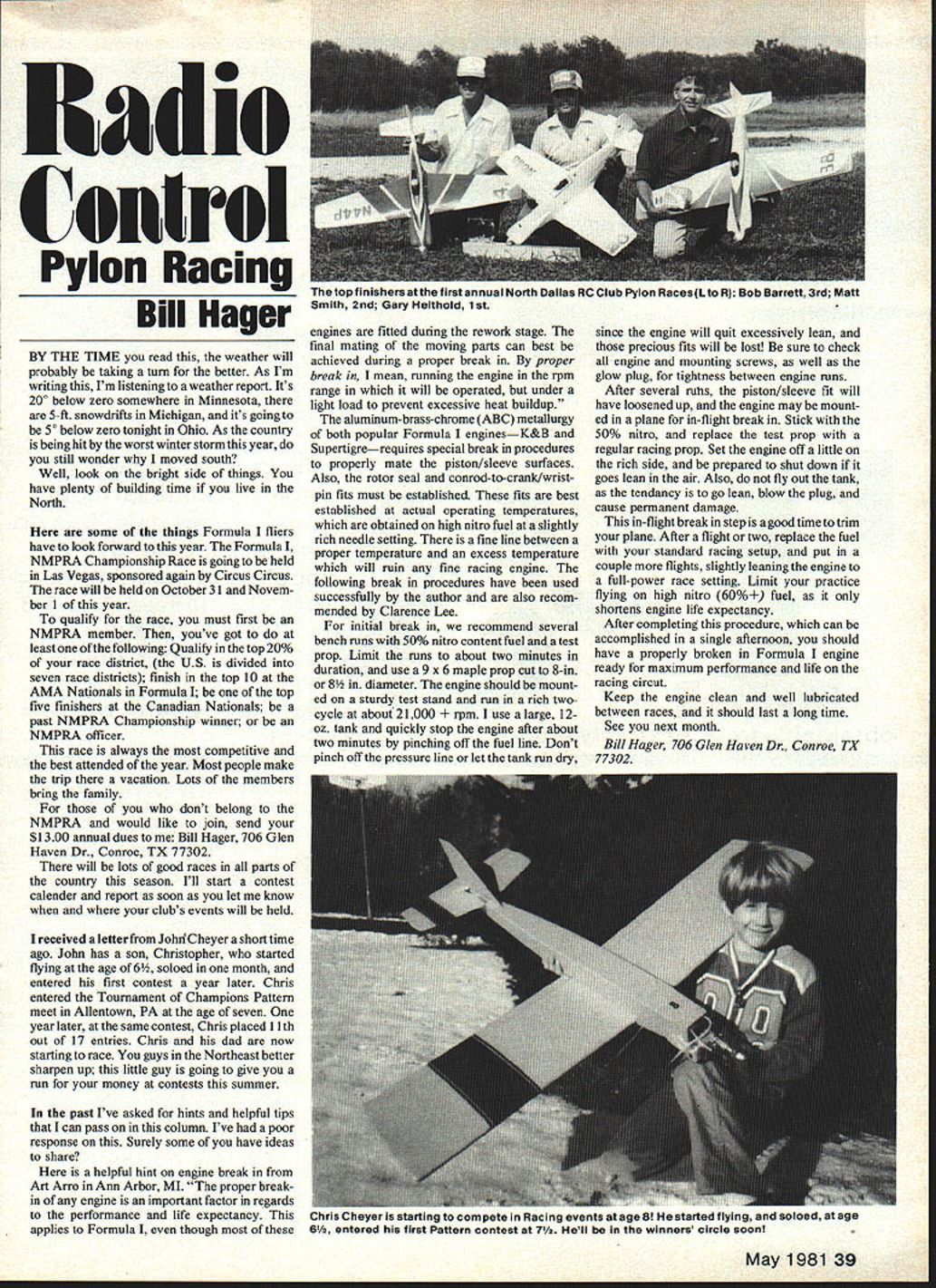
Radio Control: Pylon Racing
Bill Hager
By the time you read this, the weather will probably be taking a turn for the better. As I'm writing, I'm listening to a weather report: it's 20° below zero somewhere in Minnesota, there are 5-ft. snowdrifts in Michigan, and it's going to be 5° below zero tonight in Ohio. As the country is being hit by the worst winter storm this year, do you still wonder why I moved south?
Well, look on the bright side. You have plenty of building time if you live in the North.
Formula I NMPRA Championship
The Formula I NMPRA Championship Race will be held in Las Vegas, sponsored again by Circus Circus. The race dates are October 31 and November 1 this year.
How to qualify
To qualify for the race, you must first be an NMPRA member. Then you must meet at least one of the following:
- Qualify in the top 20% of your race district (the U.S. is divided into seven race districts)
- Finish in the top 10 at the AMA Nationals in Formula I
- Be one of the top five finishers at the Canadian Nationals
- Be a past NMPRA Championship winner
- Be an NMPRA officer
This race is always the most competitive and best attended of the year. Most people make the trip as a vacation and bring the family.
Membership
For those who don't belong to the NMPRA and would like to join, send your $13.00 annual dues to: Bill Hager 706 Glen Haven Dr. Conroe, TX 77302
Contest calendar
There will be lots of good races around the country this season. I'll start a contest calendar and report as soon as you let me know when and where your club's events will be held.
Young flyers to watch
I received a letter from John Cheyer recently. His son, Christopher, started flying at age 6½, soloed in one month, and entered his first contest a year later. Chris entered the Tournament of Champions pattern meet in Allentown, PA at age seven. One year later, at the same contest, Chris placed 11th out of 17 entries. Chris and his dad are now starting to race. You guys in the Northeast better sharpen up; this young pilot is going to give you a run for your money at contests this summer.
Call for tips
In the past I've asked for hints and helpful tips to pass on in this column, but response has been poor. Surely some of you have ideas to share?
Engine break-in (from Art Arro, Ann Arbor, MI)
"The proper break-in of any engine is an important factor in regards to performance and life expectancy. This applies to Formula I, even though most of these engines are reworked before fitting. The final mating of the moving parts can best be achieved during a proper break-in. By proper break-in, I mean running the engine in the rpm range in which it will be operated, but under a light load to prevent excessive heat buildup."
The aluminum-brass-chrome (ABC) metallurgy of both popular Formula I engines — K&B and Supertigre — requires special break-in procedures to properly mate the piston/sleeve surfaces. Also, the rotor seal and conrod-to-crank/wrist-pin fits must be established. These fits are best established at actual operating temperatures, which are obtained on high-nitro fuel at a slightly rich needle setting. There is a fine line between a proper temperature and an excess temperature that will ruin any fine racing engine. The following break-in procedures have been used successfully by the author and are also recommended by Clarence Lee.
Initial bench break-in
- Perform several bench runs using 50% nitro fuel and a test prop.
- Limit each run to about two minutes.
- Use a 9x6 maple prop cut to 8 in. or 8½ in. diameter as the test prop.
- Mount the engine on a sturdy test stand and run it rich for a two-stroke at about 21,000 rpm.
- Use a large (12-oz.) fuel tank and stop the engine after about two minutes by pinching off the fuel line.
- Do not pinch the pressure line or let the tank run dry; the engine will quit excessively lean and damage the fits.
- Between runs, check all engine and mounting screws and the glow plug for tightness.
After several runs the piston/sleeve fit will loosen up enough to proceed to in-flight break-in.
In-flight break-in
- Keep using 50% nitro fuel.
- Replace the test prop with a regular racing prop.
- Set the engine slightly rich and be prepared to shut down if it goes lean in the air.
- Do not fly out the tank—running out of fuel tends to go lean, blow the plug, and cause permanent damage.
- Use this time to trim the plane.
Final tuning and maintenance
- After a flight or two, replace the fuel with your standard racing setup.
- Put in a couple more flights, slightly leaning the engine to a full-power race setting.
- Limit practice flying on high-nitro (60%+) fuel, as it shortens engine life expectancy.
- Keep the engine clean and well lubricated between races to prolong life.
This procedure can be accomplished in a single afternoon and should leave you with a properly broken-in Formula I engine ready for maximum performance and durability on the racing circuit.
See you next month.
Bill Hager 706 Glen Haven Dr. Conroe, TX 77302
Transcribed from original scans by AI. Minor OCR errors may remain.

