
Radio Control: Pylon Racing
Bill Hager
Introduction
Sometime ago I received a newsletter from the Valencia Headwinds Model Aeronautics Club, Canoga Park, CA. An article by Larry Laulom concerning 1/2A pylon racing was included and should be of help to those who want to get started in this type of event. The following consolidates that advice and adds some practical tips for equipment, engine care, and airframe setup.
Equipment and Power System
- Airborne fuel pack: you need a reliable airborne pack; it needn't be expensive. Three systems commonly used are Kraft, Ace, and Novak — all acceptable.
- Servos: try to keep servos lightweight. KPS-12 (bantam/midget) class servos are recommended.
- Engine: options are limited in this class. A Tee Dee .051 or a Cox .051 will be adequate.
- Needle valve: use a Kim Kraft–type needle valve assembly (Ace also markets a similar item).
- Fuel system: a Tatone small double-bladder system is recommended for fuel supply.
- Carburetion: drill out the carb to a No. 24 drill size for proper fuel flow and discard the carb screen (it is not required).
- Propeller: use a 5x3 Cox gray prop.
Fuel, Lubrication, and Engine Care
- Fuel: purchase fuel in the 40–60% nitro range. Some racers use higher percentages, but 40–60% is a good starting point.
- Running tip: with a loose-fitting engine and 65% nitro, running one head gasket, some have obtained as many as seven runs on one plug; the bladder fuel system helps with consistency.
- Plugs: most plugs are ruined by running the engine too rich while setting up on the starting line. Be mindful of mixture at startup.
- Oil: use Klotz oil in the fuel — it gives adequate protection and keeps the engine cleaner. Do not use castor oil (it encourages varnish buildup).
- Varnish removal: varnish can collect quickly on a new tight engine. To remove it, buy a .45 caliber gun-cleaning brush with brass bristles (inexpensive) and use it often. Varnish shows up as brown deposits.
Engine Shutoff
Engine shutoff can be accomplished by pinching the fuel line. Fishing monofilament works well for this. Activate the cutoff by giving full down elevator after the plane has been rolled over onto its back.
Airframe Recommendations and Modifications
- Recommended model: Ace GLH II, with either the balsa or foam wing.
- Modifications:
- Replace all Lite‑Ply used on the bottom of the fuselage with equal-thickness balsa.
- Make the ailerons half the size called for in the plans. If the kit comes with 3/4‑in aileron stock, use 1/2‑in stock instead.
- Construction: use Hot Stuff CA for most of the kit assembly, but epoxy the firewall and other critical areas.
Contact
Bill Hager 706 Glen Haven Dr. Conroe, TX 77302
Full-Size Formula I Racing (Context and History)
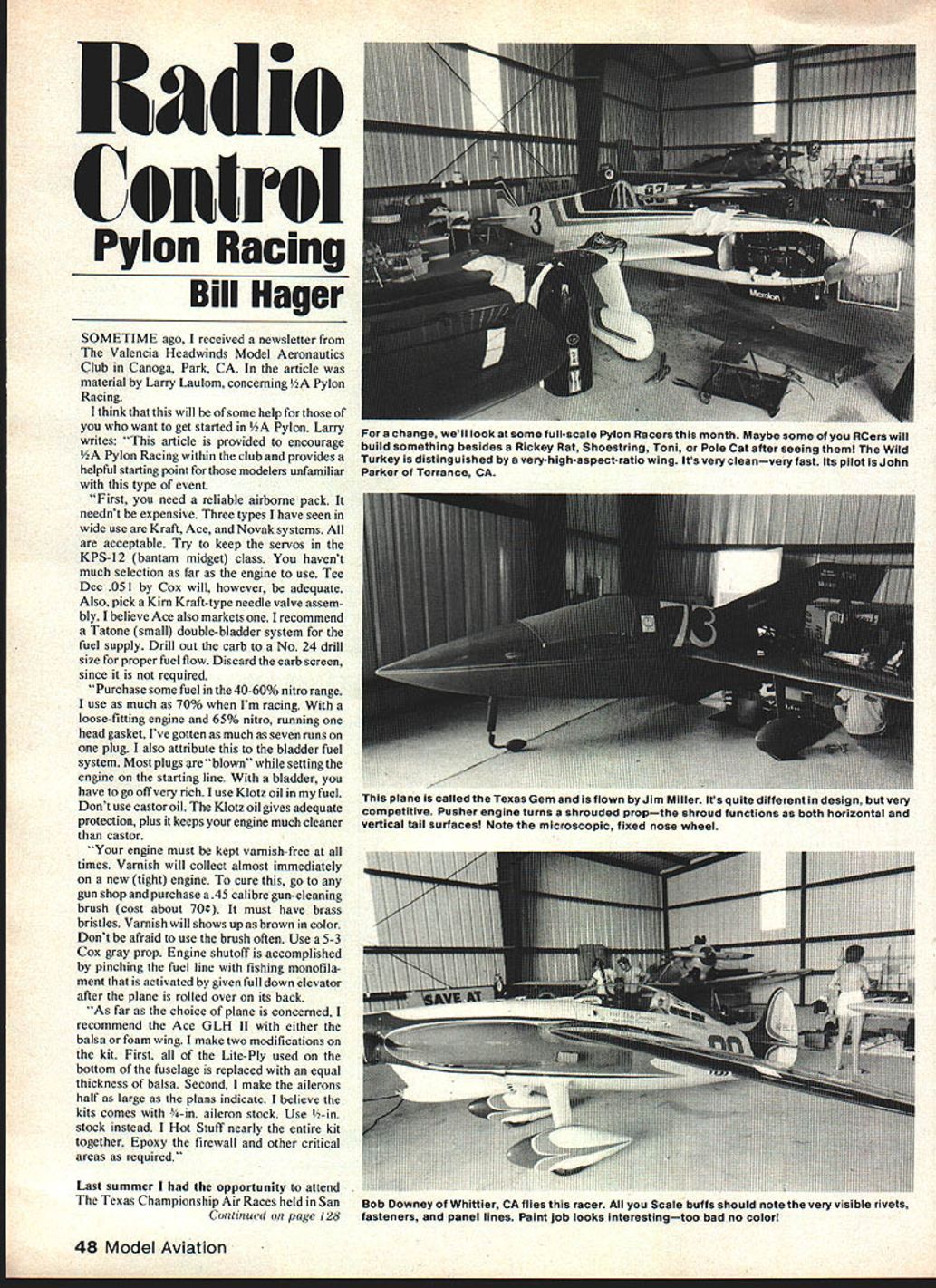
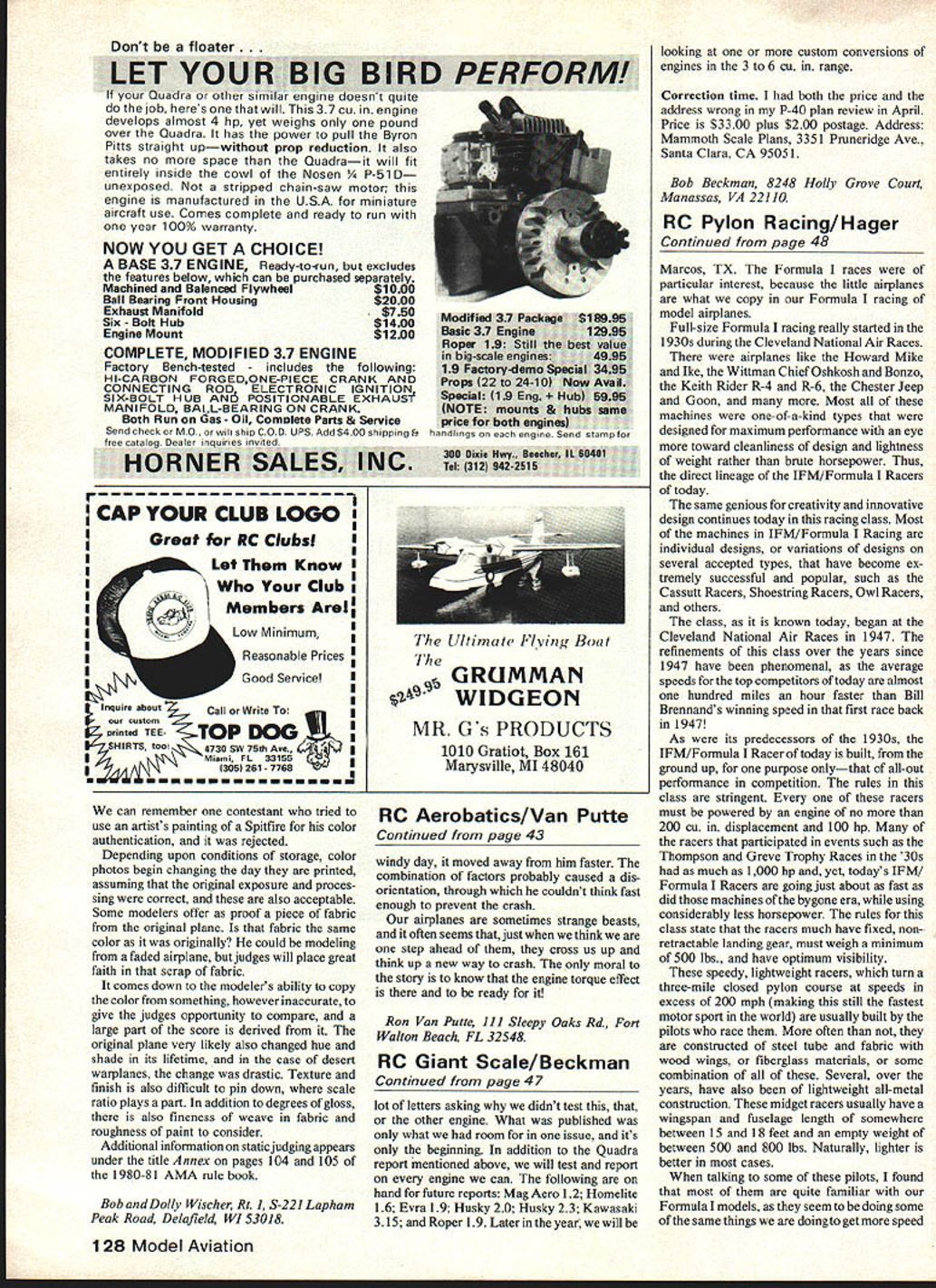
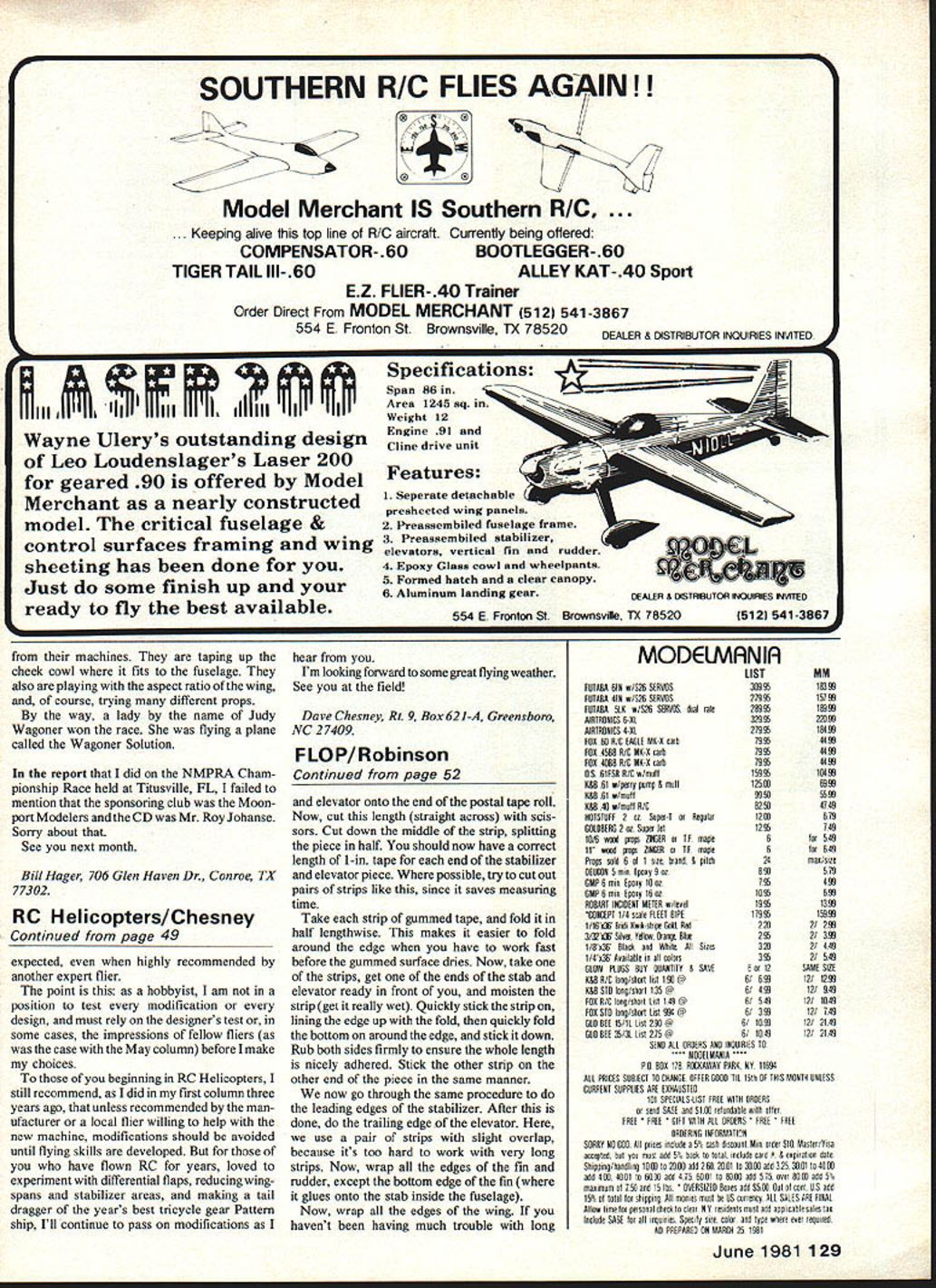
Last summer I attended the Texas Championship Air Races held in San Marcos, TX. The Formula I races were of particular interest because the full-size airplanes are the prototypes for our Formula I model racing.
Formula I racing for full-size aircraft traces its modern roots to the Cleveland National Air Races in the 1930s. Notable examples of early racers include the Howard Mike and Ike, the Wittman Chief Oshkosh and Bonzo, the Keith Rider R-4 and R-6, and the Chester Jeep and Goon. These machines were often one-off designs optimized for cleanliness of design and lightness rather than raw horsepower — a lineage that continues into today's IFM/Formula I racers.
The class as known today began at Cleveland in 1947. Since then the class has refined dramatically: average speeds for top competitors are nearly 100 mph faster than the winning speed in 1947. Modern IFM/Formula I racers are built strictly for competition, with stringent rules:
- Engine no more than 200 cu. in. displacement and 100 hp.
- Fixed, non-retractable landing gear.
- Minimum weight of 500 lb.
- Emphasis on pilot visibility and aerodynamic efficiency.
These lightweight racers routinely turn a three-mile closed pylon course at speeds in excess of 200 mph, making this among the fastest motorsports in the world. Construction materials vary — steel tube and fabric with wood wings, fiberglass, combinations of these, and sometimes all-metal. Typical dimensions are 15–18 ft wingspan and fuselage length, and empty weights between 500 and 800 lb (lighter is generally better).
When talking to many of the pilots, I found they are familiar with our Formula I models and often explore similar modifications to obtain more speed, including custom engine conversions in the 3–6 cu. in. range.
Transcribed from original scans by AI. Minor OCR errors may remain.

