
Radio Control: Pylon Racing
Bill Hager
Introduction
As you read this, the 1981 AMA Nationals will be history. If you didn't go, you missed a great contest. This is where it all happens. You can compete in almost every type of modeling: Control Line Combat, Stunt, Speed and Scale, many Free Flight events, and, for Radio Control, RC Scale, Soaring, Pattern—and what I think is the cream of the crop, Pylon Racing. This is the only time you can go and compete in or watch competition in almost every type of model aviation.
Pylon Racing is very exciting for both competitor and spectator. Why not get your club to put on a race? It can be a lot of fun and profitable for the club. The myth that putting on a race is very difficult is not true. The only person who really needs to be experienced is the Contest Director (CD). It helps if the CD is a competitor because that gives better judgment on issues that come up during the race.
Organizing a Race
- You will need about 20 eager, willing people to put on a good race.
- Plan on having about 12 people on the field at a time for things to run smoothly.
Field Crew and Roles
- Flagmen and Coordinator
- Four flagmen are needed at the number one pylon plus one coordinator to call in cuts.
- If you are short-handed, a sharp person can flag and call cuts at the same time.
- The flagman's job: watch one plane, let the pilot know when he reaches the pylon by dropping a flag, and call a cut if the flier turns too short.
- Start-Finish Line
- Four lap counter/timers and a starter are needed at the start-finish line.
- The lap counter keeps track of laps, times the plane, and records any cuts. Cuts should be called and the pilot notified as soon as the cut occurs, not after the race.
- A coordinator can be used here if you have plenty of help.
- The starter runs the race; a good starter contributes greatly to a good contest.
- Pylons Two and Three
- One person at pylon number two and one at pylon number three.
- These people should have communication with the start-finish line (air horns and hand signals work well).
- Their job is to call cuts.
Administration
- You will need people to handle registration, set up heats, call heats to the ready area, send heats to the line, send heat cards to the start line, record scores on a scoreboard after heats, and tally final standings.
- Two or three people can manage this for a local club contest, but a large championship will require more help.
Rounds
- Whatever the event, plan to run at least five rounds.
- The more heats you run, the better pilots and officials become.
Safety and Worker Protection
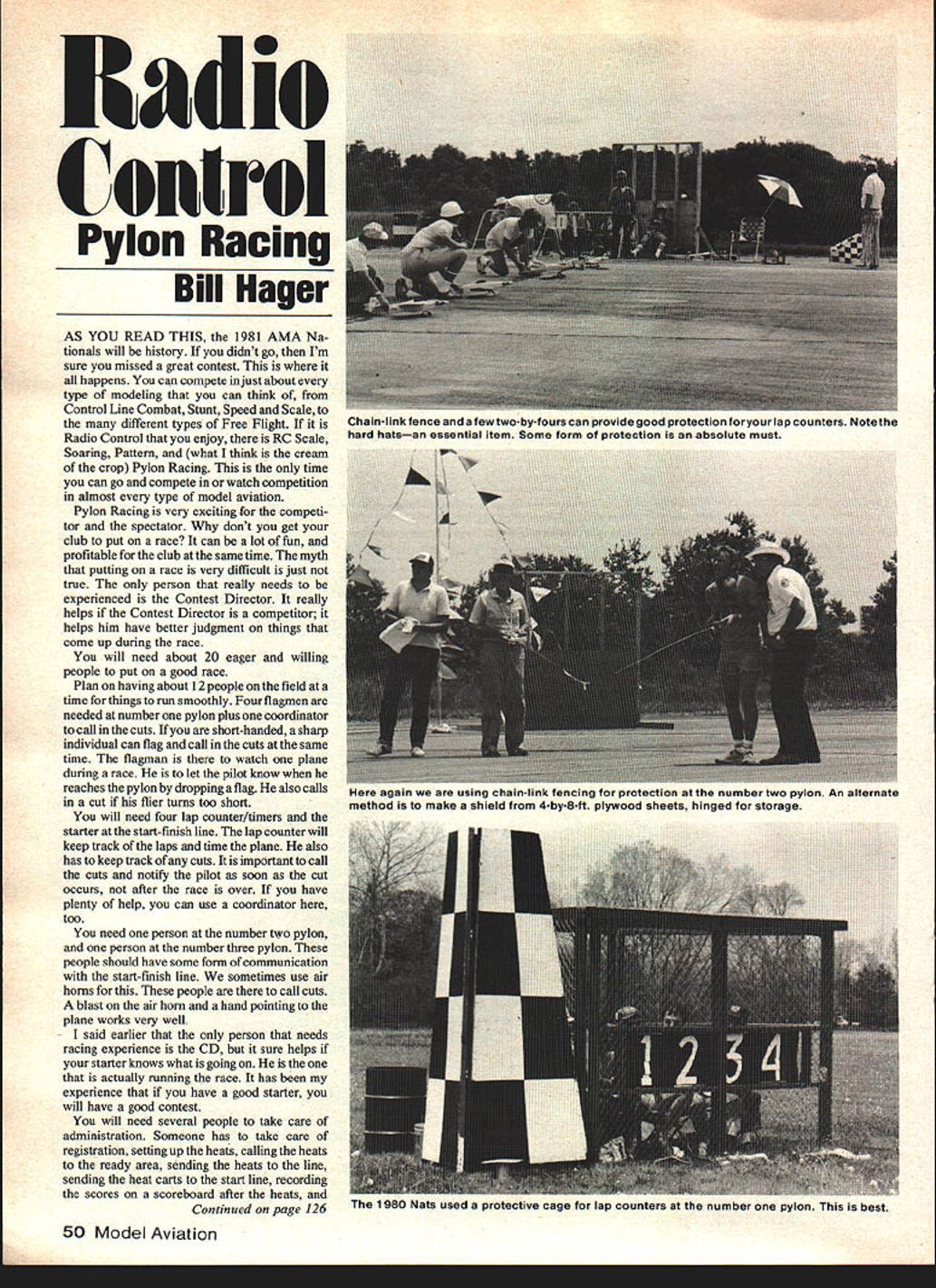
- Protect your workers: everyone on the field should wear hard hats.
- Number one pylon workers should be behind barricades.
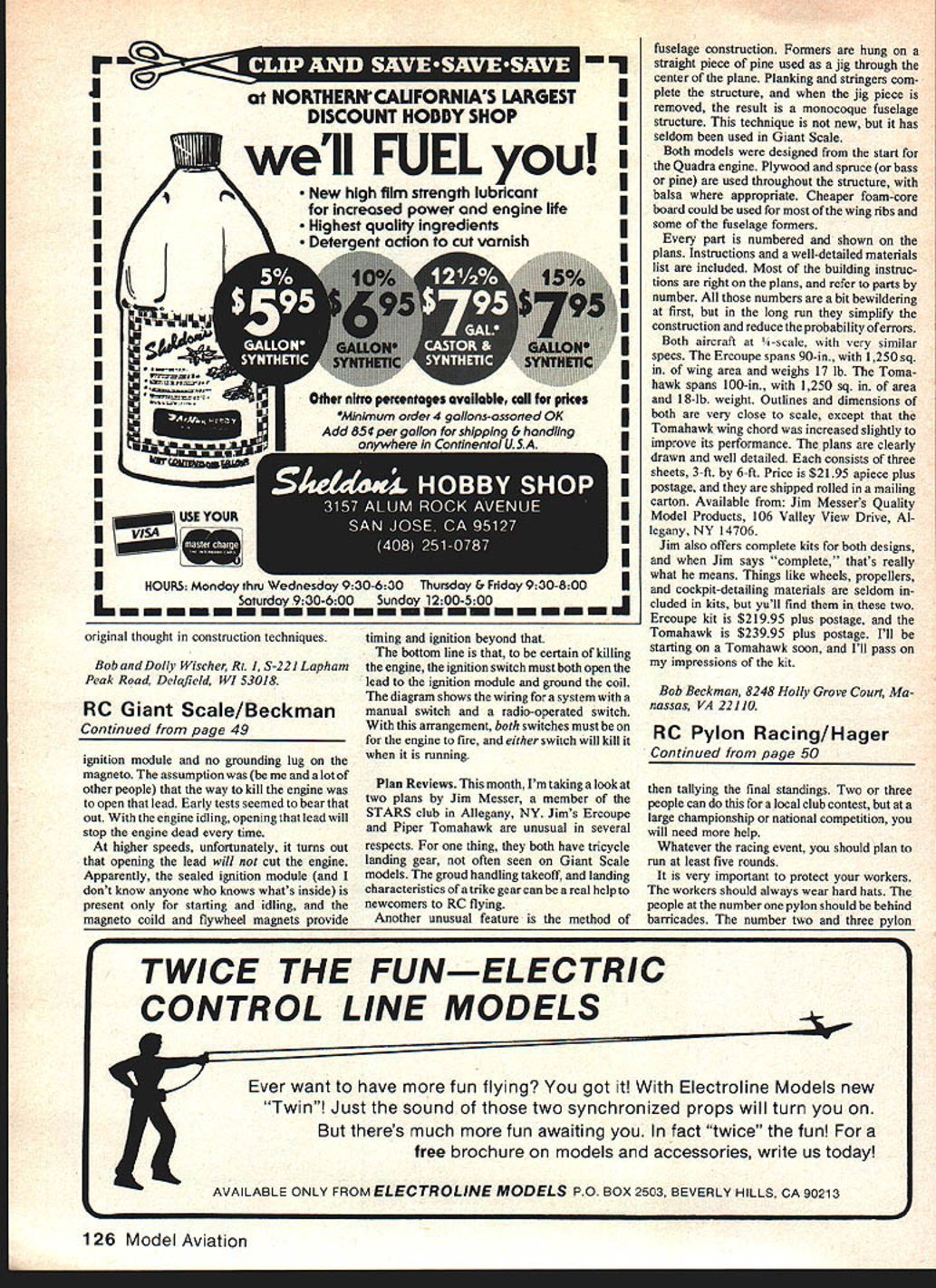
- Number two and three pylon positions should be protected by chain-link fence and/or plywood shields.
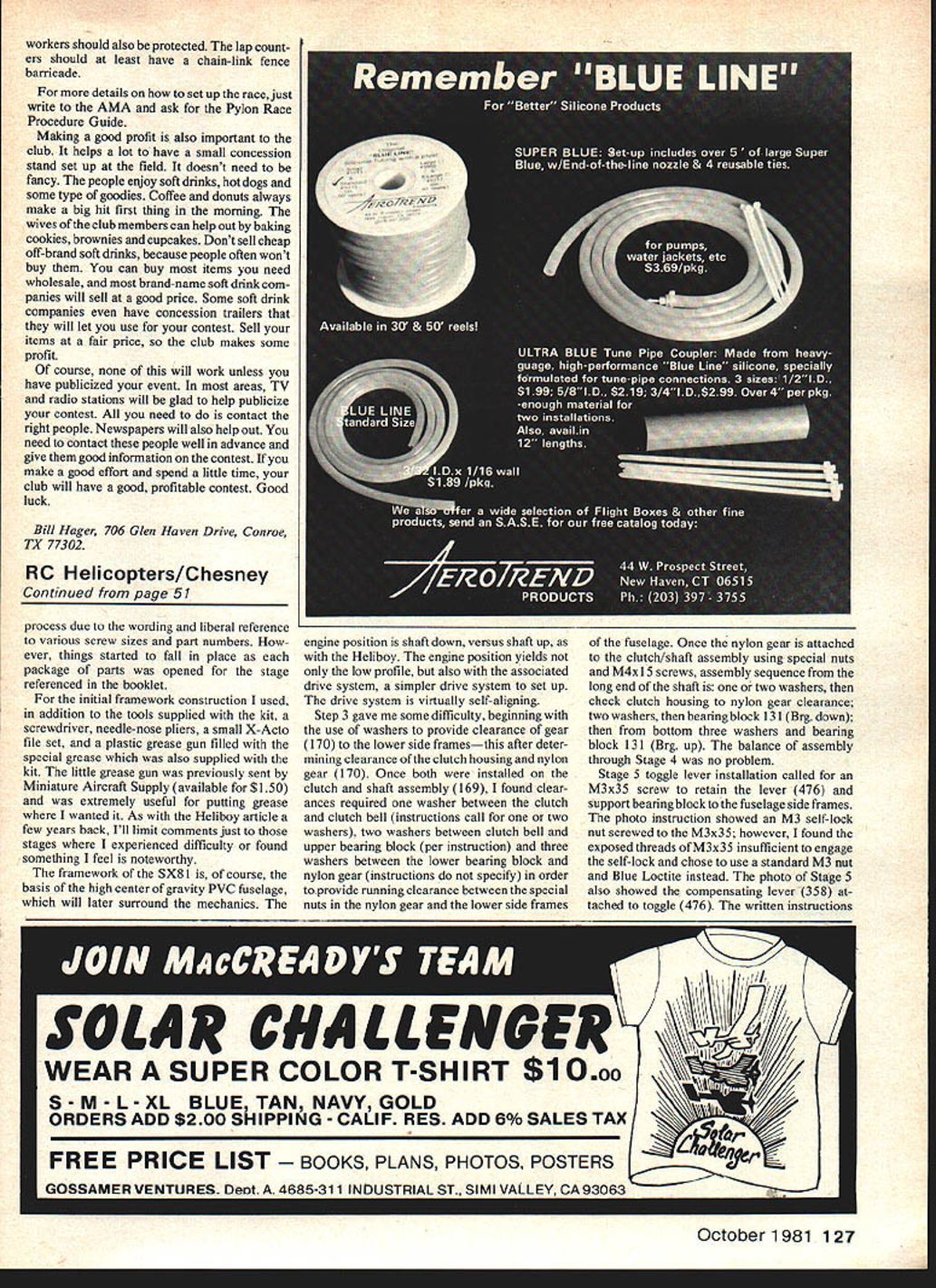
- Lap counters should have a protective cage or at least a chain-link fence barricade.
- Example: at the 1980 Nationals we used a 4-by-8-ft plywood shield hinged to a frame; another option is a cage of welded steel mesh.
- Do not allow pilots or assistants to start engines while others are in front of the propeller arc.
Pits and Spectators
- Pits should be as far from the flight line as practical.
- Engines can cut out during races; sometimes a plane will run into another plane in the pits.
- Keep spectators back and to the side of the pits.
- Announce that no one should handle another pilot's plane without that pilot's permission.
Weather and Site Considerations
- Weather is important: winds may be light in the morning and strong in the afternoon. Postpone if winds become too strong.
- Flying over water (e.g., a lake with pits on shore) provides a safe operating area and keeps damaged aircraft from hitting spectators, but recovery can be difficult.
Rules and Procedures
- Make rules clear. A good rule book is essential.
- Before the first heat, gather all pilots and explain:
- The rules
- Procedures for starting and stopping a heat
- How cuts are called
- How protests should be handled
- The scoring method and the timekeeper's duties
- Penalties for cutting pylons and what constitutes a legal pass
- Use random methods for seeding or have pilots draw starting positions.
Engines, Equipment and Safety
- Engine choice: most sporty pylon racers use two-stroke .15 to .35 engines; higher power classes may use .40 to .60.
- Make sure fuel and nitro blends are consistent; comparable propellers and fuel tank capacities help keep competition fair.
- Propeller safety is crucial.
Radio Interference
- Radio interference is a potential problem. Check all radios beforehand.
- Insist on frequency pins or modern frequency control methods.
- If using crystal radios, have a frequency board and ensure no duplicate frequencies.
- For modern proportional systems, ensure equipment is in proper working order and bind-and-verify procedures are followed.
Practice and Promotion
- Encourage local clubs to hold regular pylon days so pilots can improve and newcomers can learn rules and procedures.
- Publicize your event: TV, radio, and newspapers will usually help if you contact them well in advance and provide good information.
Concessions and Profit
- Making a profit helps the club. Set up a small concession stand—simple is fine.
- Sell soft drinks, hot dogs, coffee and donuts in the morning, and baked goods (cookies, brownies, cupcakes).
- Buy wholesale and use brand-name soft drinks if possible; some companies rent concession trailers.
- Sell at a fair price so the club makes some profit.
Additional Resources
- For more details on how to set up a race, write to the AMA and ask for the Pylon Race Procedure Guide.
Good luck and see you at the course.
Bill Hager 706 Glen Haven Drive Conroe, TX 77302
Transcribed from original scans by AI. Minor OCR errors may remain.

