
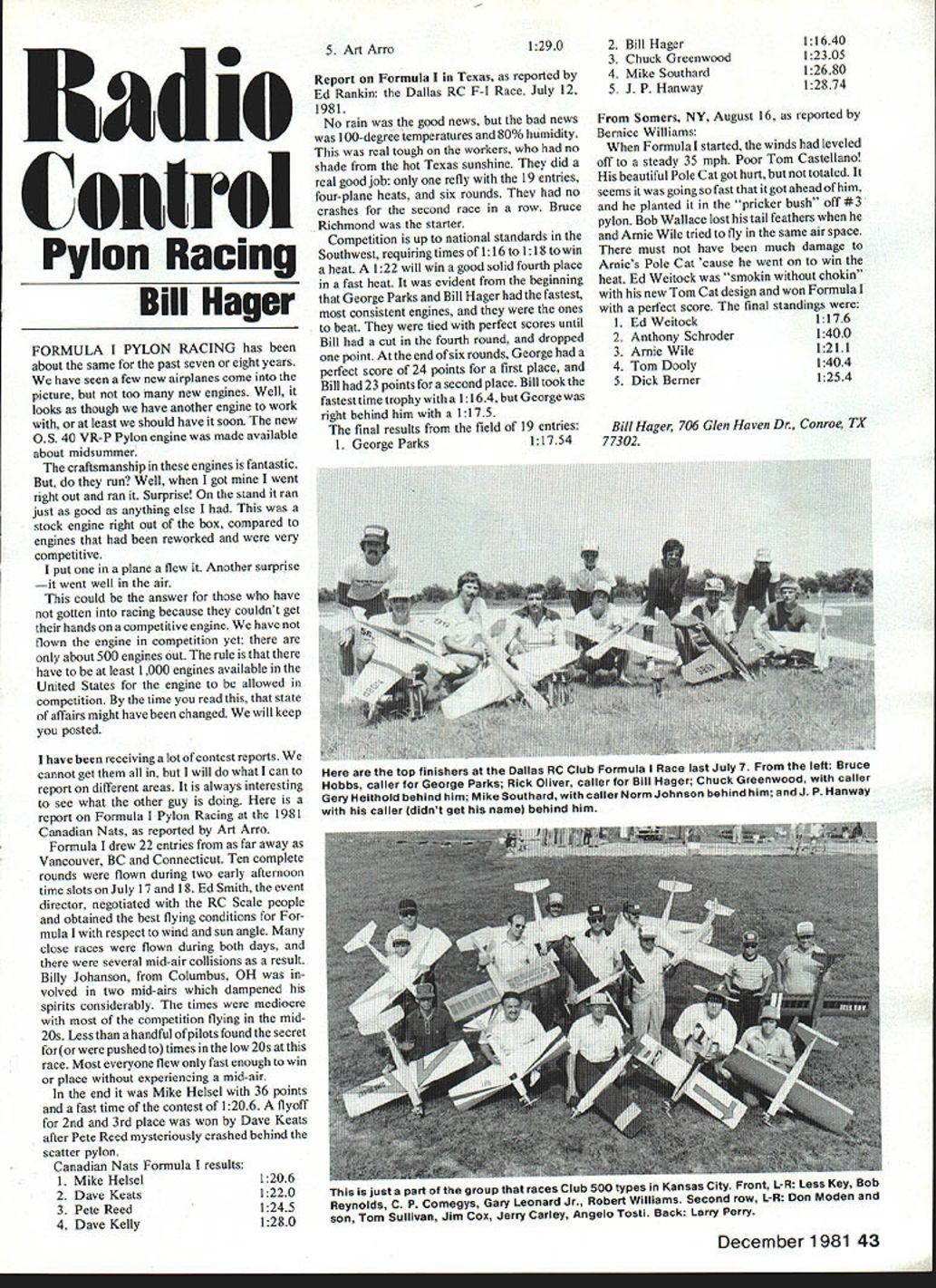
Radio Control: Pylon Racing
By Bill Hager
FORMULA I pylon racing has been about the same for the past seven or eight years. We have seen a few new airplanes come into the picture, but not too many new engines. Well, it looks as though we have another engine to work with — or at least we should have it soon. The new O.S. 40 VR-P pylon engine was made available about midsummer.
The craftsmanship in these engines is fantastic. But do they run? When I got mine I went right out and ran it. Surprise! On the stand it ran just as good as anything else I had. This was a stock engine right out of the box, compared to engines that had been reworked and were very competitive.
I put one in a plane and flew it. Another surprise — it went well in the air.
This could be the answer for those who have not gotten into racing because they couldn't get their hands on a competitive engine. We have not flown the engine in competition yet; there were only about 500 engines available. The rule is that there have to be at least 1,000 engines available in the United States for the engine to be allowed in competition. By the time you read this, that situation may have changed. We will keep you posted.
I have been receiving a lot of contest reports. We cannot get them all in, but I will do what I can to report on different areas. It is always interesting to see what the other guy is doing. Below are several reports.
1981 Canadian Nationals — Formula I (report by Art Arro)
Formula I drew 22 entries from as far away as Vancouver, BC and Connecticut. Ten complete rounds were flown during two early-afternoon time slots on July 17 and 18. Ed Smith, the event director, negotiated with the RC Scale people and obtained the best flying conditions for Formula I with respect to wind and sun angle.
Many close races were flown during both days, and there were several mid-air collisions as a result. Billy Johanson, from Columbus, OH, was involved in two mid-airs which dampened his spirits considerably. The times were mediocre, with most of the competition flying in the mid-20s. Less than a handful of pilots found the secret (or were pushed to) times in the low 20s at this race. Most everyone flew fast enough to win or place without experiencing a mid-air.
In the end it was Mike Helsel with 36 points and the fast time of the contest at 1:20.6. A flyoff for 2nd and 3rd place was won by Dave Keats after Pete Reed mysteriously crashed behind the scatter pylon.
Canadian Nats Formula I results:
- Mike Helsel — 1:20.6
- Dave Keats — 1:22.0
- Pete Reed — 1:22.5
- Dave Kelly — 1:28.0
- Art Arro — 1:29.0
Dallas RC F‑I Race, July 12, 1981 (report by Ed Rankin)
No rain was the good news, but the bad news was 100-degree temperatures and 80% humidity. This was real tough on the workers, who had no shade from the hot Texas sunshine. They did a real good job: only one refly with the 19 entries, four-plane heats, and six rounds. They had no crashes for the second race in a row. Bruce Richmond was the starter.
Competition is up to national standards in the Southwest, requiring times of 1:16 to 1:18 to win a heat. A 1:22 will win a good solid fourth place in a fast heat. It was evident from the beginning that George Parks and Bill Hager had the fastest, most consistent engines, and they were the ones to beat. They were tied with perfect scores until Bill had a cut in the fourth round and dropped one point. At the end of six rounds, George had a perfect score of 24 points for first place, and Bill had 23 points for second. Bill took the fastest-time trophy with a 1:16.4, but George was right behind him with a 1:17.5.
Final results from the field of 19 entries:
- George Parks — 1:17.54
- Bill Hager — 1:16.40
- Chuck Greenwood — 1:23.05
- Mike Southard — 1:26.80
- J. P. Hanway — 1:28.74
Somers, NY — August 16 (report by Bernice Williams)
When Formula I started, the winds had leveled off to a steady 35 mph. Poor Tom Castellano! His beautiful Pole Cat got hurt, but not totaled. It seems it was going so fast that it got ahead of him, and he planted it in the "pricker bush" off #3 pylon. Bob Wallace lost his tail feathers when he and Arnie Wile tried to fly in the same air space. There must not have been much damage to Arnie's Pole Cat because he went on to win the heat. Ed Weitock was "smokin' without chokin'" with his new Tom Cat design and won Formula I with a perfect score.
Final standings:
- Ed Weitock — 1:17.6
- Anthony Schroder — 1:40.0
- Arnie Wile — 1:21.1
- Tom Dooly — 1:40.4
- Dick Berner — 1:25.4
Bill Hager 706 Glen Haven Dr. Conroe, TX 77302
Transcribed from original scans by AI. Minor OCR errors may remain.

