
Radio Control: Pylon Racing
By Bill Hager
Event report (Wayne Yeager)
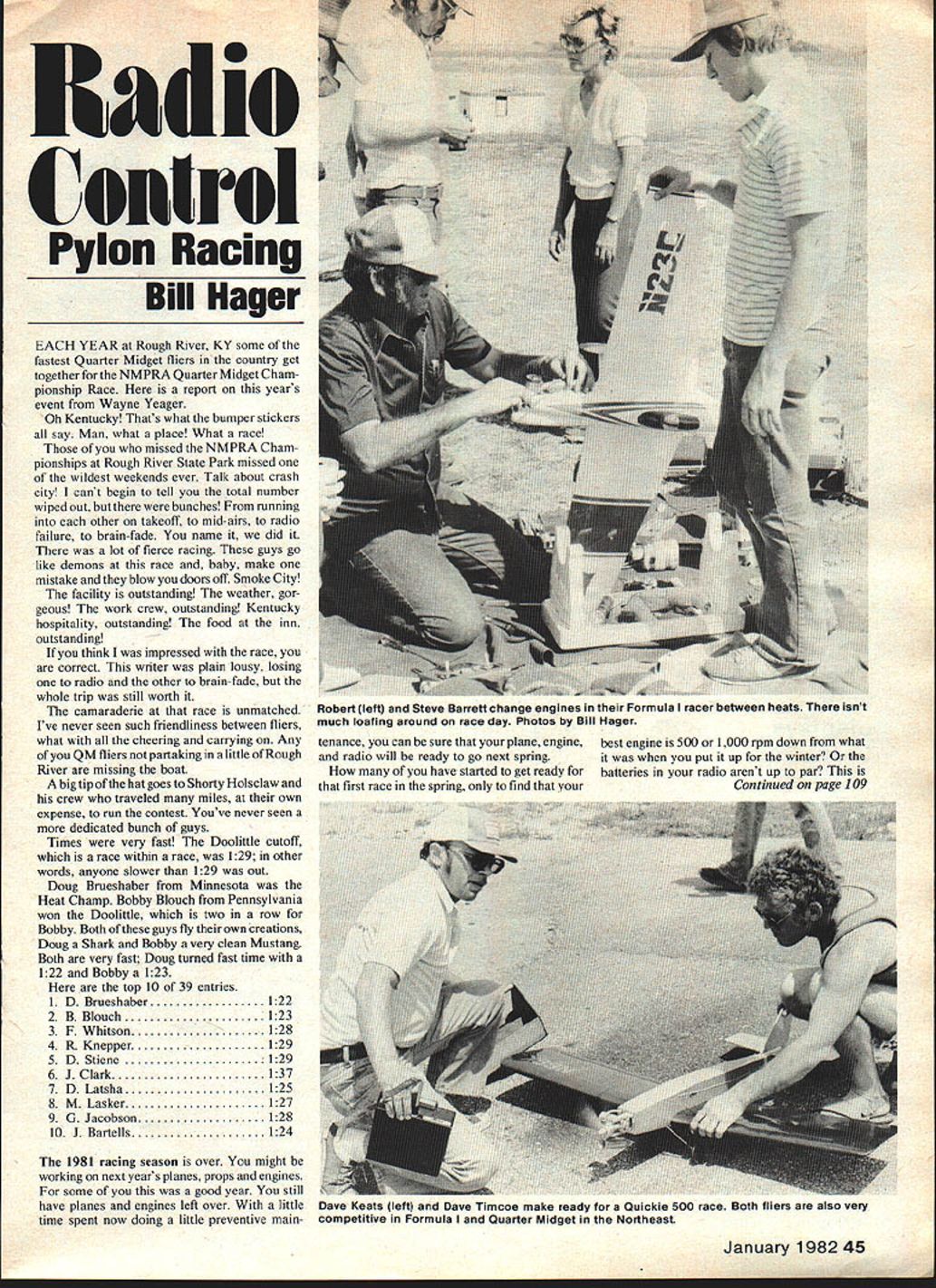
Each year at Rough River, KY, some of the fastest Quarter Midget fliers in the country get together for the NMPRA Quarter Midget Championship Race. Here is a report on this year's event from Wayne Yeager.
"Oh Kentucky!" That's what the bumper stickers all say. Man, what a place! What a race!
Those of you who missed the NMPRA Championships at Rough River State Park missed one of the wildest weekends ever. Talk about crash city! I can't begin to tell you the total number wiped out, but there were bunches — from running into each other on takeoff, to mid-airs, to radio failure, to brain-fade. You name it, we did it. There was a lot of fierce racing. These guys go like demons at this race and, baby, make one mistake and they blow you doors off. Smoke city!
The facility was outstanding. The weather, gorgeous. The work crew, outstanding. Kentucky hospitality, outstanding. The food at the inn, outstanding!
If you think I was impressed with the race, you are correct. This writer was plain lousy, losing one to radio and the other to brain-fade, but the whole trip was still worth it.
The camaraderie at that race is unmatched. I've never seen such friendliness between fliers, what with all the cheering and carrying on. Any of you Quarter Midget fliers not partaking in a little of Rough River are missing the boat.
A big tip of the hat goes to Shorty Holsclaw and his crew, who traveled many miles at their own expense to run the contest. You've never seen a more dedicated bunch of guys.
Times were very fast! The Doolittle cutoff, which is a race within a race, was 1:29; in other words, anyone slower than 1:29 was out.
Doug Brueshaber from Minnesota was the Heat Champ. Bobby Blouch from Pennsylvania won the Doolittle, which is two in a row for Bobby. Both of these guys fly their own creations — Doug a Shark and Bobby a very clean Mustang. Both are very fast; Doug turned a fast time of 1:22 and Bobby a 1:23.
Results
Here are the top 10 of 39 entries:
- D. Brueshaber ........... 1:22
- B. Blouch ............... 1:23
- F. Whitson .............. 1:28
- R. Knepper .............. 1:29
- D. Stiene ............... 1:29
- J. Clark ................ 1:37
- D. Latsha ............... 1:25
- M. Lasker ............... 1:27
- G. Jacobson ............. 1:28
- J. Bartells ............. 1:24
Off-season maintenance
The 1981 racing season is over. You might be working on next year's planes, props and engines. For some of you this was a good year — you still have planes and engines left over. With a little time spent now doing preventive maintenance, you can be sure that your plane, engine, and radio will be ready to go next spring.
How many of you have started to get ready for that first race in the spring, only to find that your best engine is 500 or 1,000 rpm down from what it was when you put it up for the winter? Or that the batteries in your radio aren't up to par? This is usually found out the first time you fly in the spring, with the famous last words, "I haven't got it." A lot of us have found out the hard way that a few minutes spent checking things and a little proper care will go a long way.
Engine storage
- Before you hang up your plane for the winter, take the engine out and clean it up.
- Flush it out with a solvent or alcohol.
- Remove the glow plug (you probably won't be able to use it next year anyway).
- Using a light motor oil or Marvel Mystery Oil, lubricate the engine thoroughly. Put several drops of oil into the intake so the engine is basically soaked in oil.
- Finally, put the engine into a Zip‑Loc bag for storage.
That doesn't take long, and it helps prevent corrosion and seizure over the winter.
Airplane and radio
- Dry out the airplane and clean all of the oil out of the engine compartment.
- Check everything for stress cracks and any other damage that might not have been noticed before.
- Remove the radio and store the plane in a cool, dry place. Avoid storage locations with extreme heat or cold.
The radio should be checked thoroughly — all wires, connections, and plugs. If you have a way to cycle your batteries, you should do so. If your radio has had a lot of hard use, consider sending it back to the factory for a check-out. If you do this during the winter months, service is usually quicker; many people wait until spring and create a queue at the factory, resulting in delays.
Batteries
- If your radio is OK and you just plan on storing it for the winter, don't forget to charge your batteries at least once a month.
- Ni-Cd batteries will not hold a charge indefinitely. If not maintained, they can reverse, and you can end up with a bad battery pack.
If you follow these few helpful tips, you can at least start the next season prepared.
Bill Hager 706 Glen Haven Dr. Conroe, TX 77302.
Transcribed from original scans by AI. Minor OCR errors may remain.

