
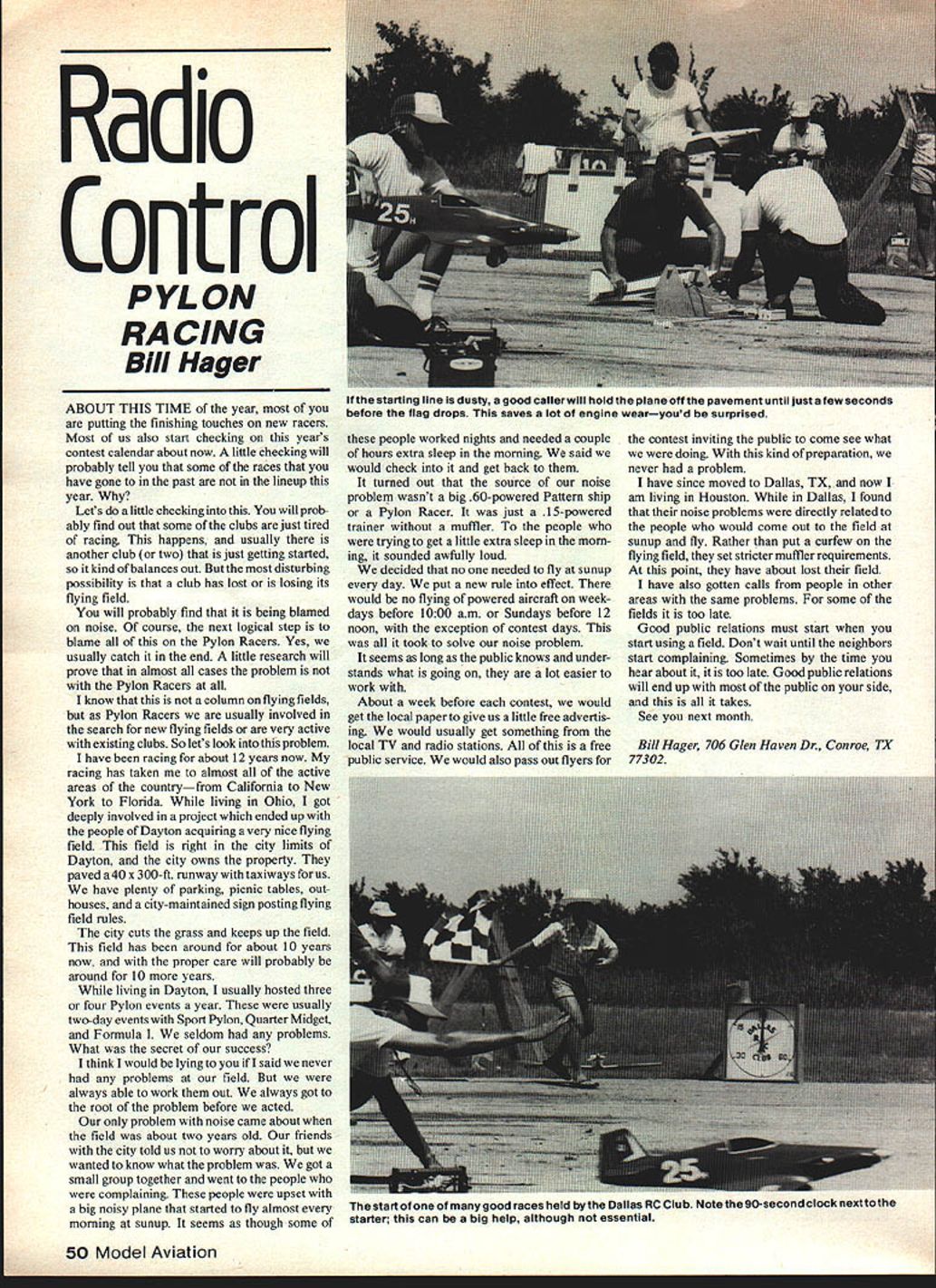
Radio Control: Pylon Racing
By Bill Hager
About this time of year most of you are putting the finishing touches on new racers, and many of us start checking the contest calendar. A little checking will probably show that some races you attended in past years are not on the lineup this year. Why?
A little inquiry will usually reveal one of several causes. Some clubs are simply tired of racing and fold, and that sometimes balances out as new clubs start up. The more disturbing possibility is that a club has lost or is losing its flying field. Often the loss is blamed on noise, and the next logical step is to blame the Pylon Racers. A little research will show that in almost all cases the problem is not with the Pylon Racers at all.
This column isn’t meant to be a treatise on flying fields, but as Pylon Racers we are often involved in the search for new flying sites or are active with existing clubs. So it’s worth looking into the problem.
I’ve been racing about 12 years. My racing has taken me to most active areas of the country—from California to New York to Florida. While living in Ohio I got deeply involved in a project that resulted in the people of Dayton acquiring a very nice flying field. The city owns the property, we have a paved 40 x 300 ft. runway with taxiways, plenty of parking, picnic tables, outhouses, and a city-maintained sign posting flying-field rules. The city cuts the grass and keeps up the field. It’s been around about 10 years and with proper care should be around for many more.
While in Dayton I usually hosted three or four Pylon events a year. These were generally two-day events featuring Sport Pylon, Quarter Midget, and Formula I. We seldom had problems. What was the secret of our success?
I would be lying if I said we never had any problems, but we were always able to work them out because we got to the root of the problem before acting.
Our only significant noise problem occurred when the field was about two years old. The city told us not to worry, but we wanted to know what the issue was. A small group went to see the people who were complaining. They were upset about a noisy airplane that began flying almost every morning at sunup; some of the neighbors worked nights and needed extra morning sleep. We told them we would check and get back to them.
It turned out the source wasn’t a big .60-powered pattern ship or a Pylon Racer but a .15-powered trainer without a muffler. To the people trying to sleep, it sounded awfully loud.
We decided no one needed to fly at sunup every day, and we adopted a new rule: no powered aircraft on weekdays before 10:00 a.m. or on Sundays before 12 noon, except on contest days. That change solved our noise problem.
In general, when the public knows and understands what is going on, they are much easier to work with. About a week before each contest we would get the local paper to give us free publicity and often get mentions on TV and radio. We also distributed flyers inviting the public to come see what we were doing. With that preparation we never had trouble.
I have since moved—first to Dallas, then to Houston. In Dallas their noise problems were directly related to people flying at sunup. Instead of a curfew, the club imposed stricter muffler requirements; despite that, they have nearly lost their field. I’ve also received calls from other areas with similar problems; for some clubs it is already too late.
Good public relations must start the moment you begin using a field. Don’t wait until neighbors complain—sometimes by then it’s too late. Good public relations will put most of the public on your side, and that is often all it takes.
See you next month.
Bill Hager 706 Glen Haven Dr. Conroe, TX 77302
Lessons learned
- Investigate complaints promptly and get to the root cause.
- Establish reasonable flying-hour rules (curfews) or muffler requirements as needed.
- Publicize contests in local media and distribute flyers to invite the public.
- Start good public relations as soon as you use a field; don’t wait for complaints.
Transcribed from original scans by AI. Minor OCR errors may remain.

