
Pylon Racing
Dave Lane
GREETINGS TO ALL you fellow modelers out there in the modeling world. This is a first for this (writer?) modeler as a contributing writer to a monthly magazine, so please bear with me.
Probably a lot of you modelers are wondering—who is this nut Dave Lane? Well, I will try to give you a short resume of my activities.
I have been involved with models since 1941. Between '41 and '60 most of my experience was in free flight (FF) scale. In 1961 RC discovered me and I have been hooked ever since. I became involved with Pylon in 1965 and have either competed or called regularly up to the present time. I also judge pattern competitions as a USPJA member.
This month I would like to reach the non-pylon modeler. Many of you have no doubt watched a pylon race or talked to someone that does race and concluded that pylon is way over your capability or too expensive. I believe this to be only partly true.
The easy and inexpensive way to get into pylon racing is with 1/2A-size aircraft. I know, the first thought is, 1/2A? Good grief! 1/2A is for the rank novice or the little kid down the street. Not so! Try it, you will like it!
The 1/2A-size plane is easy to build, not expensive, quite durable, and very easy to fly! The last part is important. Easy to fly! One of the major problems with racing is that the average pylon ship is a bit on the difficult side to fly unless you are a Bob Smith or Terry Prather.
The 1/2A rules that were developed back in 1969 established the basic 1/2A configuration used today. A 200 sq. in. wing with a constant chord and thickness, 8 sq. inches of cross section at one station of the fuselage, two main wheels, 20 ounces light and no flying wings. No engine larger than .051. These little speedsters fly great using aileron and elevator only. Some guys use rudder and elevator, but I believe the aileron system gives a smoother turn around the pylon. Ace puts out a pair of foam wing cores that most of the guys use as the basic wing for this class of racer.
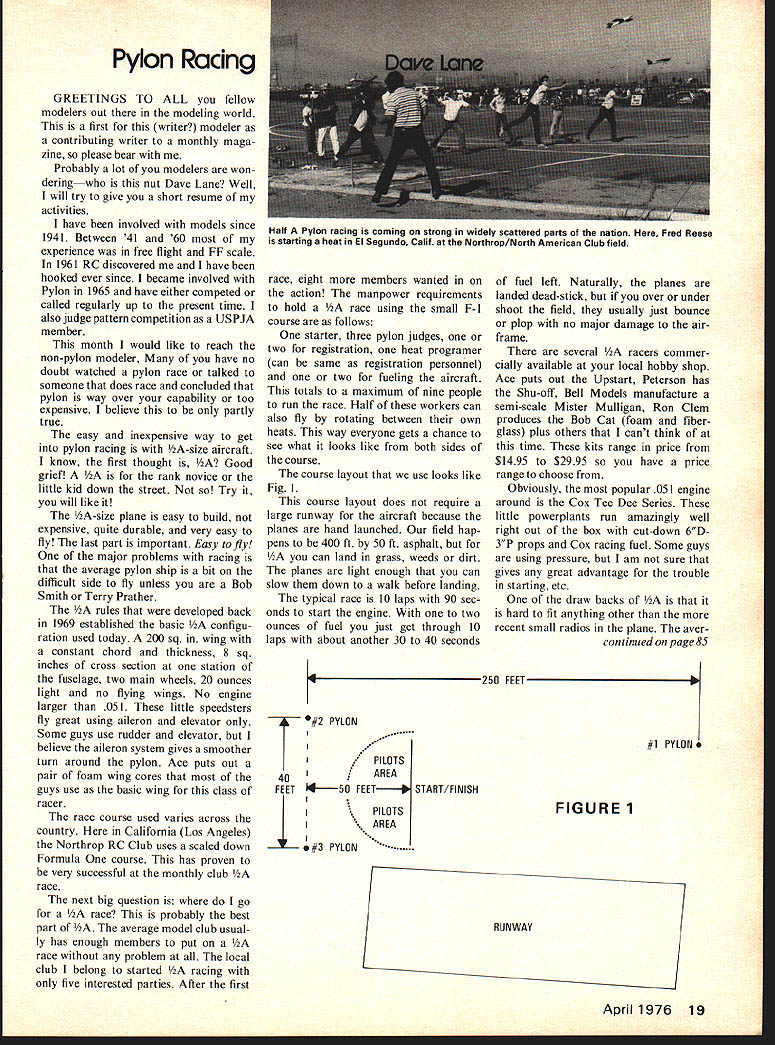
The race course used varies across the country. Here in California (Los Angeles) the Northrop RC Club uses a scaled down Formula One course. This has proven to be very successful at the monthly club 1/2A race.
The next big question is: where do I go for a 1/2A race? This is probably the best part of 1/2A. The average model club usually has enough members to put on a 1/2A race without any problem at all. The local club I belong to started 1/2A racing with only five interested parties. After the first race, eight more members wanted in on the action! The manpower requirements to hold a 1/2A race using the small F-1 course are as follows:
One starter, three pylon judges, one or two for registration, one heat programer (can be same as registration personnel), one or two for fueling the aircraft. This totals a maximum of nine people to run the race. Half of these workers can also fly by rotating between their own heats. This way everyone gets a chance to see what it looks like from both sides of the course.
The course layout that we use looks like Fig. 1.
This course layout does not require a large runway for the aircraft because the planes are hand launched. Our field happens to be 400 ft. by 50 ft. asphalt, but for 1/2A you can land in grass, weeds or dirt. The planes are light enough that you can slow them down to a walk before landing.
The typical race is 10 laps with 90 seconds to start the engine. With one to two ounces of fuel you just get through 10 laps with about another 30 to 40 seconds of fuel left. Naturally, the planes are landed dead-stick, but if you over or undershoot the field, they usually just bounce and plop with no major damage to the airframe.
There are several 1/2A racers commercially available at your local hobby shop. Ace puts out the Upstart, Peterson has the Shu-off, Bell Models manufacture a semi-scale Mister Mulligan, Ron Clem produces the Bob Cat (foam and fiberglass) plus others I can't think of at this time. These kits range in price from $14.95 to $29.95 so you have a price range to choose from.
Obviously, the most popular .051 engine around is the Cox Tee Dee Series. These little powerplants run amazingly well right out of the box with cut-down 6" D-3P props and Cox racing fuel. Some guys are using pressure cans, but I am not sure that gives any great advantage for the trouble in starting, etc.
One of the drawbacks of 1/2A is that it is hard to fit anything other than the more recent small radios in the plane. The average
RC Pylon/Lane continued from page 19
radio compartment is only 1¼ in. wide by 5 in. or 6 in. long and 2½ in. deep. There has to be some challenge to this hobby, right?
One of the things I would like to comment on about racing in general is the drifting away from the scale aspect of the aircraft. The original intent of the NMPRA event was to emulate full scale racing. So far, Formula-One has maintained this to a degree but FAI (600 sq. in. class) has all but died in the USA because of the strange looking non-scale aircraft that evolved over the years. The Quarter Midget class has become very popular but it is also, in part, due to the fact that all aircraft must look like a full-scale aircraft that has raced. I believe that if 1/2A racing would adopt the same rule, that the planes should look like a full scale aircraft, not necessarily a racing plane, but at least be 85% to 90% scale outline. At least to me, watching a group of planes racing that look like real aircraft is a lot more interesting than watching a bunch of square boxes with wings. The spectators enjoy the races more when they can identify the type of aircraft participating in the races. So much for my soap box this month.
Next month I will cover the "Quickie 500" class of racing which is the next step in the world of RC racing.
Please send any questions, ideas, gripes etc., to D. K. Lane, 4477 W. 136th St., Hawthorne, Calif. 90250. I will be more than happy to include any material received in the column.
Keep 'em flying, go fast and turn left.
Transcribed from original scans by AI. Minor OCR errors may remain.

