
Radio Control: Pylon Racing
Bill Hager
Club 500: Frequently Asked Questions
Throughout the year I receive many inquiries about Club 500 racing. Rather than replying to each person individually, I will try to answer some of the most frequently asked questions in this month's column. First place in this category is the question: "What rules do everyone use in regard to the airplane and engines?"
This is a tough one. It seems as though every area that is having racing now has its own set of rules—and they are all different!
Club 500-type racing was started as a low-key, low-cost racing event. The idea was to keep it simple for those who did not want to go "all the way" into Formula I, or for those who were just getting started in racing and could use this event as a stepping stone.
The original idea was to have it so that the new flyer had just as good a chance of winning as the seasoned pilot. When I was racing in Ohio, we had to use one type of airplane. We made gauges to check wing and fuselage thicknesses, and the planes were carefully inspected to make sure that nothing had been altered. We used a stock engine from one manufacturer, stock props, and contestants were supplied with 15% nitro fuel. You might ask, "With one engine and one make of aircraft, how can one improve? This just doesn't sound right."
Well, the idea is to keep it simple—as simple as you can. The simpler the rules, the easier they are to enforce. This way, the only way to improve is through pilot skill. In Ohio this rule worked very well. We even went so far as to handicap the good pilot by letting him start a half or even one lap behind the novice.
Next month we'll talk about how it was done in another area.
Bakersfield Formula One Race — Report
For years one of the best-attended contests was held in Bakersfield, CA. A few years ago, what seemed to be the peak of this contest, the meet disappeared from the calendar. Now it is back! The following report was sent in by George Gillberg.
The Bakersfield Aircraft Radio Control Society (BARKS) has once again put on a successful Formula One race. While for several years the Bakersfield race was the premier event in F-1, a two-year hiatus passed the mantle of leadership to the SLO Fliers' race in San Luis Obispo. While the 28 entries this year don't compare to the 100+ that used to race, it was a much more manageable number, enabling 10 rounds to be flown in two days without having to crank out a heat every 5 minutes or require a 7:00 a.m. start on Sunday to give 100 entrants five rounds each.
- Weather and conditions: Perfect weather. Conditions were particularly good on Saturday and heat times were very low.
- Fast times:
- Round 1: Dave Shadel — 1:13.32
- Round 2: Dave Shadel — 1:11.87
- Round 2/3: Mike Atzei — 1:11.01 (took fastest-time title)
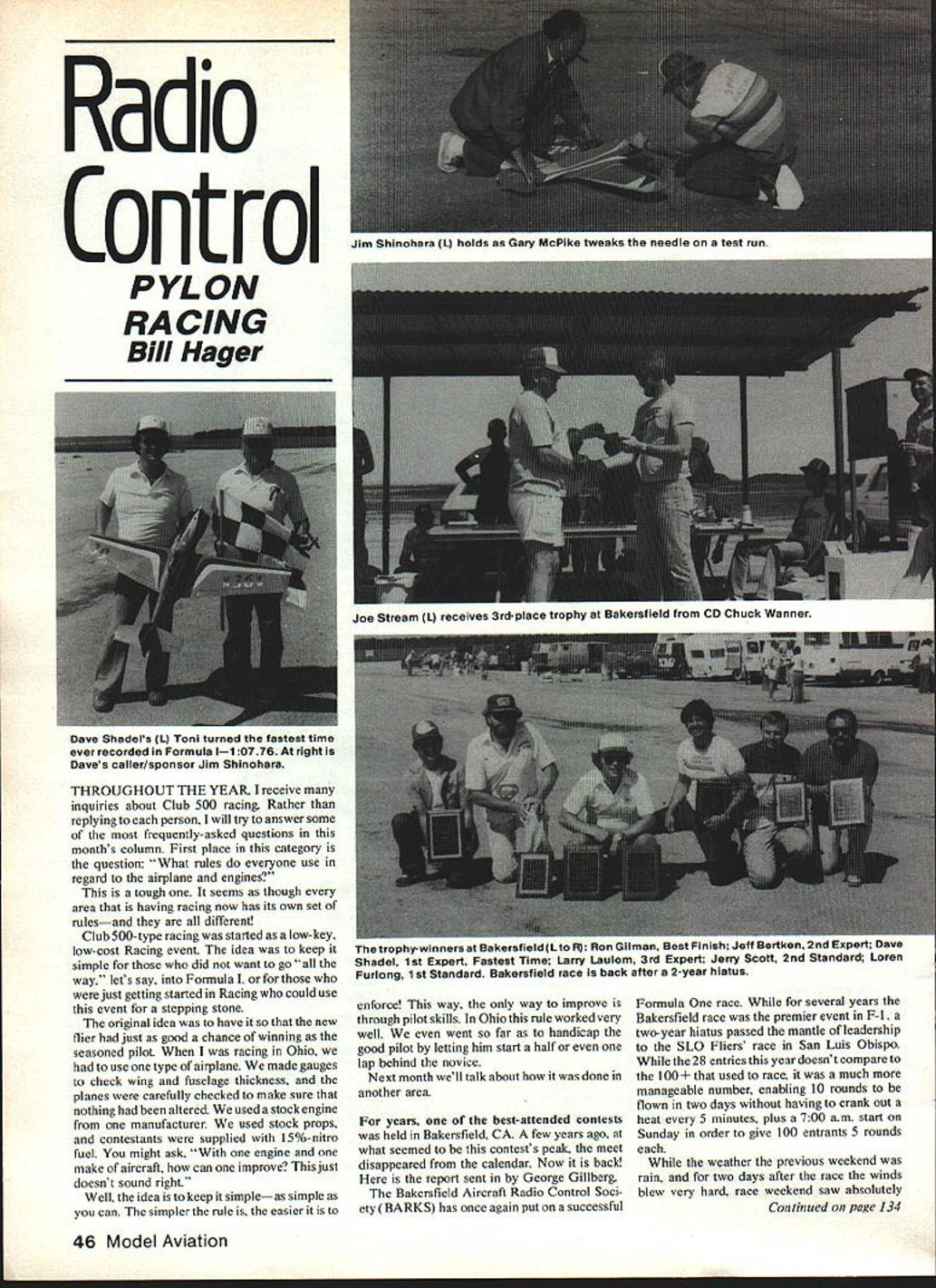
- Round 3: Dave Shadel — 1:07.76 (fastest time ever recorded in Formula One). This time was backed up by a second digital stopwatch used by the head lap counter.
- Remaining Saturday times for Dave Shadel: Rd. 4 — 1:09.63; Rd. 5 — 1:11.90 (after blowing a plug on the last lap); Rd. 6 — 1:08.80 (launched second).
After Saturday's racing the course was remeasured and found to be several inches too long, so it was certainly of legal size. Winning models were weighed after each heat.
Attrition due to crashes was relatively light, although still unfortunate for those involved. Notable incidents:
- Rusty Van Baren had a mid-air with Tom Christopher and escaped with only a cracked wheel pant.
- Tom Christopher, whose Polecat lost the entire left stabilizer, nursed his plane in for a smoother landing than most make with undamaged planes.
- On Sunday, Ron Gilman and Kent Nogy had the most spectacular mid-air of the contest, totaling both airplanes.
Times on Sunday were not as fast as Saturday, although several 1:12s and 1:13s were recorded. Larry Laulom posted a 1:11.81.
Awards and Notables
- Best finish award: Ron Gilman (Circus Racing Team) — award donated by Jim Shinohara (sponsor of the Samurai Team).
- Fast Time Trophy: Dave Shadel (Samurai Team) — donated by Circus Hobbies.
Class results:
- Standard class:
- Loren Furlong
- Jerry Scott (in his first race ever)
- Joe Stream
- Expert class:
- Dave Shadel
- Jeff Bertken
- Larry Laulom
Worth noting: Tom Christopher used the new OS engine in his primary model. While Tom's best flight wasn't really in contention for fastest time this event, the season is young and his engine will bear watching.
Thanks must be given to all the BARKS club members who worked hard to put on a good race, particularly Janet Gilman, who did an excellent job handling the paperwork.
It looks as though racing has returned to Bakersfield! I'm sure there will be a large turnout for next year's event.
See you next month.
Bill Hager 706 Glenhaven Dr. Conroe, TX 77302
Transcribed from original scans by AI. Minor OCR errors may remain.

