
Radio Control: Pylon Racing
Bill Hager
There has been no FAI Pylon Racing in this country for many years. We have, for some time now, had a new set of rules aimed at getting us interested again. It seemed as though no one was going to take the first step — that is, hold a race and say, "Let's see what happens." We have to start somewhere.
Well, it looks as though someone has taken that first step. Here is a report sent to me by Art Arro.
Event report
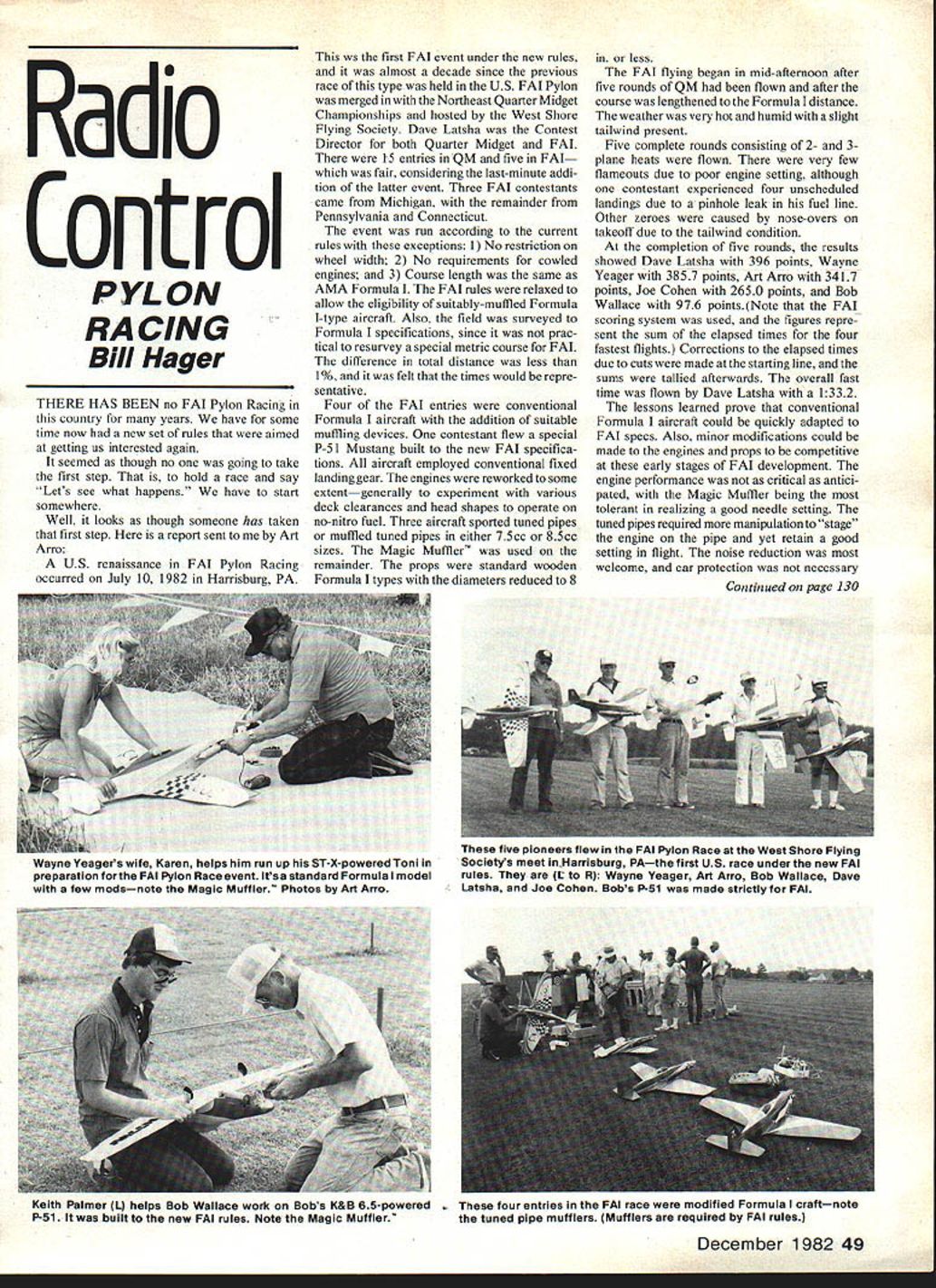
A U.S. renaissance in FAI Pylon Racing occurred on July 10, 1982, in Harrisburg, PA. This was the first FAI event under the new rules, and it was almost a decade since the previous race of this type was held in the U.S. FAI Pylon was merged in with the Northeast Quarter Midget (QM) Championships and hosted by the West Shore Flying Society. Dave Latsha was the Contest Director for both Quarter Midget and FAI.
There were 15 entries in QM and five in FAI — which was fair, considering the last-minute addition of the latter event. Three FAI contestants came from Michigan; the remainder were from Pennsylvania and Connecticut.
Rules and course
The event was run according to the current rules with these exceptions:
- No restriction on wheel width.
- No requirement for cowled engines.
- Course length was the same as AMA Formula I.
The FAI rules were relaxed to allow the eligibility of suitably muffled Formula I–type aircraft. Also, the field was surveyed to Formula I specifications, since it was not practical to resurvey a special metric course for FAI. The difference in total distance was less than 1%, and it was felt the times would be representative.
Aircraft, engines, and props
Four of the FAI entries were conventional Formula I aircraft with the addition of suitable muffling devices. One contestant flew a special P-51 Mustang built to the new FAI specifications. All aircraft employed conventional fixed landing gear.
The engines were reworked to some extent — generally experimenting with various deck clearances and head shapes to operate on no-nitro fuel. Three aircraft sported tuned pipes or muffled tuned pipes in either 7.5 cc or 8.5 cc sizes. The Magic Muffler was used on the remainder. The props were standard wooden Formula I types with the diameters reduced to 8 in. or less.
Flying and results
FAI flying began in mid-afternoon after five rounds of QM had been flown and after the course was lengthened to the Formula I distance. The weather was very hot and humid with a slight tailwind present.
Five complete rounds consisting of 2- and 3-plane heats were flown. There were very few flameouts due to poor engine setting, although one contestant experienced four unscheduled landings due to a pinhole leak in his fuel line. Other zeroes were caused by nose-overs on takeoff because of the tailwind.
At the completion of five rounds, the results (using the FAI scoring system; figures represent the sum of the elapsed times for the four fastest flights) were:
- Dave Latsha — 396.0 points
- Wayne Yeager — 385.7 points
- Art Arro — 341.7 points
- Joe Cohen — 265.0 points
- Bob Wallace — 97.6 points
Corrections to the elapsed times due to cuts were made at the starting line, and the sums were tallied afterwards. The overall fast time was flown by Dave Latsha with a 1:33.2.
Lessons learned
- Conventional Formula I aircraft can be quickly adapted to FAI specifications.
- Minor modifications to engines and props can make aircraft competitive in the early stages of FAI development.
- Engine performance was not as critical as anticipated; the Magic Muffler proved most tolerant in achieving a good needle setting.
- Tuned pipes required more manipulation to "stage" the engine on the pipe and still retain a good setting in flight.
- The noise reduction from muffling was most welcome; ear protection was not necessary.
- On the starting line, one KB-1S glow plug survived four rounds of flight plus numerous ground RPM checks.
- Due to fuel-feed problems, it was not determined whether a specially built FAI ship would be superior to a standard Formula I design.
- Heat timing demands accurate watches and trained timers to prevent errors in the elapsed-time method of scoring.
We thank Dave Latsha, the West Shore Flying Society, and those fliers who participated in this born-again FAI Pylon Race.
NMPRA Championship
As the contest season winds down, there will still be a large group of Formula I fliers getting ready for the NMPRA Championship race. This is usually the biggest, most competitive race of the year. Only those who qualify will attend.
To qualify, a flier must either:
- Finish in the top 20% in his NMPRA district,
- Finish in the top 10 at the AMA Nats, or
- Work as an officer in the NMPRA.
This year's Championship race is to be held at Seguin, TX on October 30–31 — with yours truly as the Contest Director. I hope to see you there.
Bill Hager 706 Glen Haven Dr. Conroe, TX 77302
Transcribed from original scans by AI. Minor OCR errors may remain.

