
Radio Control: Pylon Racing
Bill Hager
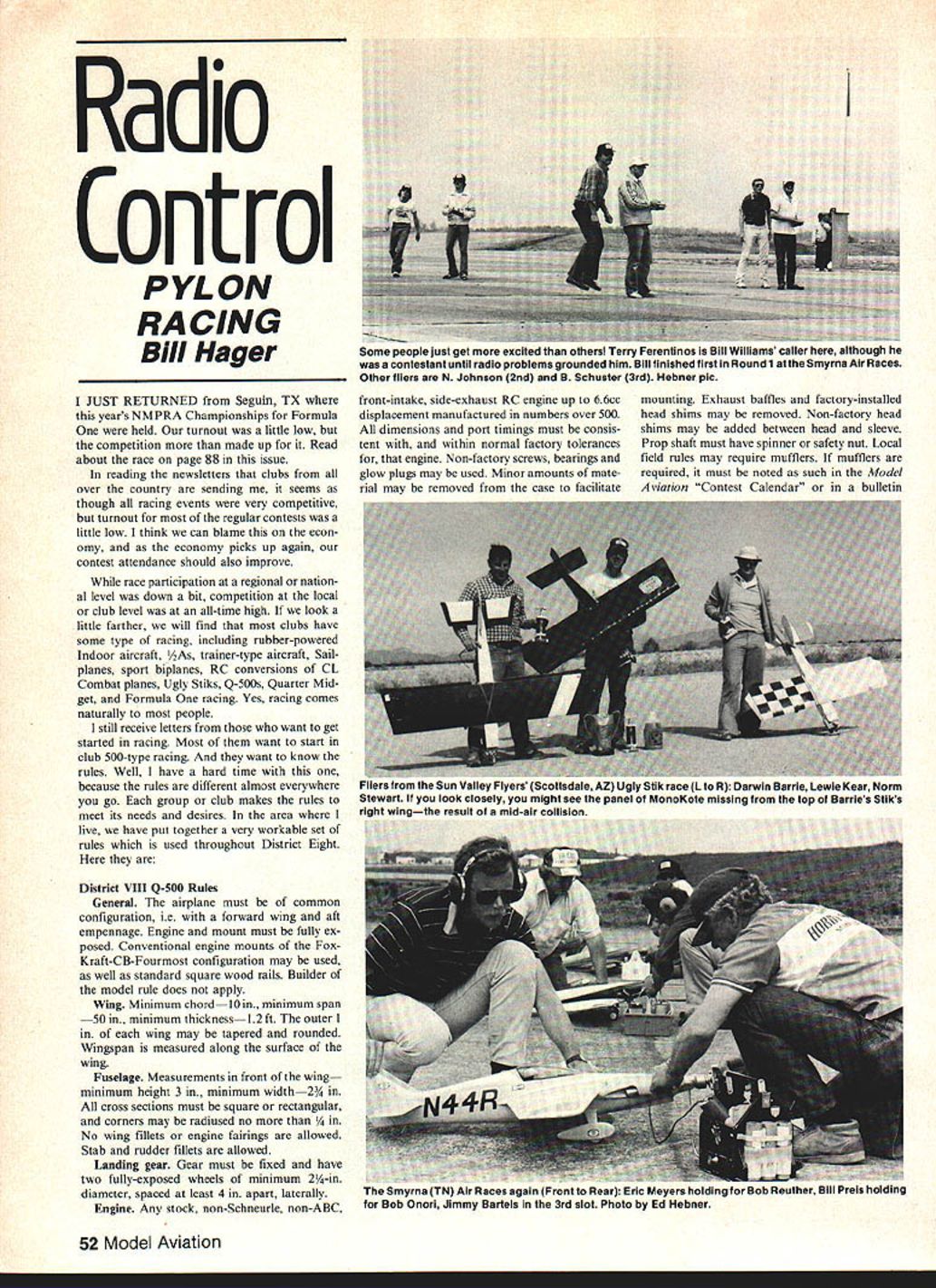
I just returned from Seguin, TX, where this year's NMPRA Championships for Formula One were held. Our turnout was a little low, but the competition more than made up for it. Read about the race on page 88 in this issue.
In reading the newsletters that clubs from all over the country are sending me, it seems as though all racing events were very competitive, but turnout for most of the regular contests was a little low. I think we can blame this on the economy, and as the economy picks up again, our contest attendance should also improve.
While race participation at a regional or national level was down a bit, competition at the local or club level was at an all-time high. If we look a little farther, we will find that most clubs have some type of racing, including rubber-powered indoor aircraft, .40s, trainer-type aircraft, sailplanes, sport biplanes, RC conversions of CL combat planes, Ugly Stiks, Q-500s, Quarter Midget, and Formula One racing. Yes, racing comes naturally to most people.
I still receive letters from those who want to get started in racing. Most of them want to start in club 500-type racing and want to know the rules. I have a hard time with this one, because the rules are different almost everywhere you go. Each group or club makes the rules to meet its needs and desires. In the area where I live, we have put together a very workable set of rules which is used throughout District Eight. Here they are:
District VIII Q-500 Rules
General
- The airplane must be of common configuration, i.e., with a forward wing and aft empennage.
- Engine and mount must be fully exposed.
- Conventional engine mounts of the Fox-Kraft-CB-Fourmost configuration may be used, as well as standard square wood rails.
- Builder-of-the-model rule does not apply.
Wing
- Minimum chord: 10 in.
- Minimum span: 50 in.
- Minimum thickness: 1/2 in.
- The outer 1/2 in. of each wing may be tapered and rounded.
- Wingspan is measured along the surface of the wing.
Fuselage
- Measurements in front of the wing: minimum height 3 in., minimum width 2-3/4 in.
- All cross sections must be square or rectangular; corners may be radiused no more than 1/4 in.
- No wing fillets or engine fairings are allowed. Stab and rudder fillets are allowed.
Landing gear
- Gear must be fixed and have two fully exposed wheels.
- Wheel minimum diameter: 2-1/4 in.
- Wheels must be spaced at least 4 in. apart laterally.
Engine
- Any stock, non-Schnuerle, non-ABC, front-intake, side-exhaust RC engine up to 6.6 cc displacement manufactured in quantities over 500.
- All dimensions and port timings must be consistent with, and within normal factory tolerances for, that engine.
- Non-factory screws, bearings, and glow plugs may be used.
- Minor amounts of material may be removed from the case to facilitate mounting.
- Exhaust baffles and factory-installed head shims may be removed.
- Non-factory head shims may be added between head and sleeve.
- Prop shaft must have spinner or safety nut.
- Local field rules may require mufflers. If mufflers are required, it must be noted in the Model Aviation "Contest Calendar" or in a bulletin mailed to local AMA fliers at least two weeks before the contest. No tuned pipes will be accepted.
- At the conclusion of the event, the top three (3) contestants' engines must be torn down and inspected. Removal of carburetor, head, back plate, and front-end parts may be required where applicable.
Other specifications
- Weight: 3 lb.
- Fuel system:
- Tank must be transparent and may contain no baffles or sponge material.
- Crankcase/muffler pressurization tank allowed.
- No pumpers; in-line pumpers allowed.
- Air-adjustable needle valves are prohibited.
- Pilot must be able to close the throttle by radio command; use of a servo is required. Mechanical shutoffs are allowed.
- Fuselage must have a readily removable hatch which allows easy inspection of the entire fuel system.
- A clear plastic window making the tank visible for inspection will be acceptable.
- Fueling must be done with the hatch removed so officials can ascertain the tank has been properly emptied and refilled before flight.
- Props: Any commercial, readily available two-bladed wood prop. Material may be removed from the blade. No refinishing allowed.
- Fuel: 15 percent nitro furnished by the organizer.
- Course: Use either the short Quarter Midget course or the regular Formula course; choice left up to contest management.
As I have said, this is what we use in Texas and the surrounding area, and it works for us. If your area doesn't have a set of rules yet, you might try ours.
Contest Reports
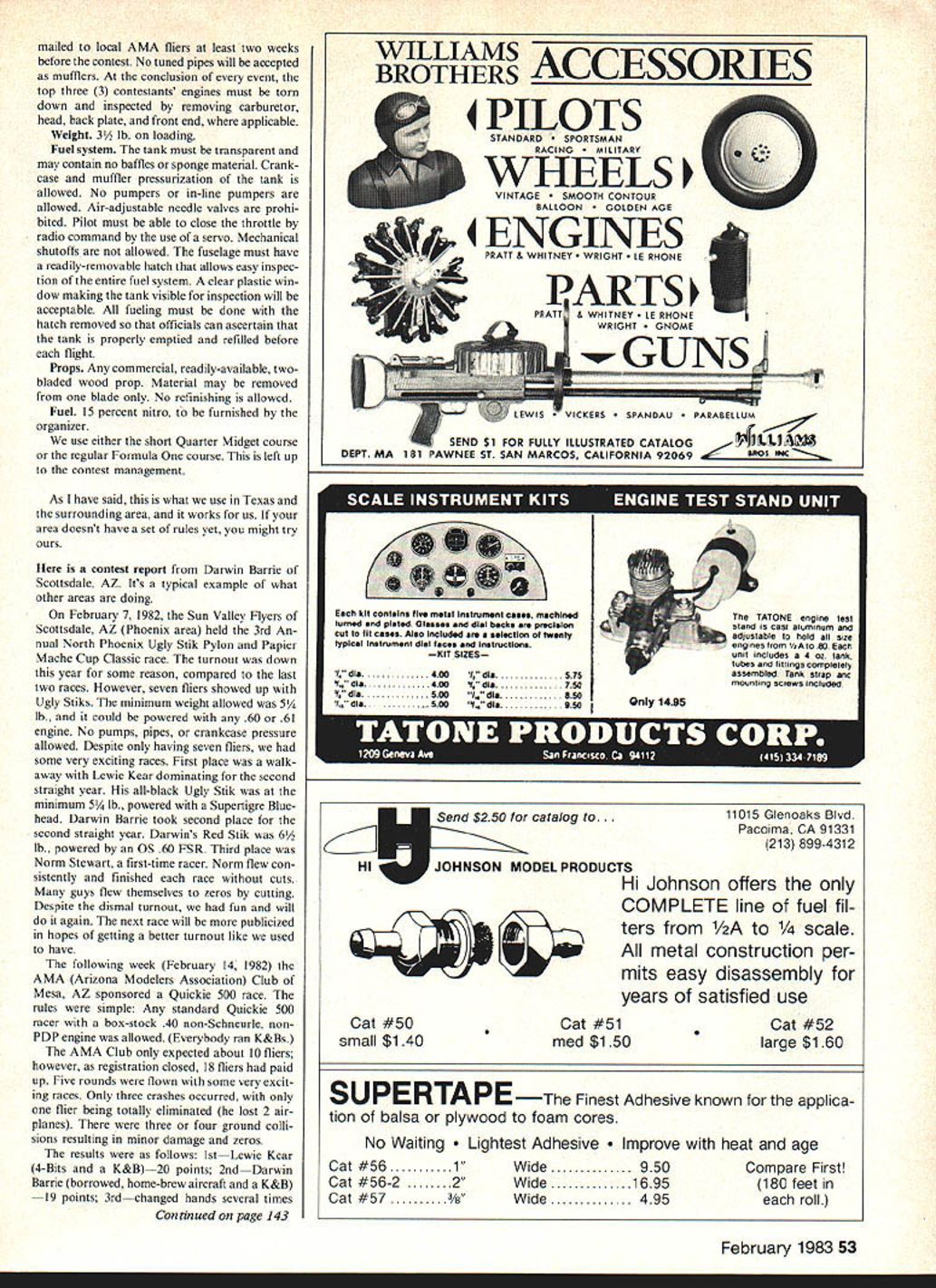
North Phoenix Ugly Stik Pylon and Paper Mache Cup Classic
Sun Valley Flyers, Scottsdale, AZ — February 7, 1982
- Turnout was down this year compared to the last two races, but seven fliers showed up with Ugly Stiks.
- Minimum weight allowed: 5 1/4 lb.; power: any .60 or .61 engine.
- No pumps, pipes, or crankcase pressure allowed.
- Despite only seven fliers, we had some very exciting races.
Results:
- Lewie Kear — dominated for the second straight year; his all-black Ugly Stik was at the minimum 5 1/4 lb., powered with a Super Tigre Blue-head.
- Darwin Barrie — second place for the second straight year; his Red Stik was 6 1/4 lb., powered by an OS .60 FSR.
- Norm Stewart — a first-time racer; flew consistently and finished each race without cuts.
Many pilots flew themselves to zeros by cutting. Despite the dismal turnout, we had fun and will do it again. The next race will be more publicized in hopes of getting a better turnout like we used to have.
Quickie 500 Race
AMA (Arizona Modelers Association) Club of Mesa, AZ — February 14, 1982
- Rules: Any standard Quickie 500 racer with a box-stock .40 non-Schnuerle, non-PDP engine was allowed (everybody ran K&Bs).
- The AMA Club expected about 10 fliers; however, 18 fliers registered.
- Five rounds were flown with some very exciting races.
- Only three crashes occurred; only one flier was totally eliminated (he lost two airplanes).
- There were three or four ground collisions resulting in minor damage and zeros.
Results:
- Lewie Kear (4-Bits and a K&B) — 20 points
- Darwin Barrie (borrowed, home-brew aircraft and a K&B) — 19 points
- Third place changed hands several times due to disqualifications. (The third-place flier had a modified engine he didn't even know about.) Rod Thompson had bought an engine from another flier and had never opened it up; the insides were leveled and polished, which explained its performance. A couple of others were also disqualified. Larry Lemons was finally declared third (modified 4-Bits and a K&B).
I think, as many others did, that this race stirred new racing interest in the Phoenix area. The next race is scheduled for April 4 with only 40 entries being allowed. This will be a test event to see if the unrestricted-engine rule will work. If it doesn't, we will go back to stock motors.
This club is doing some experimenting to find out what works best for its racing activities. I am sure that they will be successful. Just remember, safety comes first.
A note about safety: I have seen a lot of different types of pylon racing over the years. Most pylon racers are very safety conscious. However, I have seen a few who are not as careful as they could be. One common problem is people using servos that are too small and lightweight to do the job. They do this to make their planes lighter, and most of the time they end up with the servos failing and causing crashes. A crash is caused by a plane being out of control—that means you don't know where it will hit or you can't stop it. You owe it to yourself and your fellow fliers to keep your flying as safe as you can. Please don't cut corners where safety is concerned.
See you next month.
Bill Hager 706 Glen Haven Dr., Conroe, TX 77302
Transcribed from original scans by AI. Minor OCR errors may remain.

