
Radio Control: Pylon Racing
Bill Hager
Winter building and modifications
As I write this, the Northeast is having its worst snow in over 40 years. It is about 65° here in Conroe, TX. Eat your hearts out, gang! Not all is lost, though—the bad weather allows plenty of time to build your new Formula One, Club 500 racer, or Quarter Midget.
While you are at it, you might pick up an extra cheek cowl for your Formula One—or just modify the one that you have to accept both the short pipe we use in Formula One and a turned muffler or pipe so you can compete in FAI. Remember that the FAI F3D rules have been changed so that you can fly your Formula One in either event.
FAI racing revival
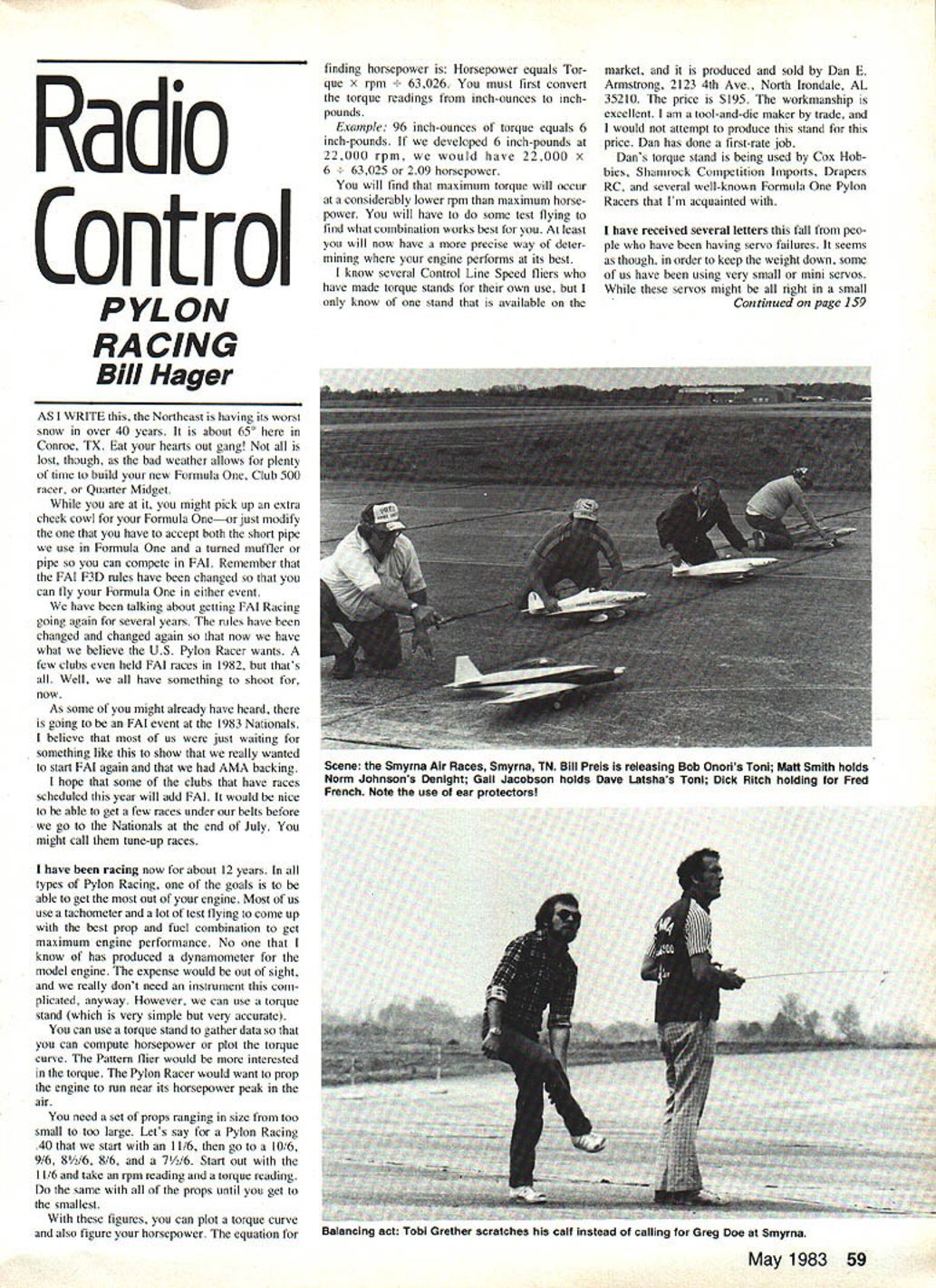
We have been talking about getting FAI Racing going again for several years. The rules have been changed and changed again so that now we have what we believe the U.S. Pylon Racer wants. A few clubs even held FAI races in 1982, but that’s all. Well, we all have something to shoot for now.
As some of you might already have heard, there is going to be an FAI event at the 1983 Nationals. I believe that most of us were just waiting for something like this to show that we really wanted to start FAI again and that we had the AMA backing.
I hope that some of the clubs that have races scheduled this year will add FAI. It would be nice to be able to get a few races under our belts before we go to the Nationals at the end of July. You might call them tune-up races.
Getting the most from your engine
I have been racing now for about 12 years. In all types of pylon racing, one of the goals is to get the most out of your engine. Most of us use a tachometer and a lot of test flying to come up with the best prop and fuel combination to get maximum engine performance. No one that I know of has produced a dynamometer for the model engine—the expense would be out of sight, and we really don't need an instrument this complicated, anyway. However, we can use a torque stand (which is very simple but very accurate).
You can use a torque stand to gather data so that you can compute horsepower or plot the torque curve. The pattern flier would be more interested in the torque. The pylon racer would want to prop the engine to run near its horsepower peak in the air.
You need a set of props ranging in size from too small to too large. For a pylon racing .40 we might start with these sizes:
- 11x6
- 10x6
- 9x6
- 8½x6
- 8x6
- 7½x6
Start with the largest (11x6), take an rpm reading and a torque reading, then repeat with each prop down to the smallest. With these figures you can plot a torque curve and also compute horsepower.
Horsepower calculation
The equation for finding horsepower is: Horsepower = (Torque × rpm) ÷ 63,026
Note: torque must be converted from inch-ounces to inch-pounds first.
Example:
- 96 inch-ounces of torque = 6 inch-pounds.
- If we developed 6 inch-pounds at 22,000 rpm: (22,000 × 6) ÷ 63,026 = 2.09 horsepower.
You will find that maximum torque occurs at a considerably lower rpm than maximum horsepower. You will have to do some test flying to find what combination works best for you. At least you will now have a more precise way of determining where your engine performs best.
Torque stand availability
I know several control-line speed fliers who have made torque stands for their own use, but I only know of one stand that is available on the market. It is produced and sold by Dan E. Armstrong, 2123 4th Ave. North, Irondale, AL 35210. The price is $195. The workmanship is excellent. I am a tool-and-die maker by trade, and I would not attempt to produce this stand for this price. Dan has done a first-rate job.
Dan’s torque stand is being used by Cox Hobbies, Shamrock Competition Imports, Drapers RC, and several well-known Formula One pylon racers that I’m acquainted with.
Servo failures and safety
I have received several letters this fall from people who have been having servo failures. It seems that, in order to keep the weight down, some of us have been using very small or mini servos. While these servos might be all right in a small sport plane or sailplane, they will not stand up to the vibrations and tremendous stresses exerted in a pylon racer. Come on, guys—let’s not sacrifice safety for an ounce of weight.
Rules changes — attention QM and F-1 fliers
Hey, guys, it’s rules-change time! Take special notice of the results of the RC Contest Board initial vote, which was reported in the March 1983 issue of Model Aviation on page 110 (in the "Competition Newsletter" section). There are seven rules-change proposals dealing with pylon which have passed the initial vote. Three of them do not, in my opinion, reflect the desires of the pylon racing fraternity in general (and I know they don’t reflect the thinking of the NMPRA—the special interest group for pylon racing).
Proposals of concern:
- RC-84-4 (authored by Horace Cain) — pertains to an alternate scoring system.
- RC-84-8 (authored by R. Wilson) — would require mufflers or tuned pipes in Quarter Midget.
- RC-84-29 (authored by R. Wilson) — would require mufflers or tuned pipes in Formula One.
You might keep your eye on the rules-change business in the "Competition Newsletter" to see if any cross-proposals have been submitted which would impact pylon. In any event, it won’t be too long (September 1, 1983, to be exact) until the RC Contest Board makes its final vote on these proposals, and if they pass, they’ll be the official rules starting in 1984.
Whether you’re for them or against them, I’d advise you to write to your AMA district RC Contest Board member (and your district vice-president, too!) and let him or her know your feelings on these pylon racing rules proposals. That way you can make your voice heard where it will do some good. Your district RC Contest Board member is supposed to vote in accordance with the desires of the modelers in his or her district and not how he or she may personally feel about a proposal.
The NMPRA will also make its opinions known to the RC Contest Board. I believe that rules affecting a specific class or type of competition—like pylon racing—should reflect the desires of the active competitors. I’m not fond of rules proposals coming from “outside.” (However, the AMA is a very democratic organization, so anyone is entitled to propose a rules change.)
Support racing — join NMPRA
If you want to support racing, you should join the NMPRA—do it today! Send your dues ($18/year) to: Gary McPike 28925 Parkheath Dr. Agoura, CA 91301
See you next month.
Bill Hager 706 Glen Haven Dr. Conroe, TX 77302
Transcribed from original scans by AI. Minor OCR errors may remain.

