
Pylon Racing
Dave Lane
LAST MONTH I stated that we would talk about "Quickie 500" racing. I would like to regress just a bit to 1/2A racing to mention that Dick Russ of Allied Models is bringing out a new 1/2A racer called "1/2A Streaker." I was able to look at one of the prototypes of this little speedster and was impressed with its appearance.
Dick mentioned that they had flown three prototypes before being satisfied with the performance. The plane is very clean with a semi-cowled engine and spinner, uses the Ace foam wing and all-balsa tail and fuselage. The 1/2A Streaker will sell for under $20.00 which is a very reasonable price considering the cost of balsa these days.
Now, Quickie 500's—this is another "one-class" type of pylon racing that is getting more popular each year. Here again is an airplane that the average modeler and pilot can build and fly without a great deal of time and money expended.
The Q-500 was developed by Glenn Spickler, Bakersfield, Calif., past president of the NMPRA two years running. Glen saw a need for a standard class of racing to get new people involved in Pylon. So, he came up with a .40 cu. in. front rotor powered airplane with 500 sq. in. of wing area, constant chord, constant thickness, box fuselage, no cowl; the engine must be out in the "breeze," and at least two wheels. After Glenn set the pace, several manufacturers have developed Q-500's that fit these rules. The average kit sells for $35.00 to $50.00 depending on how many goodies are included in the kit.
The Q-500 class uses the same basic course as Formula One and requires the same number of personnel to run a contest. This includes four (4) flagmen for pylon #1, one (1) chief pylon judge for #1, one (1) flagman for pylon #2 and one (1) for pylon #3. Four (4) lap counters, one (1) chief lap counter, one (1) starter and two to three people for registration and heat make-up. This adds up to 15 or 16 people. Obviously you have to convince the club members that racing is great in order to get help!
Let's look a little closer at the Q-500 airplane. The idea is to keep it simple. The wing is conventional in construction, using either symmetrical or semi-symmetrical airfoils and strip ailerons. Remember, constant chord and thickness must be 15% of the chord. The most popular designs now in use have the wing mounted on the bottom of the fuselage with the stab mounted flush on top of the fuselage. The fuselage is nothing more than two 1/8 or 3/16 balsa sheets with three or four bulkheads and a 1/8" sheet top and bottom. The firewall should be 1/4, three or five ply plywood epoxied in place. The fin, rudder, stab and elevators are made from 1/4 medium hard balsa. The landing gear is either mounted in the fuselage or wing. Dave Lane usually uses 5/32 wire with or without fairings. Fairings are faster but more trouble. Wheels have to be 2 1/4 in. diameter and there must be at least two of them externally mounted. No wheels mounted within the fuselage as in the "funny" FAI birds.
Most of the Q-500's are covered with Monokote-type covering materials to keep the weight down to the minimum of 3 1/2 lbs.
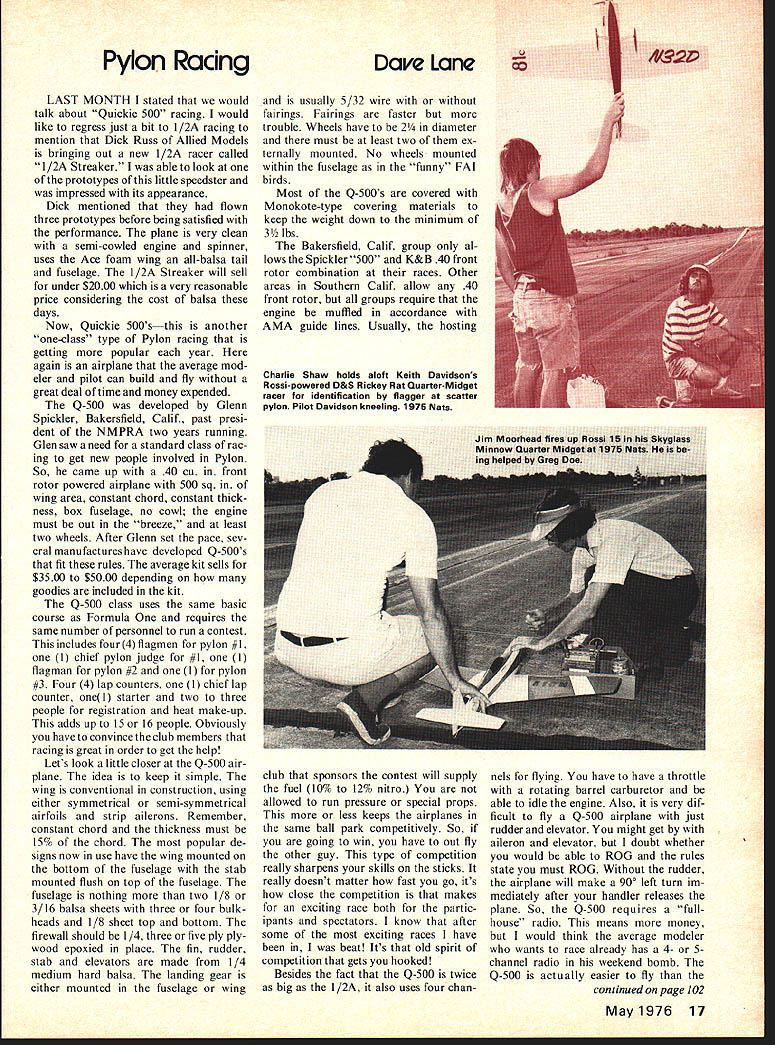
The Bakersfield, Calif. group only allows the Spickler "500" and K&B .40 front rotor combination at their races. Other areas in Southern Calif. allow any .40 front rotor, but all groups require that the engine be muffled in accordance with AMA guidelines. Usually, the hosting club that sponsors the contest will supply the fuel (10% to 12% nitro). You are not allowed to run pressure or special props. This more or less keeps the airplanes in the same ball park competitively. So, if you are going to win, you have to out fly the other guy. This type of competition really sharpens your skills on the sticks. It really doesn't matter how fast you go, it's how close the competition is that makes for an exciting race both for the participants and spectators. I know that after some of the most exciting races I have been in, I was beat! It's that old spirit of competition that gets you hooked!
Besides the fact that the Q-500 is twice as big as the 1/2A, it also uses four channels for flying. You have to have a throttle with a rotating barrel carburetor and be able to idle the engine. Also, it is very difficult to fly a Q-500 airplane with just rudder and elevator. You might get by with aileron and elevator, but I doubt whether you would be able to ROG and the rules state you must ROG. Without the rudder, the airplane will make a 90° left turn immediately after your handler releases the plane. So, the Q-500 requires a "full-house" radio. This means more money, but I would think the average modeler who wants to race already has a 4- or 5-channel radio in his weekend bomb. The Q-500 is actually easier to fly 1/2A ships especially if there is any wing area to contend with. The added weight, plus the increased area and additional controls, make it easier to stay out of, or get out of, trouble.
Let's talk a bit about that thing you hang on the front of the silly thing to make it go. Eighty percent of the Q-500 racing rules state that the engine must be absolutely "stock" out of the box. You must use the carburetor that comes with the engine and it must be an RC type. Some of the clubs go so far as to limit the engine to a specific manufacturer's engine, such as the K & B .40 front-rotor with a Perry carb.
After you purchase this hunk of aluminum, carefully disassemble it and inspect it thoroughly for any minute chips, etc., that might be inside. With today's method of mass production, the quality control inspectors have a hard time finding everything wrong with the engine. Clean up any burrs or nicks you find in the case or on the crank. Be sure the piston fits in accordance with the manufacturer's specifications. Check the rod alignment and fit. The rod should be straight and a minimum of slop on the wrist pin and crank pin. Reassemble the engine carefully. Use a light machine oil during this process to protect all moving parts. Never turn a dry engine — this will do more damage than a few turns. (Torq all head bolts and case bolts evenly.)
The same thing with the carburetor. It is important to check the carb body and the rotating barrel for foreign material. Adjust the carb per the instructions and fine tune after the engine is running.
The next major item is the propeller. In Q-500 you cannot modify the prop. So, when you purchase the prop, be very selective. Especially notice the hub. Be sure it is flat on both the front and rear surfaces, the hole is in the center and true to the hub surfaces.
To finish off the front end, most areas allow a spinner, but no cowls. If you don't use a spinner, an AMA prop nut must be used. Use a spinner if you can; they really do help! Now go to your hobby shop, buy a Q-500 and go race!
Now that we have pretty well covered the virtues of Q-500, I would like to mention a memo about a replacement for balsa! That's right — replacement for balsa. A company called Envoy Corp. in Phoenix, Ariz. is promoting a product called Enviro-wood. According to the memo, "cost should be half or less than half of current balsa prices! Product quality should be uniform and high with no flaws such as warps, knots, irregular density, checks, splits or worm holes. Characteristics other than just density can be specified and programmed for production. Sheets and blocks of medium density, then edge-cut and multicolored stained parts that will pull that 'crunched and stained balsa' look to shape."
I know, this sounds too good to be true. But if you want to try this product, or get additional info, write to Envoy Corp., P.O. Box 15917, Phoenix, Ariz. 85060.
Keep 'em flying, go fast and turn left! (My address is: 4477 136th, Hawthorne, Ca. 90250.)
Transcribed from original scans by AI. Minor OCR errors may remain.

