
Radio Control: Pylon Racing
Bill Hager
Racing season is here again, and by the looks of the mail I'm getting, there are going to be lots of new fliers on the pylon course this year.
I'm still getting plenty of mail about Club 500 racing. What are the rules? What about having Club 500 racing at the AMA Nats? And so on.
Club 500 and the Nats
Let's take the question about making Club 500 racing a part of the Nats.
Club 500 racing was started as a fun event that anyone could enter and have a chance to win. It is supposed to be a low-key, simple, easy event. In almost every case, this is how it started out, with people using a stock engine, a non-altered stock kit, a stock prop, and usually the host club supplied 15% nitro fuel.
For some people, the event would be a stepping-stone used to sharpen skills for possible activity in Formula I or Quarter Midget racing. For the great majority of you, this is all the pylon racing you want. So why make it difficult? Why change a good thing? Keep the event low-key and simple!
For those of you getting bored with the event, it's time for you to move on to something else like Formula I or Quarter Midget. I can almost guarantee that you will be a long time tiring of these events.
Don't try to change the simple event, as this defeats its purpose in the first place. It will only close the door to the person who wanted to get started in something low-key.
Letter from Jim Bocckinfuso (Long Island Flying Eagles)
I received a letter the other day from Jim Bocckinfuso. Jim's club is the Long Island Flying Eagles. This letter is a good example of what has happened in other parts of the country:
Dear Bill:
Thought you would like to hear from a small club on Long Island, so I am forwarding you a copy of this month's newsletter The Eagles Nest. I am the vice-president and co-editor of this newsletter, and our club is composed of 30 great guys who love to fly. We are mostly a fun-fly club, but we hold two pylon races each year, and these races are the most fun we have.
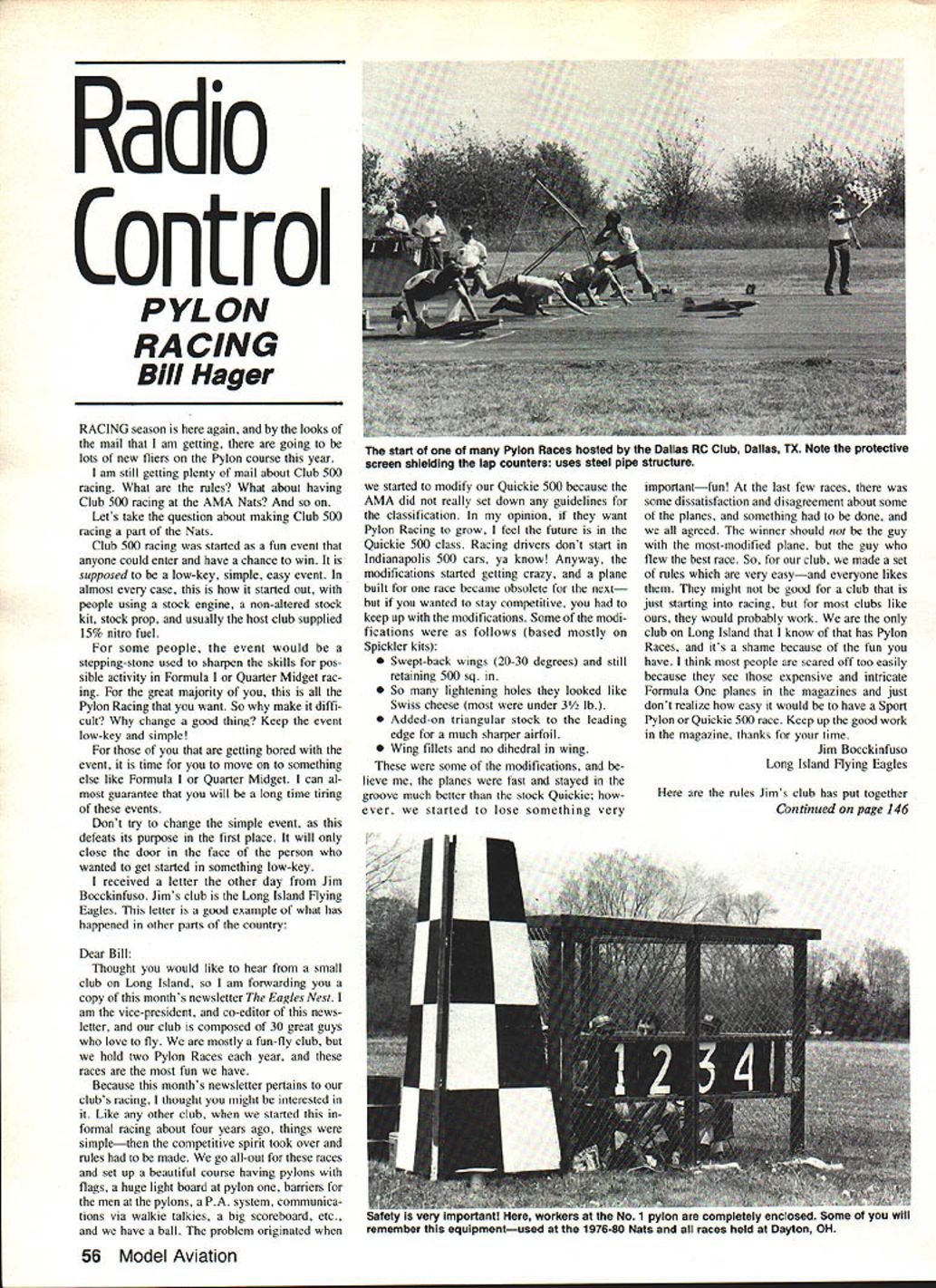
Because this month's newsletter pertains to our club's racing, I thought you might be interested in it. Like any other club, when we started this informal racing about four years ago, things were simple—the competitive spirit took over and rules had to be made. We go all-out for these races and set up a beautiful course having pylons with flags, a huge light board at pylon one, barriers for the men at the pylons, a P.A. system, communications via walkie-talkies, a big scoreboard, etc., and we have a ball.
The problem originated when we started to modify our Quickie 500 because the AMA did not really set down any guidelines for the classification. In my opinion, if they want pylon racing to grow, I feel the future is in the Quickie 500 class. Racing drivers don't start in Indianapolis 500 cars, ya know! Anyway, the modifications started getting crazy, and a plane built for one race became obsolete for the next—but if you wanted to stay competitive, you had to keep up with the modifications. Some of the modifications were as follows (based mostly on Spickler kits):
- Swept-back wings (20–30 degrees) while still retaining 500 sq. in.
- So many lightening holes they looked like Swiss cheese (most were under 3½ lb.)
- Added-on triangular stock to the leading edge for a much sharper airfoil
- Wing fillets and no dihedral in wing
These were some of the modifications, and believe me, the planes were fast and stayed in the groove much better than the stock Quickie; however, we started to lose something very important—fun! At the last few races, there was some dissatisfaction and disagreement about some of the planes, and something had to be done, and we all agreed. The winner should not be the guy with the most-modified plane, but the guy who flew the best race. So, for our club, we made a set of rules which are very easy—and everyone likes them. They might not be good for a club that is just starting into racing, but for most clubs like ours, they would probably work. We are the only club on Long Island that I know of that has pylon races, and it's a shame because of the fun you have. I think most people are scared off too easily because they see those expensive and intricate Formula One planes in the magazines and just don't realize how easy it would be to have a Sport Pylon or Quickie 500 race. Keep up the good work in the magazine, thanks for your time.
Jim Bocckinfuso Long Island Flying Eagles
Club rules for Quickie 500 (Long Island Flying Eagles)
The only fair way of running this event is to pit man against man, and not against the most-modified Quickie. With everything now being equal, the man who turns the tightest turns and runs the straightest course will win. These are the rules for Quickie 500:
- Any commercially kitted Quickie 500 with NO modifications of any kind, except to make an additional access hatch in the fuselage for the receiver. No modifications means: no lightening holes, no excessive sanding of wood, no addition of parts like sharp leading edges, no substitution of any parts, etc. The dihedral called for must be used. No substitute parts will be permitted. Please, guys, don't circumvent this, because you will only be building a plane for nothing. We want all the planes in this class to have exactly the same chance.
- No scratch-built planes will be allowed. This is to prevent anyone from using the lightest contest-grade wood and substitute leading edges, etc.
- Any commercially available engine is allowed, providing it has a side exhaust and front carburetor and intake. Engine must be stock and no modifications or rework will be allowed on it. Only stock propellers are allowed.
- Muffler: any expansion-type, unmodified or modified muffler will be allowed. No flow-throughs, no tuned pipes, no variations of the same.
These rules make everything even. Just build a stock Quickie 500, show up with an engine in it, trim it out and have as much chance to win as anyone else. This category of racing should be a fun event for those who enjoy racing for speed and not a war of modifications. There will still be some room for experimentation—such as trying different engines and prop combinations, or even trying different adhesives or manufacturers of Quickie 500s—but that's as far as it will go.
Once again, let's keep it simple. Think about it. You don't see the new people changing the rules around to make the event more competitive. Usually it is the seasoned flier changing the rules, possibly because he is bored. It is time for him to move on.
Once racing is in your blood, you are hooked. There is nothing more exciting. But you have to have a place to start.
Corrections and notes
In the March issue, I listed some of the kits available to the pylon racer. The information on the LR-1A was incorrect. This kit is by Ed Allen and Harley Condra, 5364 Via Alcazar, San Diego, CA 92111 (phone 619-571-3761 or 619-268-0830). Kit price is $85.
Send me your contest reports and a black & white 5 x 7 if you can, and I will try to get it in. See you next month.
Bill Hager 706 Glen Haven Conroe, TX 77302
Transcribed from original scans by AI. Minor OCR errors may remain.

