
Radio Control: Pylon Racing
Bill Hager
East Coast Championship Q500 Race (Oct 1–2)
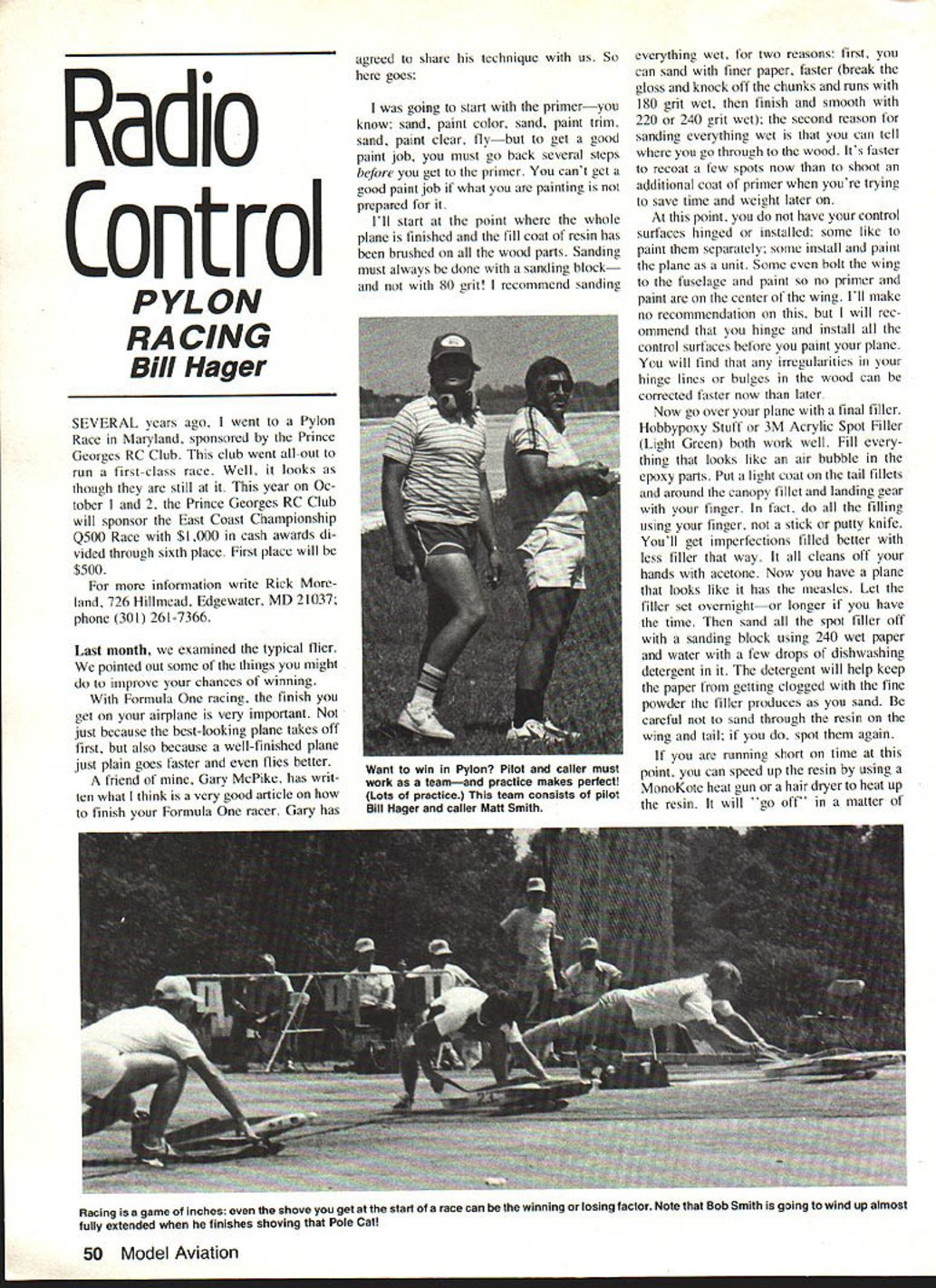
Several years ago I went to a pylon race in Maryland sponsored by the Prince George's RC Club. The club went all-out to run a first-class race, and they continue to do so. This year, October 1–2, the Prince George's RC Club will sponsor the East Coast Championship Q500 Race with $1,000 in cash awards divided through sixth place. First place will be $500.
For more information write Rick Moreland, 726 Hillmead, Edgewater, MD 21037; phone (301) 261-7366.
---
Finishing Your Formula One Racer (by Gary McPike)
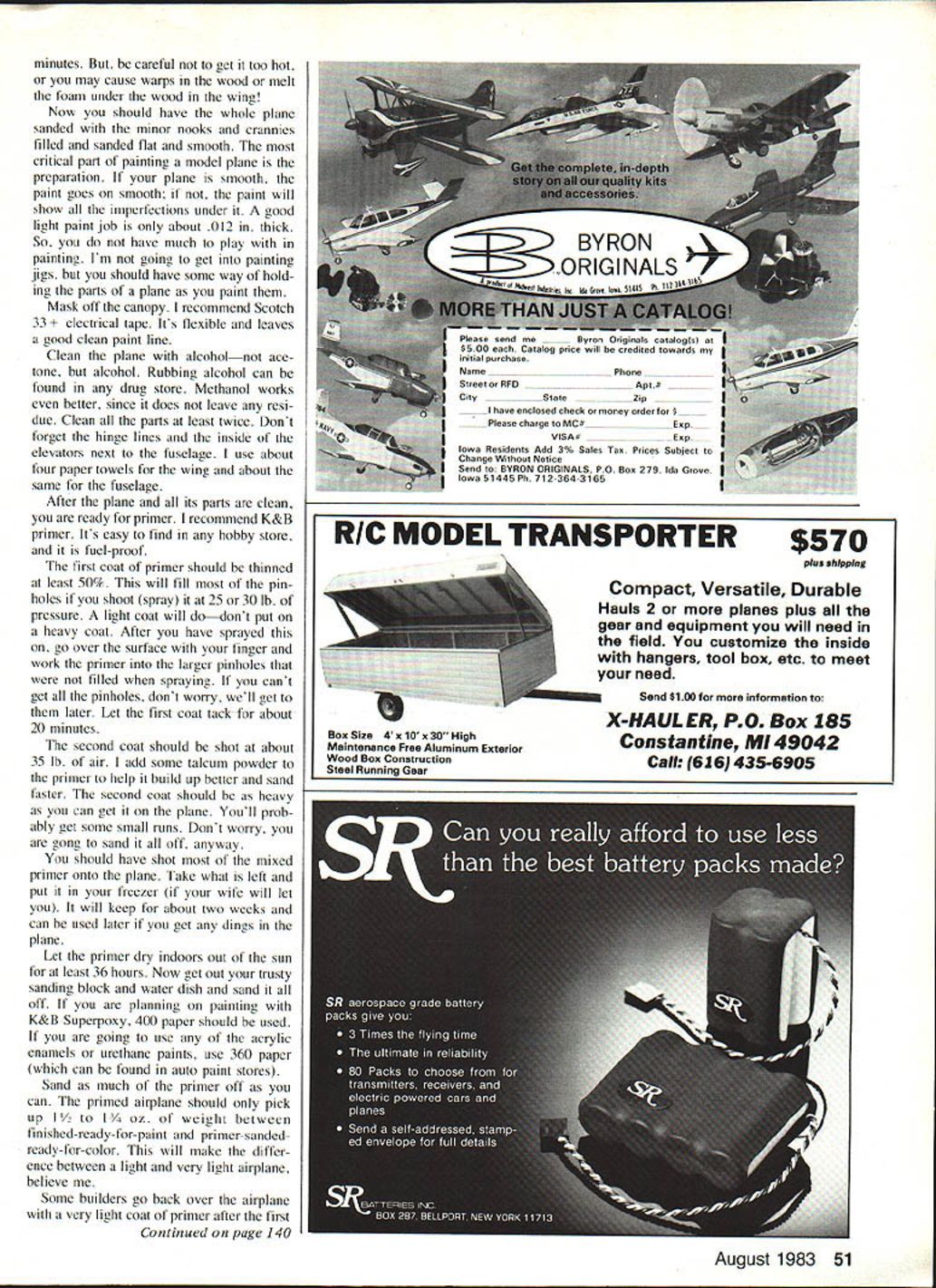
Last month we examined the typical flier and pointed out things that might improve your chances of winning. Finish on the airplane is very important — not just because the best-looking plane takes off first, but because a well-finished plane flies faster and better. Gary McPike has provided the following technique for finishing a Formula One racer.
#### General principle You can't get a good paint job without preparing the surface. Start where the whole plane is finished and a fill coat of resin has been brushed on all wood parts. A smooth plane makes smooth paint. The final paint is only about .012" thick, so you don't have much margin for hiding imperfections.
#### Sanding
- Always sand with a sanding block.
- Do not use coarse 80-grit for finishing.
- Sand everything wet for two reasons:
- You can use finer paper and remove gloss/chunks faster — break the gloss and knock off runs with 180-grit wet, then finish and smooth with 220–240-grit wet.
- Wet sanding shows where you’ve sanded through to the wood, so you can recoat small spots now rather than add weight later.
- Be careful not to sand through the resin on wing and tail surfaces.
#### Control surfaces
- Hinge and install all control surfaces before painting.
- Painting with hinges installed lets you correct hinge-line irregularities or bulges earlier when repairs are easier.
#### Spot filling
- Use a final filler such as Hobbypoxy Stuff or 3M Acrylic Spot Filler (Light Green).
- Fill any pinholes or air-bubble-looking spots in epoxy parts.
- Apply light coats with your finger (better coverage with less filler). Clean hands with acetone.
- Let filler set overnight (or longer if possible).
- Sand off spot filler with a sanding block using 240-grit wet paper and water with a few drops of dishwashing detergent (detergent helps prevent paper clogging).
- If you sand through resin, spot-recoat and repeat filling/sanding as necessary.
#### Speeding cure (if short on time)
- You can speed resin curing with a MonoKote heat gun or hair dryer. Heat will make resin "go off" in minutes.
- Be careful: excessive heat may warp parts or melt foam under wood sections.
#### Masking and cleaning
- Have painting jigs or a way to hold parts while painting.
- Mask the canopy with Scotch 33 electrical tape — flexible and leaves a clean paint line.
- Clean the plane with alcohol (not acetone). Rubbing alcohol is OK; methanol is better because it leaves no residue.
- Clean parts at least twice. Don't forget hinge lines inside the elevators and next to the fuselage.
- Use about four paper towels for the wing and about the same for the fuselage when cleaning.
#### Priming
- Recommended primer: K&B primer (fuel-proof and available at hobby stores).
- First coat: thin at least 50% to help fill pinholes. Spray a light coat at 25–30 lb air pressure. Work primer into larger pinholes with your finger after spraying. Let this coat tack about 20 minutes.
- Second coat: spray at about 35 lb air pressure. Add a little talcum powder to the primer to help it build up and sand faster. Apply as heavy a second coat as you can without worrying about small runs — you will sand it off.
- Store leftover mixed primer in the freezer (if practical) — it will keep about two weeks for touch-ups.
#### Drying and sanding primer
- Let primer dry indoors out of direct sun for at least 36 hours.
- Sand the primer off with the correct paper:
- If using K&B Superpoxy: 400-grit paper.
- If using acrylic enamels or urethane paints: 360-grit (available at auto paint stores).
- Sand as much primer off as possible. The primed airplane should only pick up about 1/2 to 1 oz. of weight between finished-ready-for-paint and primer-sanded-ready-for-color — this makes a noticeable difference in overall weight.
- Some builders apply a very light additional coat of primer after sanding the heavy coat to catch remaining pinholes; others skip this if their color paint contains filler. Either way, sand off as much primer as you can.
#### Final appearance and next steps
- After sanding, the airplane should look like a "meadow in early spring" — small patches of white primer and larger patches of resin/epoxy showing through.
- More on finishing your pylon racer next month.
---
Shreveport Race Report (April 9–10)
Reported by Dave Layman:
"This was the first race the Shreveport bunch had ever seen—much less run—and they did a fantastic job, with only a few outside people helping them, namely Ron Schark and Leland Morton at the timer's table and No. 1 pylon as instructors, and Bruce 'Pole Cat' Richmond as starter. Everything went without a hitch, with no protests and no mid-airs. The only casualties I can recall were Fred Freund losing an elevator servo and totaling his Tom Cat trying to mow the lawn, and Dub Jett trying to land on the power lines with his Tom. (Toms weren't made for walking tightropes!)
The race got off to a blazing start with George Parks turning a 1:17.5 to win his heat and Jerry Small winning his heat at 1:17.9. Newcomer Jim Young, flying his first F-1 race, did a fine job of flying — a bit high and wide, but 'safely.' A new 'old' face showed up and surprised everyone. John Jennings came out of hibernation after 2½ years, flying as well as ever and winning his first heat at 1:19.7. Dick Ritch was second at 1:20.6.
Overall, the race was smooth for the first race of the season. The Shreveport Club is to be commended for a job well done."
Race highlights / top times:
- George Parks — Denight / X-40 — 1:17.5
Other notable heat winners: Jerry Small — 1:17.9; John Jennings — 1:19.7; Dick Ritch — 1:20.6.
Transcribed from original scans by AI. Minor OCR errors may remain.

