
Radio Control: Pylon Racing
Bill Hager
CORRECTION. In the October 1983 issue, I wrote that the Roswell Air Force Races were held in Orlando, FL. They were held in Roswell, GA — not Orlando. Sorry about that, guys.
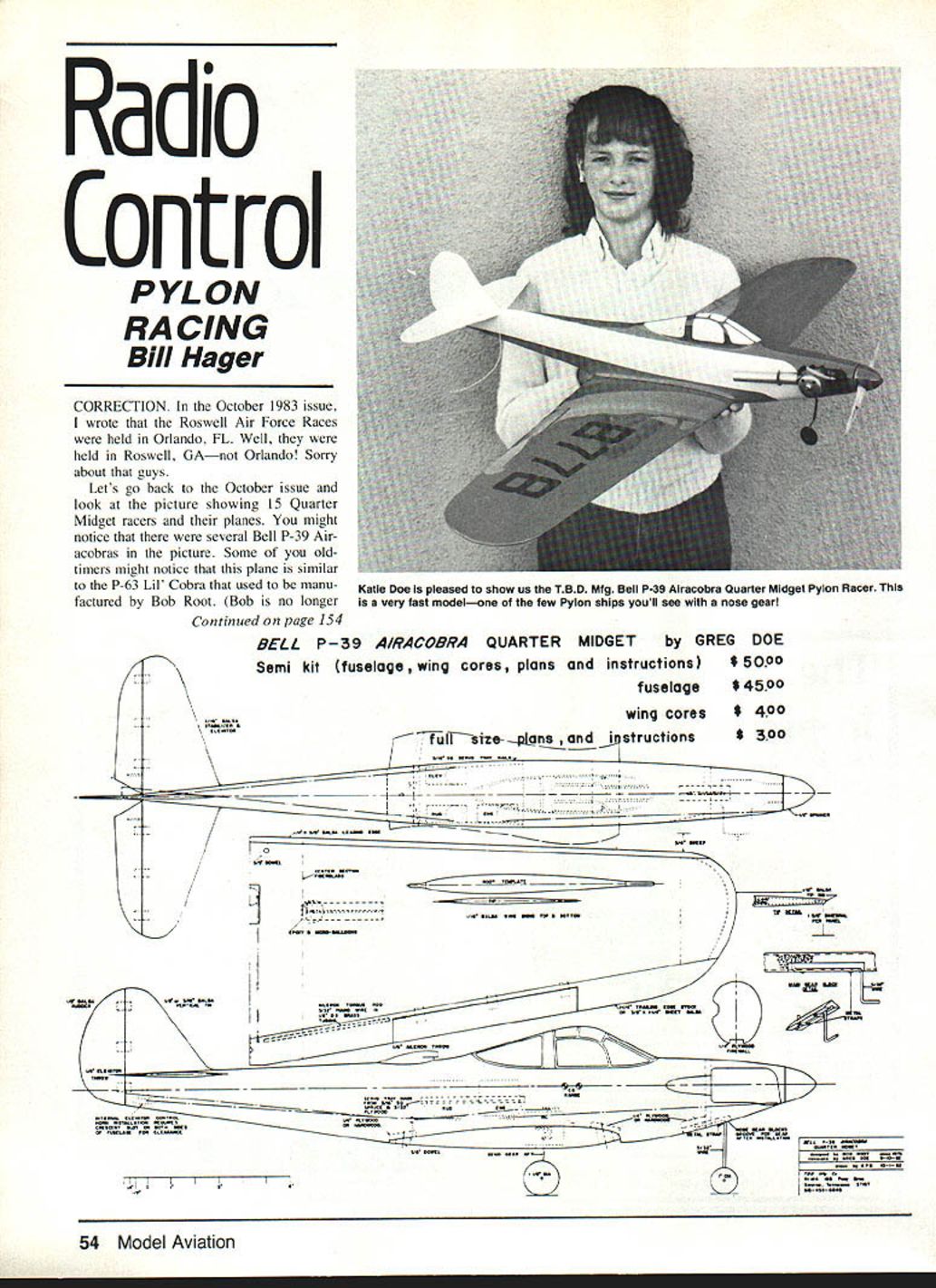
Let's go back to the October issue and look at the picture showing 15 Quarter Midget racers and their planes. You might notice that there were several Bell P-39 Airacobras in the picture. Some of you oldtimers might notice that this plane is similar to the P-63 Lil' Cobra that used to be manufactured by Bob Root (Bob is no longer manufacturing that plane). However, the Bell P-39 Airacobra is being produced, on a limited-production basis, by T.B.D. Manufacturing Company, Rt. No. 4, 166 Pony Drive, Smyrna, TN 37167 (phone 615-459-6845).
With the limited supply of pylon-racing engines and planes on the market, we are always glad to see someone else get into manufacturing a new product.
For you Formula One fliers, this year's NMPRA Championship Race is going to be held October 22–23 in San Luis Obispo, CA. For those new to Formula One — in order to qualify for the NMPRA Championship Race, you must first be an NMPRA member. In addition, you must meet one of the following:
- finish in the top 20% in your district,
- be an NMPRA officer,
- be a past Championship Race winner,
- or finish in the top 10 at the AMA Nationals.
The NMPRA Championship Race always proves to be the most competitive meet of the year, and most of the Formula One pilots put all of their efforts into qualifying.
Who said racing is dying?
As I read through the newsletters I receive from around the country, I find that almost every club has some kind of racing.
The Skylark RC Club had a race they called the Skylark 40. It was designed to allow anyone to compete with whatever airplane they wanted and still be competitive. The race is a 40-lap event. The course is not a standard pylon course, since only two pylons are set up. Rules and format:
- 40-lap event.
- Only two pylons are used.
- Time starts when the plane leaves the ground and stops when the 40th lap is finished.
- Time runs even when the plane lands to make a pit stop.
- Final standings are based on elapsed time.
I would like to know how this race turned out.
Here is a report on this year's Canadian Nationals sent to me by Ken Ainsworth:
"Pylon racing at the '83 Canadian Nationals turned out to be everything we had hoped it would be — good flying and keen competition. Pylon had the most entries in RC events, with nine FAI, 20 Sport, and 16 Formula One.
"FAI proved to be the event showing the most interest. Although there were only nine entries, the comments from the non-fliers in the pits were that it is almost as fast as Formula One — and the cost is a little more livable. I believe that if more local contests were held, then this event would balloon to double the size at our next Nationals.
"In Sport Pylon, the Scat Cat and Quickie 500 were evenly split as the most popular planes. In Formula One, the Polecat and the Toni were the most popular planes, with the Supertrig and OS the predominant engines.
"In the first two rounds of Formula One, the wind direction took its toll, with many planes nosing over on takeoff; consequently, we changed the course.
"Formula One ended with a flyoff for first and second between Pete Reed and Mike Helsel. Both had equal points and equal fast times; in the fourth round they had flown against each other, and Mike Helsel had won. In Round 6, they flew together and Pete Reed won.
"Upon arriving at the start line, both fliers requested a race-horse start, and it was obvious from the time they started engines that both fliers were going all out. Rounding pylon No. 1, both planes were up and tucked. Coming down between 1 and 2, the planes were stacked. Going into No. 2 pylon, the inevitable happened — a mid-air collision destroying one plane and killing the engine on the other. First place was then decided by the second-best time, with Pete Reed being awarded first place."
RESULTS
FAI:
- Randy Smith (Saskatchewan, Canada), Toni — OS VRP/Magic muffler, 1:34
- Pete Reed (Connecticut, U.S.A.), P-51 — Supertrig, 1:36
- Doug Moisk (Saskatchewan, Canada), Toni — Supertrig, 1:38
Sport:
- Ralph Perillo (NY, U.S.A.), Scat Cat — ST ABC, 1:49
- Gary Gau (NY, U.S.A.), Scat Cat — HP Gold Cup, 1:46
- Mike Helsel (Maine, U.S.A.), No Name — ST .40, 1:50
Formula One:
- Pete Reed (Connecticut, U.S.A.), Little Toni — Supertrig, 1:22
- Mike Helsel (Maine, U.S.A.), (plane not specified) — Supertrig, 1:22
- Murray Hamula (Alta., Canada), Toni — Supertrig X-40, 1:24
Event Director — Ken Ainsworth Contest Director — Rick Paine
We have come a long way since the early sixties. Pylon racing today is at its best. If you aren't racing and would like to be — what's stopping you? While it is very fast, it is also one of the safest-run events in modeling. Today's equipment is at its best. There is no reason why you can't start racing and in a short time become as competitive as the rest of us.
See you at the races.
Bill Hager 706 Glen Haven Dr. Conroe, TX 77302
Transcribed from original scans by AI. Minor OCR errors may remain.

