
Radio Control: Pylon Racing
Bill Hager
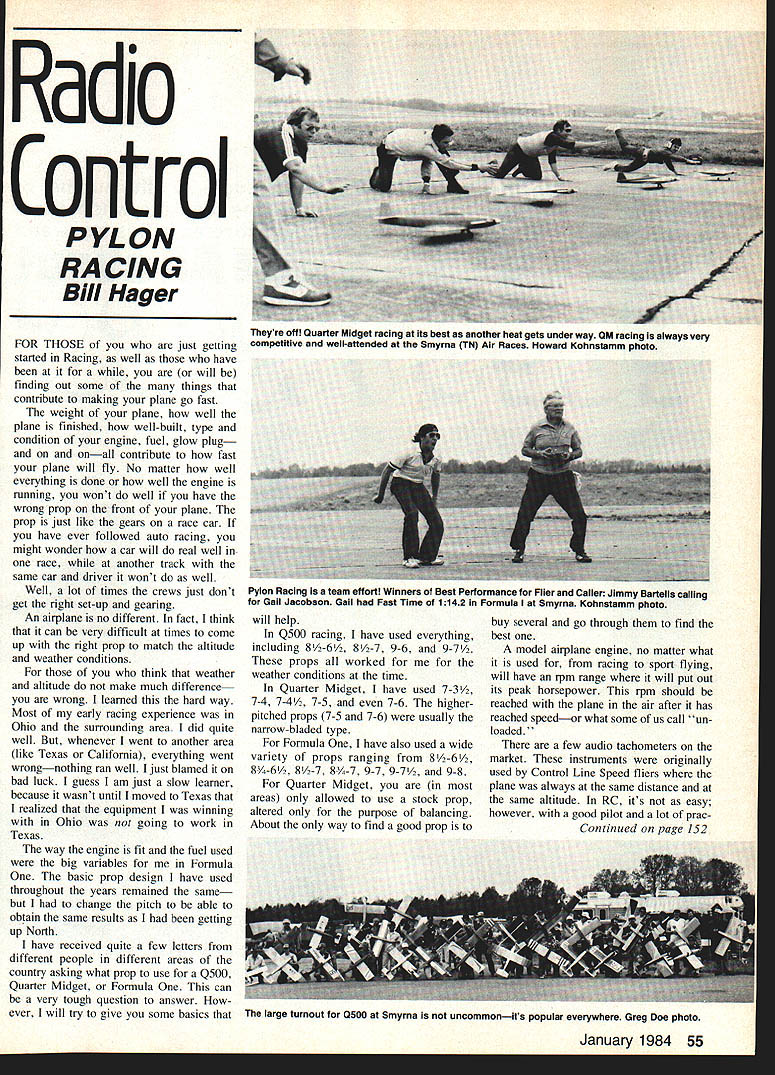
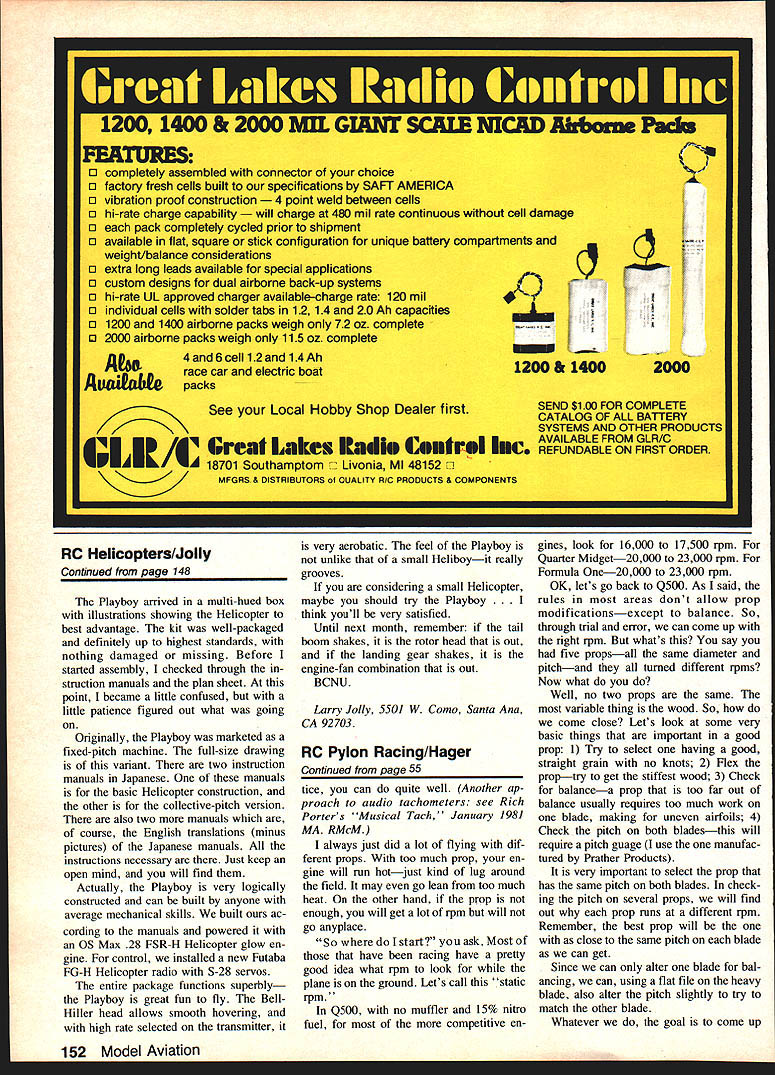
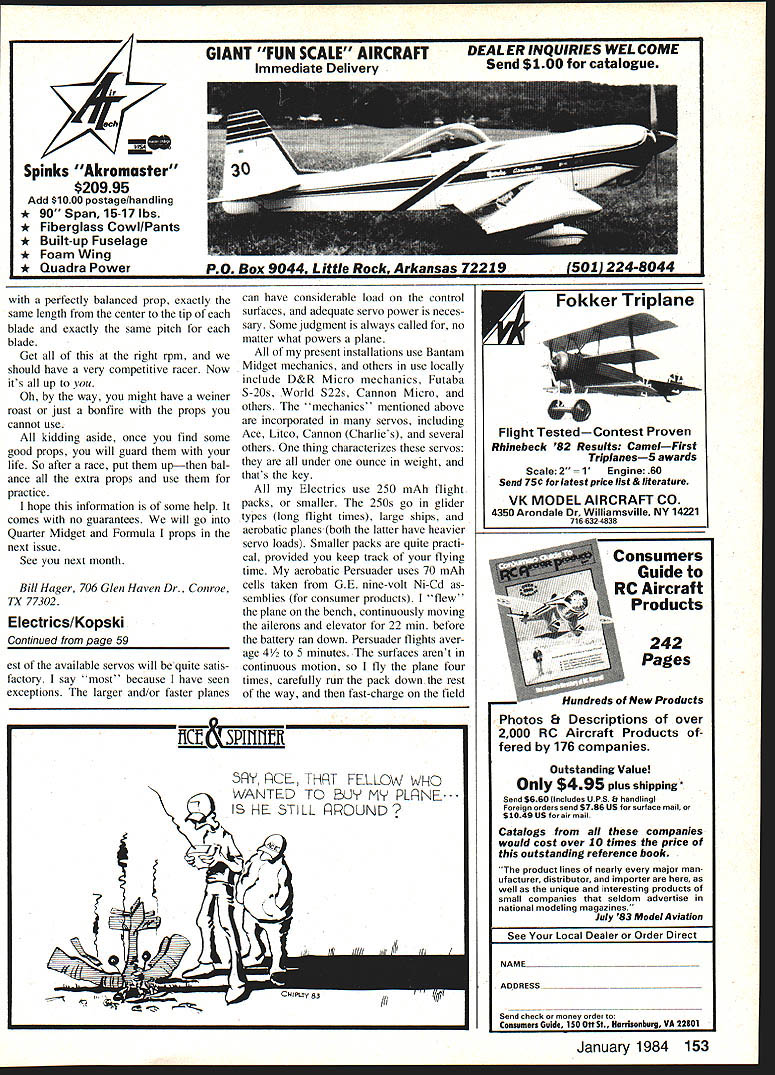
For those of you who are just getting started in racing, as well as those who have been at it for a while, you are (or will be) finding out some of the many things that contribute to making your plane go fast.
The weight of your plane, how well the plane is finished, how well-built, type and condition of your engine, fuel, glow plug—on and on—all contribute to how fast your plane will fly. No matter how well everything is done or how well the engine is running, you won't do well if you have the wrong prop on the front of your plane. The prop is just like the gears on a race car. If you have ever followed auto racing, you might wonder how a car will do real well in one race, while at another track with the same car and driver it won't do as well. A lot of times the crews just don't get the right set-up and gearing.
An airplane is no different. In fact, it can be very difficult at times to come up with the right prop to match the altitude and weather conditions. For those of you who think that weather and altitude do not make much difference—you are wrong. I learned this the hard way. Most of my early racing experience was in Ohio and the surrounding area. I did quite well. But whenever I went to another area (like Texas or California), everything went wrong—nothing ran well. I just blamed it on bad luck. I guess I am just a slow learner, because it wasn't until I moved to Texas that I realized that the equipment I was winning with in Ohio was not going to work in Texas.
The way the engine is fitted and the fuel used were the big variables for me in Formula One. The basic prop design I have used throughout the years remained the same—but I had to change the pitch to be able to obtain the same results as I had been getting up North.
I have received quite a few letters from different people in different areas of the country asking what prop to use for a Q500, Quarter Midget, or Formula One. This can be a very tough question to answer. However, I will try to give you some basics that will help.
Prop choices by class
- Q500: I have used 8.5-6.5, 8.5-7, 9-6, and 9-7.5. These props all worked for me depending on the weather conditions at the time.
- Quarter Midget: I have used 7-3.5, 7-4, 7-4.5, 7-5, and even 7-6. The higher-pitched props (7-5 and 7-6) were usually the narrow-bladed type.
- Formula One: I have used a wide variety ranging from 8.5-6.5, 8.5-7, 8.75-7, 9-7, 9-7.5, and 9-8.
For Quarter Midget, you are (in most areas) only allowed to use a stock prop, altered only for the purpose of balancing. About the only way to find a good prop is to buy several and go through them to find the best one.
Static RPM
A model airplane engine, no matter what it is used for, from racing to sport flying, will have an rpm range where it will put out its peak horsepower. This rpm should be reached with the plane in the air after it has reached speed—or what some of us call "unloaded."
There are a few audio tachometers on the market. These instruments were originally used by control-line speed fliers where the plane was always at the same distance and at the same altitude. In RC it's not as easy; however, with a good pilot and a lot of practice you can do quite well. (For another approach to audio tachometers, see Rich Porter's "Musical Tach," January 1981.)
Most of those who have been racing have a pretty good idea what rpm to look for while the plane is on the ground. Let's call this "static rpm."
- Q500 (no muffler, 15% nitro): 16,000–17,500 rpm (for most competitive engines).
- Quarter Midget: 20,000–23,000 rpm.
- Formula One: 20,000–23,000 rpm.
Selecting and preparing props
As I said, rules in most areas don't allow prop modifications except for balancing. So, through trial and error, we can come up with the right prop. But what if you buy five props—all the same diameter and pitch—and they all turn different rpms? Not all props are the same. The most variable thing is the wood. How do we come closer? Look at some basic things that are important in a good prop:
- Try to select one having a good, straight grain with no knots.
- Flex the prop—try to get the stiffer wood.
- Check for balance—a prop that is too far out of balance usually requires too much work on one blade, making for uneven airfoils.
- Check the pitch on both blades—this will require a pitch gauge (I use the one manufactured by Prather Products).
It is very important to select a prop that has the same pitch on both blades. In checking the pitch on several props, we will find not only that each prop runs at a different rpm, but the props also will have different pitch. Remember, the best prop will be within one or two degrees of the same pitch on each blade.
Since we can only alter one blade for balancing, we can, using a flat file on the heavy blade, also alter the pitch slightly to try to match the other blade. Whatever we do, the goal is to come up with a perfectly balanced prop, exactly the same length from the center to the tip of each blade and exactly the same pitch for each blade.
Get all of this at the right rpm, and you should have a very competitive racer.
Tips on handling and practice
With too much prop, your engine will run hot—just kind of lug around the field. It may even go lean from too much heat. On the other hand, if the prop is not enough, you will get a lot of rpm but will not go anyplace.
Oh, by the way, you might have a wiener roast or just a bonfire with the props you cannot use. All kidding aside, once you find some good props, you will guard them with your life. After a race, put them up—then balance all the extra props and use them for practice.
I hope this information is of some help. It comes with no guarantees. We will go into Quarter Midget and Formula One props in the next issue. See you next month.
Bill Hager 706 Glen Haven Dr. Conroe, TX 77302
Transcribed from original scans by AI. Minor OCR errors may remain.

