
Radio Control: Pylon Racing
Bill Hager
It's winter. As I write this, the National Weather Report tells of heavy snows and very cold weather all over the North. For those of you who still wonder why I moved to Texas from Ohio, it was 76° here today. Eat your hearts out, gang!
Let's look at the good side of it. You spend more time at home, and you have plenty of time to rebuild your fleet of racers for next season.
Some things to remember when putting your planes up for the winter—I find it wise to pull the radio gear out of the plane and go over it thoroughly. If it is in need of factory service, do it now. Don't wait until spring, when everyone else sends their gear in. Also, the technicians won't be as rushed and can do a better job.
If your radio checks out OK, put it away. Don't forget to charge your batteries at least once a month. If you don't, and your batteries get too low, a cell might get reversed. This will ruin your battery pack and sometimes, if not caught, will cause much grief in lost planes next spring.
Pull the engine and fuel tank out. If your firewall has soaked up some fuel, now is the time to dry it out. There are products on the market that are good for this. I use a spot remover called CDR2. Go over the plane thoroughly—you might be surprised at what you find. I put oil in the engine and store it in a dry area. Don't store in an airtight container or a plastic bag. If you have kept the original box, just wrap the engine in a paper towel and put it in the box. Come next spring, you will be ready to go. Now you can start your winter projects.
Earlier in the year, I put in a plug for the Q500 race that the Prince George's Radio Control Club (Bowie, MD) was going to put on. Here is a report sent to me by Rick Moreland.
PGRC Q500 East Coast Championship Race — Report (Rick Moreland)
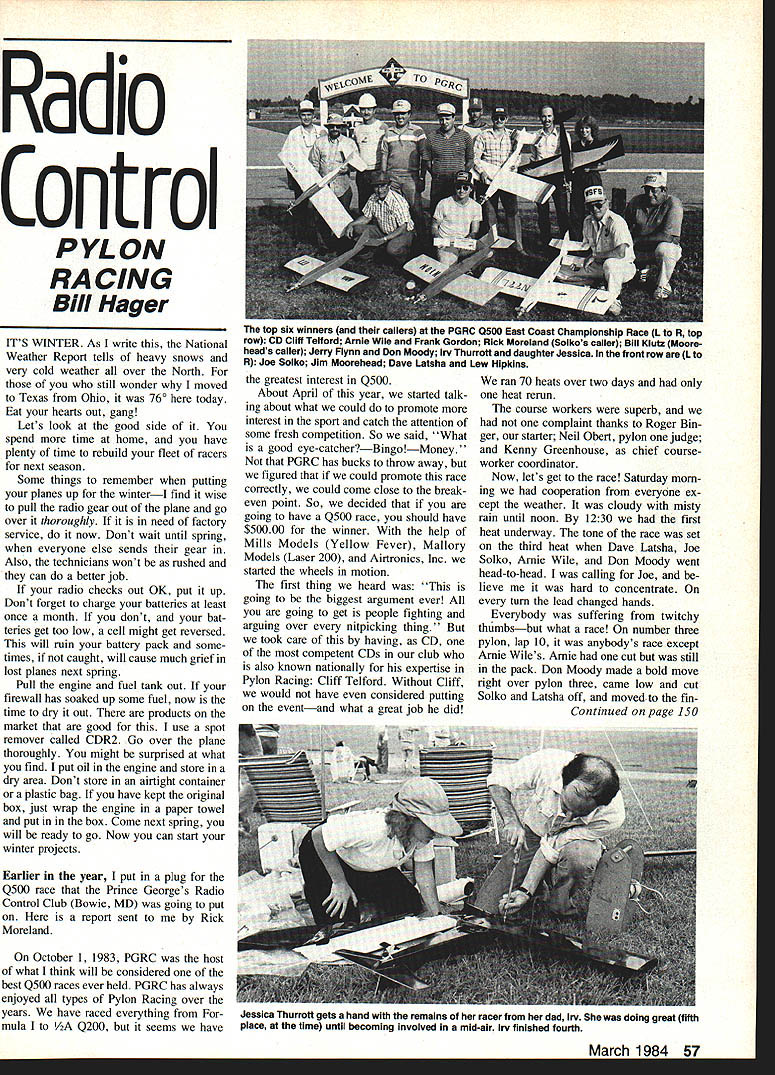
On October 1, 1983, PGRC hosted what I think will be considered one of the best Q500 races ever held. PGRC has always enjoyed all types of pylon racing over the years. We have raced everything from Formula 1 to 1/2A Q200, but it seems we have the greatest interest in Q500.
About April of this year, we started talking about what we could do to promote more interest in the sport and catch the attention of some fresh competition. So we said, "What is a good eye-catcher? — Bingo! — Money." PGRC has bucks to throw away, but we figured that if we could promote the race correctly, we could come close to the break-even point. So we decided that if you are going to have a Q500 race, you should have $500.00 for the winner. With the help of Mills Models (Yellow Fever), Mallory Models (Laser 200), and Airtronics, Inc., we started the wheels in motion.
The first thing we heard was: "This is going to be the biggest argument ever! All you are going to get is people fighting and arguing over every nitpicking thing." But we took care of this by having, as CD (Contest Director), one of the most competent CDs in our club who is also known nationally for his expertise in pylon racing: Cliff Telford. Without Cliff, we would not have even considered putting on the event—and what a great job he did!
We ran 70 heats over two days and had only one heat rerun.
The course workers were superb, and we had not one complaint thanks to Roger Binger, our starter; Neil Obert, pylon one judge; and Kenny Greenhouse, chief course-worker coordinator.
Now, let's get to the race. Saturday morning we had cooperation from everyone except the weather. It looked cloudy with misty rain until noon. By 12:30 the first heat was underway. The tone of the race was set on the third heat when Dave Latsha, Joe Solko, Arnie Wile, and Don Moody went head-to-head. I was calling for Joe, and believe me, it was hard to concentrate. The lead changed hands constantly. Everybody was suffering from twitchy thumbs—but what a race!
On number three pylon, lap 10, it was anybody's race except Arnie Wile's. Arnie had one cut but was still in the pack. Don Moody made a bold move right over pylon three, came low and cut Solko and Latsha off, and moved to the finish.
A nose ahead for the win.
What a spectacular race—couldn't believe it! You won't believe the times—remember that we are flying a 3 1/2-lb. airplane with 50-in. wingspan over the Quarter Midget course, using K&B .40/.60 engines. Don Moody's time was 125.7, Dave Latsha had 126.6, Joe Solko had 129.4, and Arnie Wile, flying 11 laps, was 143.0.
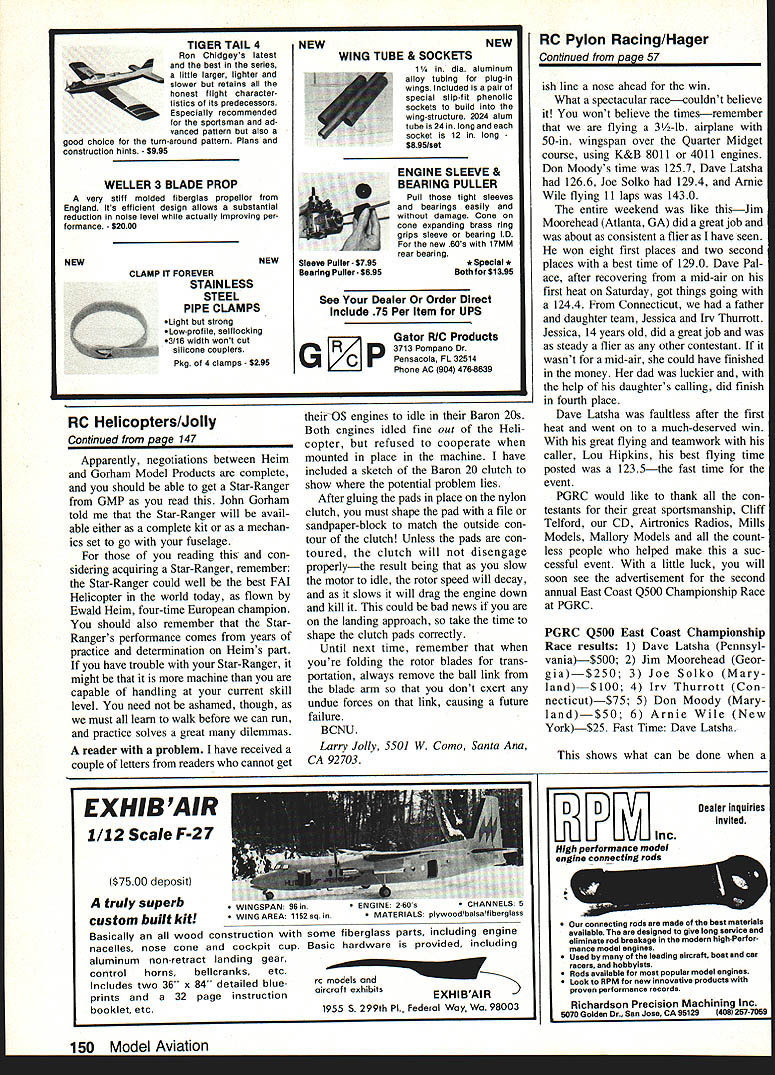
The entire weekend was like this—Jim Moorehead (Atlanta, GA) did a great job and was about as consistent a flier as I have seen. He won eight first places and two second places with a best time of 129.0. Dave Palace, after recovering from a mid-air on his first heat on Saturday, got things going with a 124.4. From Connecticut, we had a father-and-daughter team, Jessica and Irv Thurrott. Jessica, 14 years old, did a great job and was as steady a flier as any other contestant. If it wasn't for a mid-air, she could have finished in the money. Her dad was luckier and, with the help of his daughter's calling, did finish in fourth place.
Dave Latsha was faultless after the first heat and went on to a much-deserved win. With his great flying and teamwork with his caller, Lou Hipkins, his best flying time posted was a 123.5—the fast time for the weekend.
PGRC would like to thank all the contestants for their great sportsmanship, Cliff Telford, our CD, Airtronics Radios, Mills Models, Mallory Models, and all the country clubs who helped make this a successful event. With a little luck, you will soon see the advertisement for the second annual East Coast Q500 Championship Race at PGRC.
PGRC Q500 East Coast Championship — Official Results
- Dave Latsha (Pennsylvania) — $500
- Jim Moorehead (Georgia) — $250
- Joe Solko (Maryland) — $100
- Irv Thurrott (Connecticut) — $75
- Don Moody (Maryland) — $50
- Arnie Wile (New York) — $25
Fast Time: Dave Latsha
This shows what can be done when a group puts out a little effort. See you next month.
Bill Hager 706 Glen Haven Dr. Conroe, TX 77302
Transcribed from original scans by AI. Minor OCR errors may remain.

