
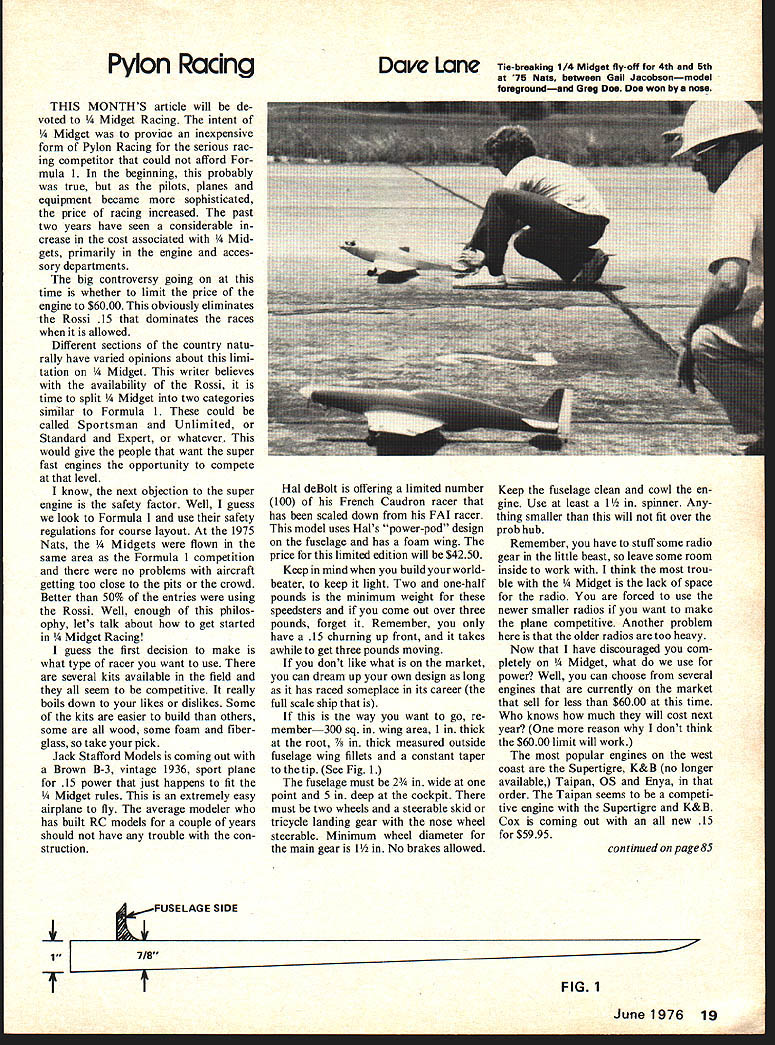
Pylon Racing
Dave Lane
THIS MONTH'S article will be devoted to 1/4 Midget Racing. The intent of 1/4 Midget was to provide an inexpensive form of Pylon Racing for the serious racing competitor that could not afford Formula 1. In the beginning, this probably was true, but as the pilots, planes and equipment became more sophisticated, the price of racing increased. The past two years have seen a considerable increase in the cost associated with 1/4 Midgets, primarily in the engine and accessory departments.
The big controversy going on at this time is whether to limit the price of the engine to $60.00. This obviously eliminates the Rossi .15 that dominates the races when it is allowed.
Different sections of the country naturally have varied opinions about this limitation on 1/4 Midget. This writer believes with the availability of the Rossi, it is time to split 1/4 Midget into two categories similar to Formula 1. These could be called Sportsman and Unlimited, or Standard and Expert, or whatever. This would give the people that want the super fast engines the opportunity to compete at that level.
I know, the next objection to the super engine is the safety factor. Well, I guess we look to Formula 1 and use their safety regulations for course layout. At the 1975 Nats, the 1/4 Midgets were flown in the same area as the Formula 1 competition and there were no problems with aircraft getting too close to the pits or the crowd. Better than 50% of the entries were using the Rossi. Well, enough of this philosophy, let's talk about how to get started in 1/4 Midget Racing.
I guess the first decision to make is what type of racer you want to use. There are several kits available in the field and they all seem to be competitive. It really boils down to your likes or dislikes. Some of the kits are easier to build than others, some are all wood, some foam and fiberglass, so take your pick.
Jack Stafford Models is coming out with a Brown B-3, vintage 1936, sport plane for .15 power that just happens to fit the 1/4 Midget rules. This is an extremely easy airplane to fly. The average modeler who has built RC models for a couple of years should not have any trouble with the construction.
Hal deBolt is offering a limited number (100) of his French Caudron racer that has been scaled down from his FAI racer. This model uses Hal's "power-pod" design on the fuselage and has a foam wing. The price for this limited edition will be $42.50.
Keep in mind when you build your world-beater, to keep it light. Two and one-half pounds is the minimum weight for these speedsters and if you come out over three pounds, forget it. Remember, you only have a .15 churning up front, and it takes awhile to get three pounds moving.
If you don't like what is on the market, you can dream up your own design as long as it has raced someplace in its career (the full scale ship that is).
If this is the way you want to go, remember — 300 sq. in. wing area, 1 in. thick at the root, 7/8 in. thick measured outside the fuselage wing fillets and a constant taper to the tip. (See Fig. 1.)
The fuselage must be 2 3/4 in. wide at one point and 5 in. deep at the cockpit. There must be two wheels and a steerable skid or tricycle landing gear with the nose wheel steerable. Minimum wheel diameter for the main gear is 1 1/2 in. No brakes allowed.
Keep the fuselage clean and cowl the engine. Use at least a 1 1/2 in. spinner. Anything smaller than this will not fit over the prop hub.
Remember, you have to stuff some radio gear in the little beast, so leave some room inside to work with. I think the most trouble with the 1/4 Midget is the lack of space for the radio. You are forced to use the newer smaller radios if you want to make the plane competitive. Another problem here is that the older radios are too heavy.
Now that I have discouraged you completely on 1/4 Midget, what do we use for power? Well, you can choose from several engines that are currently on the market that sell for less than $60.00 at this time. Who knows how much they will cost next year? (One more reason why I don't think the $60.00 limit will work.)
The most popular engines on the west coast are the Supertigre, Taipan, OS and Enya, in that order. The Taipan seems to be a competitive engine with the Supertigre. Cox is coming out with an all new .15 for $59.95. The rules state that the engine must be stock, use a muffler and the carburetor must be designed for the specific engine. This only leaves the glow plug to play with (legally). After you install the engine, take care in setting the idle. The plane must stand at rest while idling without the help of you or your caller. Usually this means the idle must be at or below 4,000 r.p.m. The other stickler here is that the engine must be running until the plane lands. (When the wheels touch the runway and the plane quits flying.) You cannot get away with a high-speed touch and bounce and then land in the next county and get points for landing with the engine running. If you land dead stick, you lose 1/2 point for that heat.
Some of the CD's will state to the contestant that there will be an idle check before, during or after the race, so be prepared.
The advantage of the idle rule keeps the guys reasonably honest as far as the engine is concerned. Unfortunately, the Rossi goes like hell and idles too.
Another rule that makes for conversation is the fact the propeller must be stock. You can only sand one blade on the back side for balance. The manufacturer's trademark or size must be readable on the front of each blade. Sneaky, huh? The Top Flite 7-5N racing prop works well with the K&B's and Supertigre's. The Rossi likes the 7-5 Rev-up racing prop. Some guys also have good luck with the 7-6 and 7-5 (wide blade) Top Flite props. The only thing to do here is experiment until you find the one that works best.
Mufflers are the other bug-a-boo that you have to master. I have had good luck with the Du-Bro muffler that uses a series of plates spaced with washers. The secret here is to use all of the plates. These mufflers have about the least amount of drag and are light. If you use a rear exhaust port engine, good luck! The only other alternative is to race only where mufflers are not required.
There has been much criticism between the NMPRA and the 1/4 Midget fraternity over the past year or so. Now that George Zink has been brave enough to step forward and take on the job of representing the 1/4 Midget group with the NMPRA, we should see some improvement in the relations. I hope that all of you out there in the 1/4 Midget land will support George Zink and, if you have any problems or suggestions, be sure to contact him and let him know your views. This is the only way we can further this great sport of Pylon Racing.
I received the following set of proposed 1/4 Pylon rules from Bob Aberle, Hauppauge, NY, who has been in touch with the P.R.O.P.S. (Pylon Racers of Puget Sound). Bob is supporting these rules as a uniform standard for the country.
1/4 Pylon Racing Rules
- General: All AMA and FAI regulations covering the flier, his aircraft, and equipment shall be applicable to this event. Simultaneous hand launch shall be made by all participants in a race. All contestants in a particular race will be given 2 minutes to start their engines. Anyone not started after the 2-min. time period is automatically disqualified for that race. No pylon collars shall be used. No racing shall be done individually against a clock. No ROG's will be required. The two-up circle rule is left to the discretion of the host club or contest director.
- Engine Specifications: The maximum engine displacement shall be .05 cu. in. The engine shall be a production engine produced in quantities greater than 5,000 and available through normal retail outlets in the United States.
- Weight: Weight less fuel but including all equipment necessary for flight shall be not less than 20 oz. but not greater than 32 oz.
- Fuselage: No fuselage cross sectional area minimum will be stipulated. The previous 8.5 sq. in. minimum cross sectional area is now deleted. This will allow greater prospect for originality in design. Average size of a small R/C system basically dictates a reasonable fuselage cross section without the need for further limitations. Wheels are not required. (Hand launching greatly simplifies the running of races. No longer need a smooth take-off surface. Also the 1/4's were easily upset on landings simply because of the existence of a landing gear.)
- Wing: Minimum area 200 sq. in., including the area displaced by the fuselage. The minimum thickness...
of airfoil at the root chord will be 7/8 in. The ratio of thickness to chord at the root must be maintained at the tip section as well. (This is a slight variation from the PROPS rule. It will allow a taper-wing planform to have a proportionately thinner airfoil section at the tips. Calling for a fixed 3/16 in. thick airfoil section minimum, right to the tips, will only produce an awkward wing section which might tend to keep the constant-chord wing as the only sensible planform. This would minimize the choice of wing designs which essentially eliminates any hope of originality.) The wing may have any planform. For example — constant chord, tapered, leading edge, tapered trailing edge, swept back (but no delta wings or flying wings will be permitted). Fidelity to scale racing planes is not required. Neither are retractable landing gear required.
- Engine Cut-Off: Provision must be made for some type of positive engine cut-off. This can be simply a wire to squeeze off the fuel line or the full-cover control or possibly a Tatone Fuel Shut-Off valve attached to a control surface etc. Rigid fuel pick-up tubes (inside of tanks) which require the plane to be held inverted, while the fuel is exhausted, are expressly forbidden. This is necessary for safe flying in a popular spectator sport such as this. Not being able to kill your engine immediately can be a real hazard.
- Race Course: Use a three pylon course as shown in the following:
THREE PYLON RACE COURSE
Bob Aberle continues "I think that about covers it. I might add that my comments are strictly my own and are not representative of my club. Unfortunately, our local Long Island 1/4 A Pylon Racing has been practically non-existent. This lack of enthusiasm is primarily due to the lack of a single, uniform set of racing rules here in the U.S. All other problems are directly related. Up to now kit manufacturers have held off on the production of 1/4 A pylon racers because of the potential losses that might be incurred if the final rules end up significantly different from the present racing designs. It is one thing to publish a design in a magazine, but just think of the cost involved to tool up for a production run of new kits. Once these rules are finalized and put to bed, it is entirely possible that big kit manufacturers (ARF's and semi-ARF's) will get into the act, offering cheap, yet practical 1/4 A pylon racers. This would be just the start! You never know, we may still see the day again that a new .049 engine will hit the market with a name other than Cox on it. Keep plugging and let's put it all together in '76. (My address is 4477 136th, Hawthorne, CA 90250.)"
Transcribed from original scans by AI. Minor OCR errors may remain.

