
Radio Control: Pylon Racing
Bill Hager
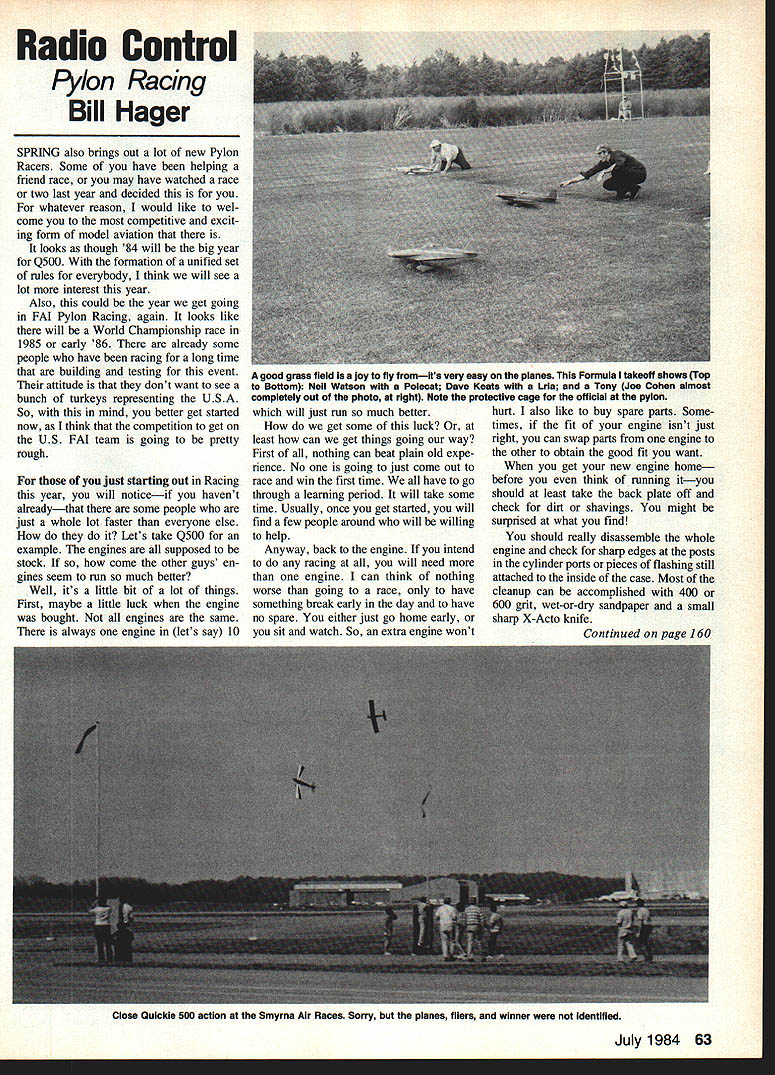
Spring also brings out a lot of new pylon racers. Some of you have been helping a friend race, or you may have watched a race or two last year and decided this is for you. For whatever reason, welcome to the most competitive and exciting form of model aviation there is.
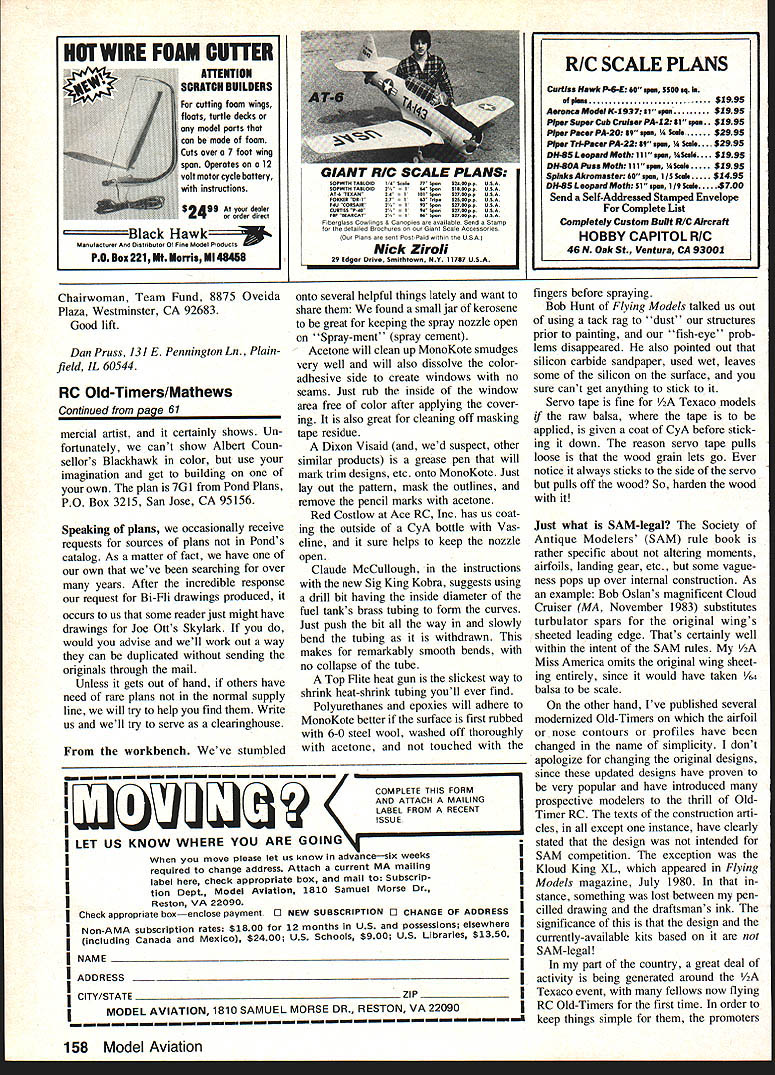
It looks as though 1984 will be a big year for Q500. With the formation of a unified set of rules for everybody, I think we will see a lot more interest. Also, this could be the year we get going again in FAI Pylon Racing. It looks like there may be a World Championship race in 1985 or early 1986. Several veteran racers are already building and testing for this event; their attitude is they don't want a weak team representing the U.S.A. If you aspire to make a U.S. FAI team, you'd better get started now—the competition will be rough.
Getting started and the learning curve
If you're just starting out in racing, you will notice—if you haven't already—that some people are a whole lot faster than everyone else. How do they do it? Take Q500 as an example: the engines are supposed to be stock, yet some engines seem to run much better. The difference is a little bit of many things: maybe a lucky purchase (not all engines are the same; roughly one in ten may run noticeably better), experience, careful setup, and preparation.
Nothing beats plain old experience. No one is going to come to a race and win the first time. There is a learning period, and it takes time. When you get started you'll usually find a few people willing to help.
Engines
Spares and parts
If you intend to do any racing at all, you will need more than one engine. I can think of nothing worse than going to a race, breaking something early in the day, and having no spare—you either go home early or sit and watch. An extra engine won't hurt. I also recommend buying spare parts: sometimes the fit of parts between two engines lets you swap components to obtain a better fit.
Inspecting and cleaning a new engine
When you bring a new engine home—before you even think of running it—inspect it carefully. At minimum, take the backplate off and check for dirt or metal shavings. You might be surprised at what you find.
You should really disassemble the whole engine and check for:
- Sharp edges at the posts or in the cylinder ports.
- Pieces of flashing still attached to the inside of the case.
Most of the cleanup can be accomplished with 400- or 600-grit wet-or-dry sandpaper and a small, sharp X-Acto knife.
When you are sure everything is cleaned up:
- If you have an ultrasonic cleaner, use it to finish cleaning all parts.
- If you don't have one, flush all the parts completely with paint thinner or alcohol. You'll be surprised at the junk that comes out of a new engine.
- Spray all the clean parts lightly with oil (for example, WD-40) and you are ready to reassemble.
When reassembling, be careful not to overtighten the screws. Many good racing engines have been ruined by over-tightening. If you are not mechanically inclined and don't have someone to help, at least remove the backplate, make sure the engine is clean, and check that all screws are snug (but not too tight).
Now the engine is ready to be broken in and test-run. More on engine break-in next month.
Control rules
Elevator-control tabs
A number of contests are allowing the use of "tabs" for elevator control. I have no quarrel with this and feel it is a wise move, since elevators can be difficult to develop on some designs. However, it should be clearly understood that such a change is for local use only and is totally illegal for national-level competition. This is consistent with the non-SAM-legal published designs for my Panther II and Kloud King XL.
MECA
The other Mecca? Moslems bow toward one (Mecca), and Old-Timer nuts to another (MECA). The one we are talking about here is the Model Engine Collectors Association. With nearly 1,800 members, MECA shares a common interest in old-time spark engines from the 1930s and 1940s, with additional interest in glow and diesel power plants.
Collectoquettes are held regionally to give members an opportunity to display engines and to buy, sell, and trade. Naturally, much discussion and socializing goes on at these events. A "Grand National Collecto" is held in conjunction with the SAM Champs.
MECA has two publications:
- The Swap Sheet (issued bi-monthly)
- The Bulletin (dealing with engine history and information)
Both are included with the annual dues of $10. To join, contact secretary/treasurer Bob McClelland, 3007 Travis, West Lake, LA 70669 for an application.
Some chuckles
Corresponding with many SAM-types around the world yields a collection of wild and funny stories. A few examples:
- Jean Gibbs (York, PA) told her husband Dick that while he was out mowing the lawn some guys had called to ask if he'd like to come watch them fly their quarter-pounders.
- Ed Zartmann (also of York), when asked why he'd opened the needle valve four turns instead of the requested one turn, replied: "Oh, I was using metric turns."
- The Rev. Bob Lowe (Muldersdrift, South Africa), upon discovering the T.D. had fallen off his Strato Streak in the glide: "Well, I thought it was a little stallish, ha."
- George Wandell recalls a contest near St. Louis in the summer of 1949 with his Sunduster and a Cosmic Rave fuselage. After ignition trouble, he hand-launched and the model circled, descending to about 30 feet where it locked into a thermal. "It was officially timed for 25 minutes, 26 seconds. I chased it through water up to my waist and mud up to my knees for 45 minutes until a buddy caught up in a car. We were stopped by the Mississippi River with the plane a dot in the sky, obviously over the river. I gave up and went back to pick up the first-place trophy and returned home. A couple of days later, a postcard from a farmer's wife arrived saying the plane had landed in their yard in Golden Eagle, IL, at about 7:30 p.m. I still have the plane." Remarkably, George received his trophy while the model was still in the air.
- The wildest "lost plane story" of all time: Nino Campana D.C. (Sault Ste. Marie, Ontario) tells of a modeler launching a free-flight model in 1940 that went out of sight and wasn't found until a hunter came across the badly weathered remains some forty miles away. The owner's name was still legible, so the model was returned. A boy had lost it; a mature man had it returned—20 years had passed.
Lost and found
Anyone with a free-flight background knows the need for identification tags on models. Unfortunately, RC-assist flyers don't always follow this practice. AMA rules clearly state that all models must display the name and AMA number of the owner.
My sons always used a rubber stamp on the wood of their free-flight models before covering and also adhered a tag somewhere on the pylon. The labels gave name, address, phone number, and the advice to "call collect ... reward." As a result, they had models returned from Wisconsin to Louisiana and California to Ohio.
The AMA has simplified this by making pre-printed labels available.
Closing notes
Some of what I write comes from newsletters I receive directly or through AMA headquarters, giving a cross-section of activity around the country. Occasionally someone sends a report and pictures of a race their club held; I try to include these in the column. If you have something of value, send it along with any pictures you may have.
Transcribed from original scans by AI. Minor OCR errors may remain.

