
Radio Control: Pylon Racing
Bill Hager
Last October the NMPRA (National Miniature Pylon Racing Association) held its annual Championship Race at San Luis Obispo, CA. It was hosted by the SLO fliers. That group also sponsors a race each spring called the California State Championships. Here is what happened there, as reported by George Stewart.
This year's race was held May 19 and 20. The Formula I race drew mostly Californians, although Dub Jett and Dave Layman came from Texas, and Don Rice made it from the state of Washington.
Under a hot sun and perfect blue skies, Contest Director Jim Sneed called the pilots together at 8:00 a.m., and starter Tom Wiggin flagged away the first heat at 8:30. Thirty-four pilots competed, and heats clicked off about according to form during the morning. Following the lunch break, as pilots settled down and thumbs loosened up, Dave Shadel (a member of Jim Shinohara's Samurai Racing Team) broke away by posting a blistering 1:09.43. As it happened, this stood up as the fastest time for the meet. Dave set the pace flying a Kazi.
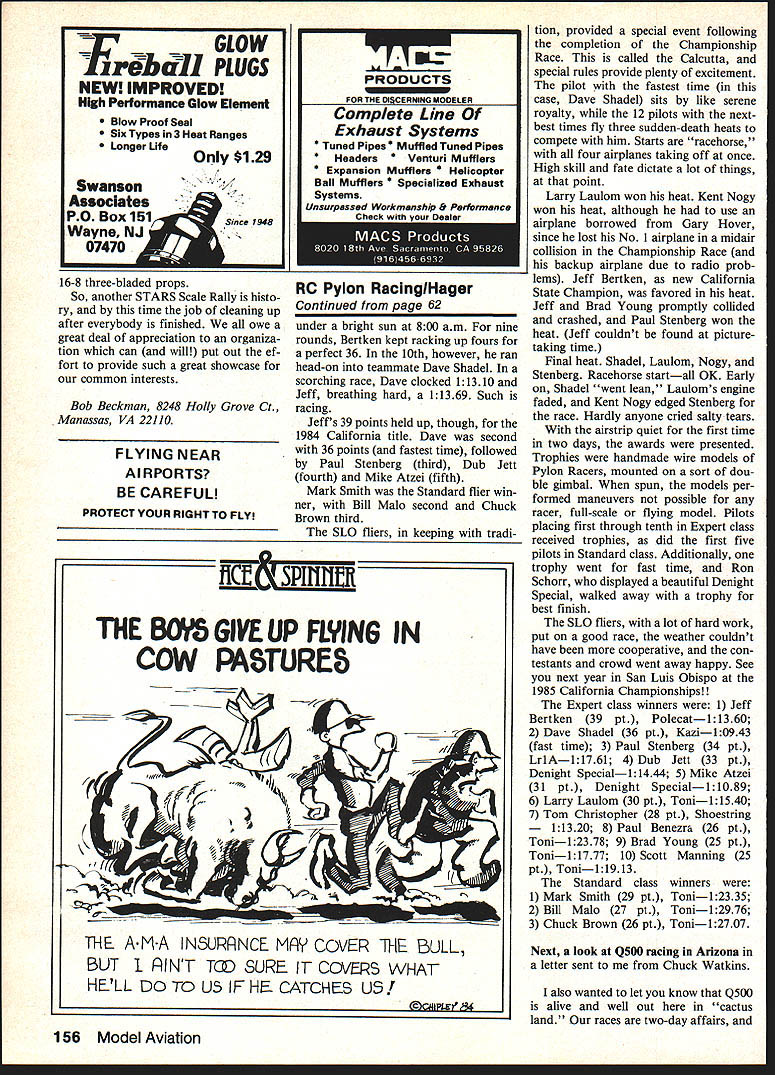
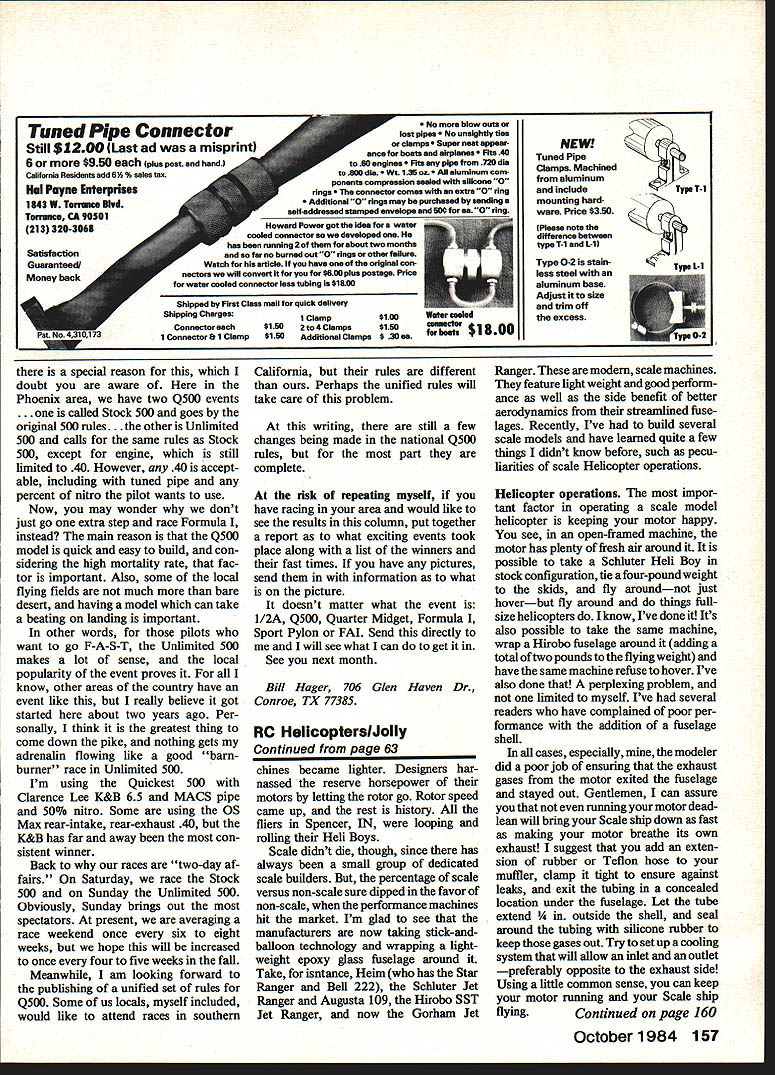
As usual, the event drew a fair crowd of local citizens, who appeared to enjoy the exciting heats and the whine of racing engines. The SLO fliers provided a refreshment stand, and there was a static display of an assortment of models which drew much attention. A complete and professional printed program was available to explain, in general, the rules and fine points of Formula I racing, as well as a rundown on the participating pilots. The weatherman helped with a cooling breeze off the nearby Pacific.
Six rounds were completed on Saturday. Leader at the end of the day was SLO president Jeff Bertken with a perfect score of 24. Dub Jett of Texas, flying a Denight Special, was breathing down his neck, however, with a 23. Pressing hard were Dave Shadel with a Kazi (20) and Larry Laulom and Bill Malo with 18s. Bill is a Standard flier, doing real well up there with the big boys. At the end of the six rounds, over a hundred hungry people gathered for a steak-and-chicken barbecue right next to the ready line.
Early Sunday morning there was a thick sea fog hanging over the airstrip. However, CD Jim Sneed worked his magic, the fog burned away, and the first heat was off the ground under a bright sun at 8:00 a.m. For nine rounds, Bertken kept racking up fours for a perfect 36. In the 10th, however, he ran head-on into teammate Dave Shadel. In a scorching race, Dave clocked 1:13.10 and Jeff, breathing hard, a 1:13.69. Such is racing.
Jeff's 39 points held up, though, for the 1984 California title. Dave was second with 36 points (and fastest time), followed by Paul Stenberg (third), Dub Jett (fourth), and Mike Atzei (fifth).
Mark Smith was the Standard flier winner, with Bill Malo second and Chuck Brown third.
The SLO fliers, in keeping with tradition, provided a special event following the completion of the Championship Race. This is called the Calcutta, and special rules provide plenty of excitement. The pilot with the fastest time (in this case, Dave Shadel) sits by like serene royalty, while the 12 pilots with the next-best times fly three sudden-death heats to compete with him. Starts are "racehorse" style, with all four airplanes taking off at once. High skill and fate dictate a lot of things at that point.
Larry Laulom won his heat. Kent Nogy won his heat, although he had to use an airplane borrowed from Gary Hover, since he lost his No. 1 airplane in a midair collision in the Championship Race (and his backup airplane due to radio problems). Jeff Bertken, as new California State Champion, was favored in his heat. Jeff and Brad Young promptly collided and crashed, and Paul Stenberg won the heat. (Jeff couldn't be found at picture-taking time.)
Final heat: Shadel, Laulom, Nogy, and Stenberg. Racehorse start — all OK. Early on, Shadel "went lean," Laulom's engine faded, and Kent Nogy edged Stenberg for the race. Hardly anyone cried salty tears. With the airstrip quiet for the first time in two days, the awards were presented.
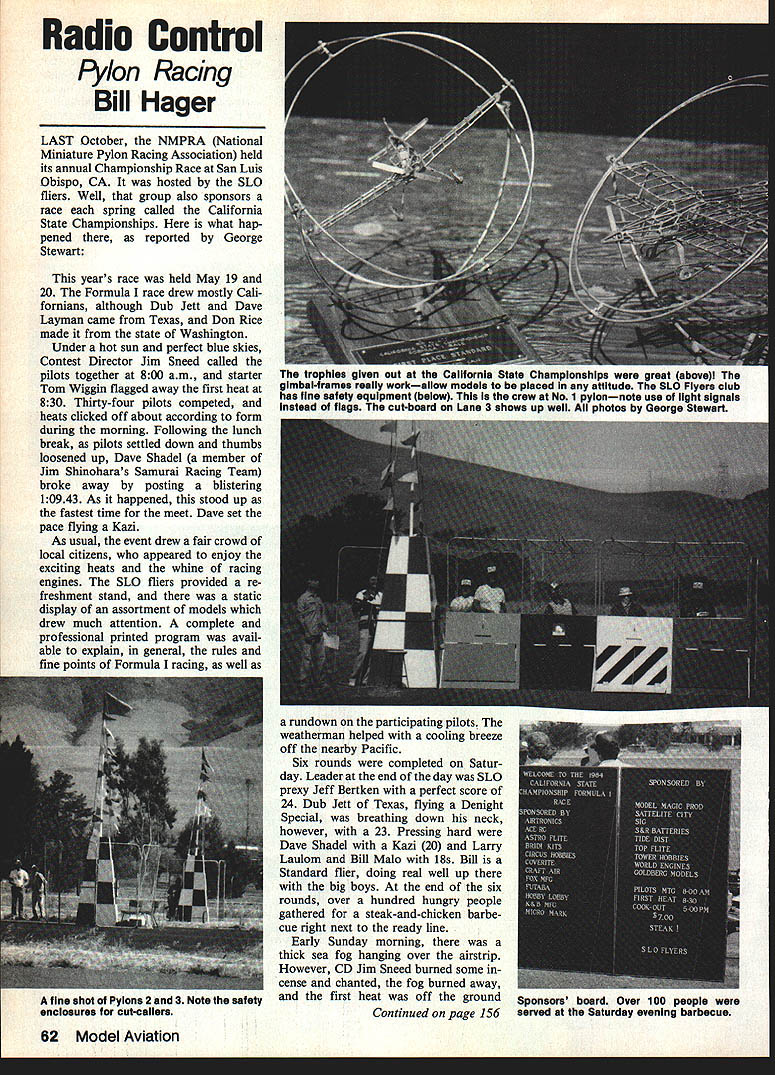
Trophies were handmade wire models of Pylon Racers, mounted on a sort of double gimbal. When spun, the models performed maneuvers not possible for any racer, full-scale or flying model. Pilots placing first through tenth in Expert class received trophies, as did the first five pilots in Standard class. Additionally, one trophy went for fastest time, and Ron Schorr, who displayed a beautiful Denight Special, walked away with a trophy for best finish.
The SLO fliers, with a lot of hard work, put on a good race. The weather couldn't have been more cooperative, and the contestants and crowd went away happy. See you next year in San Luis Obispo at the 1985 California Championships!
Expert class winners
- Jeff Bertken — 39 pt., Polecat — 1:13.60
- Dave Shadel — 36 pt., Kazi — 1:09.43 (fast time)
- Paul Stenberg — 34 pt., Lr/A — 1:17.61
- Dub Jett — 33 pt., Denight Special — 1:14.44
- Mike Atzei — 31 pt., Denight Special — 1:10.89
- Larry Laulom — 30 pt., Tom — 1:15.40
- Tom Christopher — 28 pt., Shoestring — 1:13.20
- Paul Beneze — 26 pt., Toni — 1:23.78
- Brad Young — 25 pt., Toni — 1:17.77
- Scott Manning — 25 pt., Toni — 1:19.13
Standard class winners
- Mark Smith — 29 pt., Toni — 1:23.35
- Bill Malo — 27 pt., Toni — 1:29.76
- Chuck Brown — 26 pt., Toni — 1:27.07
Q500 / Unlimited 500 in Phoenix
There is a special reason for our local Q500 events in the Phoenix area. We have two Q500 events — one called Stock 500 which follows the original 500 rules, and the other called Unlimited 500 which follows the same rules as Stock 500 except for the engine. Unlimited 500 allows any .40 engine, including twin tuned-pipe types, and any percentage of nitro the pilot wants to use.
You may wonder why we don't just race Formula I instead. The main reason is that the Q500 model is quick and easy to build, and considering the high mortality rate, that factor is important. Also, some of the local flying fields are not much more than bare desert, and having a model which can take a beating on landing is important.
For those pilots who want to go F-A-S-T, Unlimited 500 makes a lot of sense, and the local popularity of the event proves it. For all I know, other areas of the country have an event like this, but I really believe it got started here about two years ago. Personally, I think it is the greatest thing to come down the pike, and nothing gets my adrenaline flowing like a good "barn-burner" race in Unlimited 500.
I'm using the Quickset 500 with a Clarence Lee K&B 6.5 and MACS pipe and 50% nitro. Some are using the OS Max rear-intake, rear-exhaust .40, but the K&B has far and away been the most consistent winner.
We run two-day affairs: on Saturday we race Stock 500 and on Sunday Unlimited 500. Obviously, Sunday brings out the most spectators. At present we are averaging a race weekend once every six to eight weeks, but we hope this will increase to once every four to five weeks in the fall.
Meanwhile, I am looking forward to the publishing of a unified set of rules for Q500. Some of us locals, myself included, would like to attend races in southern California, but their rules are different than ours. Perhaps the unified rules will take care of this problem. At this writing, there are still a few changes being made in the national Q500 rules, but for the most part they are complete.
Call for race reports
If you have racing in your area and would like to see the results in this column, put together a report describing the exciting events that took place along with a list of the winners and their fast times. If you have any pictures, send them in with information as to what is in the picture.
It doesn't matter what the event is: 1/2A, Q500, Quarter Midget, Formula I, Sport Pylon, or FAI. Send reports directly to me and I will see what I can do to get them in. See you next month.
Bill Hager 706 Glen Haven Dr. Conroe, TX 77385
Transcribed from original scans by AI. Minor OCR errors may remain.

