


Radio Control: Pylon Racing — Bill Hager
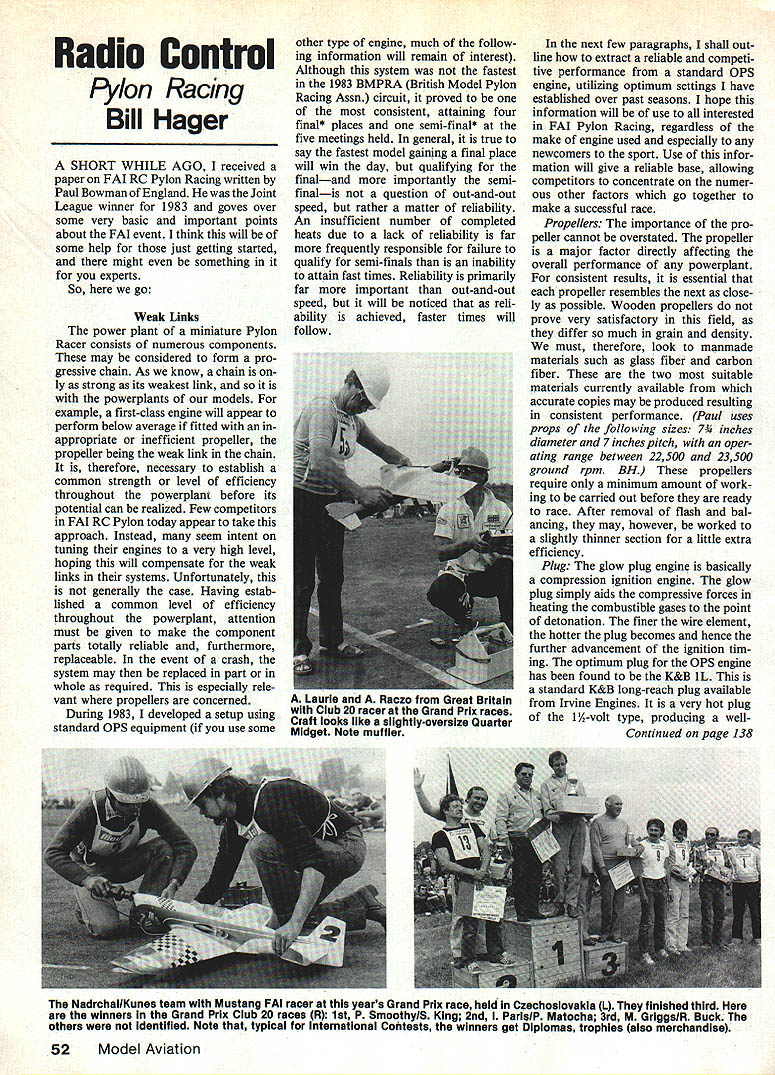
A short while ago I received a paper on FAI RC pylon racing written by Paul Bowman of England. He was the Joint League winner for 1983 and goes over some very basic and important points about the FAI event. I think this will be of some help for those just getting started, and there might even be something in it for you experts.
So, here we go:
Weak Links
The power plant of a miniature pylon racer consists of numerous components. These may be considered to form a progressive chain. As we know, a chain is only as strong as its weakest link, and so it is with the powerplants of our models. For example, a first-class engine will appear to perform below average if fitted with an inappropriate or inefficient propeller, the propeller being the weak link in the chain.
It is therefore necessary to establish a common strength or level of efficiency throughout the powerplant before its potential can be realized. Few competitors in FAI RC pylon racing today appear to take this approach. Instead, many seem intent on tuning their engines to a very high level, hoping this will compensate for the weak links in their systems. Unfortunately, this is not generally the case.
Having established a common level of efficiency throughout the powerplant, attention must be given to make the component parts totally reliable and, furthermore, replaceable. In the event of a crash, the system may then be replaced in part or in whole as required. This is especially relevant where propellers are concerned.
During 1983 I developed a setup using standard OPS equipment (if you use some other type of engine, much of the following information will remain of interest). Although this system was not the fastest in the 1983 BMPRA (British Model Pylon Racing Assn.) circuit, it proved to be one of the most consistent, attaining four final places and one semi-final at the five meetings held. In general, it is true to say the fastest model gaining a final place will win the day, but qualifying for the final—and more importantly the semi-final—is not a question of out-and-out speed, but rather a matter of reliability.
An insufficient number of completed heats due to a lack of reliability is far more frequently responsible for failure to qualify for semi-finals than is an inability to attain fast times. Reliability is primarily far more important than out-and-out speed, but it will be noticed that as reliability is achieved, faster times will follow.
In the next few paragraphs I shall outline how to extract a reliable and competitive performance from a standard OPS engine, utilizing optimum settings I have established over past seasons. I hope this information will be of use to all interested in FAI pylon racing, regardless of the make of engine used and especially to any newcomers to the sport. Use of this information will give a reliable base, allowing competitors to concentrate on the numerous other factors which go together to make a successful race.
Propellers
The importance of the propeller cannot be overstated. The propeller is a major factor directly affecting the overall performance of any powerplant. For consistent results, it is essential that each propeller resembles the next as closely as possible. Wooden propellers do not prove very satisfactory in this field, as they differ so much in grain and density.
We must, therefore, look to manmade materials such as glass fiber and carbon fiber. These are the two most suitable materials currently available from which accurate copies may be produced resulting in consistent performance. Paul uses props of the following sizes: 7½ inches diameter and 7 inches pitch, with an operating range between 22,500 and 23,500 ground rpm. These propellers require only a minimum amount of working to be carried out before they are ready to race. After removal of flash and balancing, they may, however, be worked to a slightly thinner section for a little extra efficiency.
Plug
The glow-plug engine is basically a compression-ignition engine. The glow plug simply aids the compressive forces in heating the combustible gases to the point of detonation. The finer the wire element, the hotter the plug becomes and hence the further advancement of the ignition timing. The optimum plug for the OPS engine has been found to be the K&B 1L. This is a standard K&B long-reach plug available from Irvine Engines. It is a very hot plug of the 1-1/2-volt type, producing a well-advanced ignition.
Care must be taken when starting the engine to regulate the current flow through the element in order to prevent damage. Having a fine element, the plug is easily destroyed by a lean mixture setting. The state of the plug element is a good indication of the running conditions within the engine. This is especially useful during racing when it is difficult to distinguish the sound of one's own engine.
If the element at a race is found to be intact and undistorted, the mixture was probably set too rich. If the element is found to be intact but slightly distorted, the mixture was probably correct. At this setting, the plug should be changed every race to maintain performance. If the element is not found intact or is found to be severely distorted, the mixture was probably too lean. Great care must be taken when using this plug, as a lean mixture setting may cause the element to become detached, resulting in irrevocable damage to the piston/liner and cylinder head.
Head clearance
The volume available in the combustion chamber at top dead center of the piston stroke is directly related to the clearance between the piston crown and the cylinder head squish band. A change in this clearance will result in a change of the compression ratio of the engine; therefore, the compression ratio may be regarded in terms of the head clearance.
Too much clearance will lower the compression ratio, retarding the ignition and causing a subsequent loss of power. In this condition, the engine will be difficult to run on pipe and will require a lean mixture setting to maintain rpm.
Too little clearance will increase the compression ratio, thereby highly advancing the ignition and also causing a subsequent loss of power. In this condition, the engine will run on pipe but will require a rich mixture setting to maintain rpm and prevent overheating. For the OPS engine, I have found 0.012 inches to be the optimum clearance giving a reliable and competitive performance in all weathers and conditions. The head clearance of each individual engine must therefore be established using a depth gauge or similar instrument. It may then be adjusted to the optimum by inserting shims under the head as required.
Tuned-length exhaust pipe
Due to the design of a two-stroke engine, during every cycle unburnt gases are lost from the cylinder into the exhaust system. The tuned-length exhaust pipe is a simple resonant device used to improve the performance of a two-stroke engine by pushing back into the cylinder some of the unburnt gases.
The resonant frequency of a tuned pipe is partly dependent on its length and must be matched to the operating rpm of the engine. For ease, the resonant length of the pipe is normally regarded in terms of the length from the glow plug to the point of widest diameter of the pipe. A decrease in tuned length will raise the operating rpm of the pipe, while an increase in tuned length will lower the operating rpm of the pipe.
The optimum length for the OPS unsilenced pipe, or the OPS silenced pipe with its rear can removed, has been found to be 23.25 cm. This corresponds to an operating range between 22,500 and 23,500 ground rpm. However, there are many reasons for an engine to run below its best performance; therefore, I suggest an initial tuned length at 24 cm, reducing to the optimum in 0.25 cm stages when a little more power is required.
Exhaust manifold
The standard OPS exhaust manifold has not proved to be very satisfactory. I have, therefore, replaced this component by a short manifold machined from solid aluminum bar. The joint between the manifold and tuned pipe is best effected using silicon rubber tubing, allowing a gap of 3 mm for expansion and movement between the manifold and pipe.
The most durable silicon rubber tubing currently available is manufactured by Micro Mold. This tubing will normally last for six or more flights, but should be replaced at frequent intervals. This will prevent perforation of the exposed area by hot exhaust gases. In addition to the above, I have available similar manifolds suited to OS and K&B engines.
(To be continued.)
Finals and semi-finals
Paul Bowman refers to "finals" and "semi-finals." This is because a number of European countries, including Great Britain, modify the FAI flying rules. They use the FAI system for selecting semi-finalists. Depending on the number of heats flown, a competitor may drop his worst score. Typically, the scores counted would be four out of four, four out of five, five out of seven, etc., depending on the number of heats flown.
- The organizers rank the competitors, with the eight top scorers chosen for the semi-final.
- Two heats are flown in the semi-finals.
- The four fastest times qualify for the final.
- Places five through eight are ranked on semi-final times.
- The top four are ranked on the final times.
The top four flyers tend to regard the heats almost as practice and the semi-final and final as the "real" competition.
Next month I will have a full report on the '84 Grand Prix races held in Czechoslovakia and the conclusion of Paul Bowman's article on FAI racing.
See you next month.
Bill Hager 706 Glen Haven Dr. Conroe, TX 77385
Transcribed from original scans by AI. Minor OCR errors may remain.

