
Radio Control: Pylon Racing
By Bill Hager
FAI may be back. I think that 1985 will tell the tale, with the U.S.A. sending a team to the FAI RC Pylon World Championships in Canada.
As promised, this month we are going to finish the article by Paul Bowman on the basics of FAI.
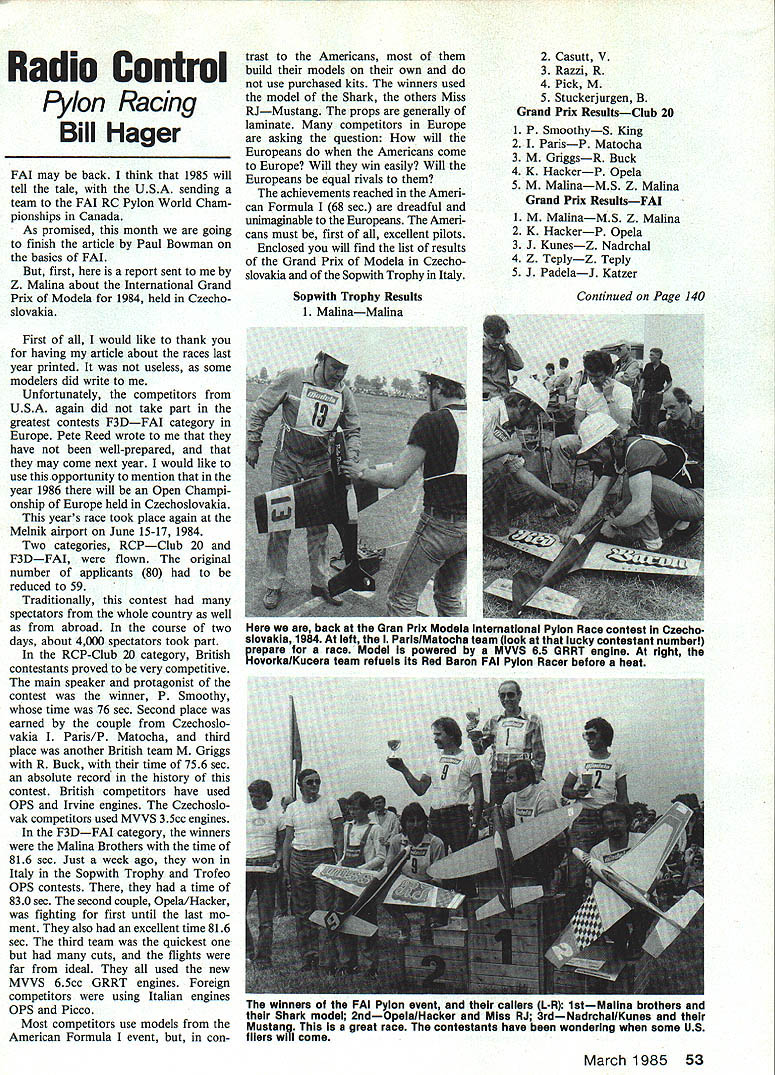
But first, here is a report sent to me by Z. Malina about the International Grand Prix of Modela for 1984, held in Czechoslovakia.
International Grand Prix of Modela (Melník Airport, June 15–17, 1984) — Z. Malina
First of all, I would like to thank you for having my article about the races last year printed. It was not useless, as some modelers did write to me.
Unfortunately, the competitors from the U.S.A. again did not take part in the greatest contests (F3D — FAI category) in Europe. Pete Reed wrote to me that they have not been well-prepared, and that they may come next year. I would like to use this opportunity to mention that in the year 1986 there will be an Open Championship of Europe held in Czechoslovakia.
This year's races took place again at the Melník airport on June 15–17, 1984.
Two categories, RCP-Club 20 and F3D-FAI, were flown. The original number of applicants (80) had to be reduced to 59.
Traditionally, this contest had many spectators from the whole country as well as from abroad. In the course of two days, about 4,000 spectators took part.
In the RCP-Club 20 category, British contestants proved to be very competitive. The main speaker and protagonist of the contest was the winner, P. Smoothy, whose time was 76 sec. Second place was earned by the couple from Czechoslovakia, I. Paris / P. Matocha, and third place was another British team, M. Griggs with R. Buck, with their time of 75.6 sec, an absolute record in the history of this contest.
British competitors used OPS and Irvine engines. The Czechoslovak competitors used MVVS 3.5 cc engines.
In the F3D-FAI category, the winners were the Malina brothers with the time of 81.6 sec. Just a week ago, they won in Italy in the Sopwith Trophy and Trofeo OPS contests, where they had a time of 83.0 sec. The second couple, Opela / Hacker, were fighting for first until the last moment. They also had an excellent time, 81.6 sec. The third team was the quickest one but had many cuts, and the flights were far from ideal. They all used the new MVVS 6.5 cc GRRT engines. Foreign competitors were using Italian engines OPS and Picco.
Most competitors use models from the American Formula I event, but, in contrast to the Americans, most of them build their models on their own and do not use purchased kits. The winners used the Shark model; the others used the Miss RJ—Mustang. Props are generally of laminate. Many competitors in Europe are asking the question: How will the Europeans do when the Americans come to Europe? Will they win easily? Will the Europeans be equal rivals to them?
The achievements reached in the American Formula I (68 sec.) are dreadful and unimaginable to the Europeans. The Americans must be, first of all, excellent pilots.
Enclosed you will find the list of results of the Grand Prix of Modela in Czechoslovakia and of the Sopwith Trophy in Italy.
Sopwith Trophy Results
- Malina — Malina
- Casutt, V.
- Razzi, R.
- Pick, M.
- Stuckergurgen, B.
Grand Prix Results — Club 20
- P. Smoothy — S. King
- I. Paris — P. Matocha
- M. Griggs — R. Buck
- K. Hacker — P. Opela
- M. Malina — M. S. Z. Malina
Grand Prix Results — FAI
- M. Malina — M. S. Z. Malina
- K. Hacker — P. Opela
- J. Kunes — Z. Nadrchal
- Z. Teply — Z. Teply
- J. Padela — J. Katzer
Hey, U.S. fliers, how much more of an invitation do you want?
FAI Basics — Paul Bowman (remainder of report)
#### Needle valve assembly The standard OPS needle valve assembly is of the lock-nut type. This design has proven to be very reliable. Vibration caused by the engine loosens the lock nut, allowing the needle to vibrate away from its original setting. To eliminate this problem, the OPS assembly is best replaced by an OS spring-type assembly. This may be glued in place using epoxy resin (which may also be used to plug the redundant hole in the venturi slide). The OS spring-type assembly has a positive, click-by-click action, allowing a precise mixture adjustment to be made.
#### Pipe pressure I have found pipe pressure to be the most reliable and by far the easiest to operate. Pipe pressure may be obtained by tapping the tuned pipe close to its point of largest diameter and connecting the fitting to the fuel tank vent. A suitable tap-fitting may be effected using a short length of brass tubing glued into position using 24-hour Araldite epoxy resin. The brass tube should not protrude more than 1 mm into the expansion chamber.
#### The mixture setting This is the most important single adjustment made to the powerplant. If in doubt as to the correct setting, always run rich at first, adjusting progressively towards the optimum with each flight. It will be noticed, when using pipe pressure, that there is a considerable increase in the fuel requirement after take-off. The mixture setting must, therefore, be assessed during flight and adjusted accordingly. If, once airborne, the mixture setting becomes too lean, the flight must be terminated immediately to avoid damage to the engine.
#### Fuel tank In general, I have used an eight-ounce Kavan clunk tank. I have found eight ounces of fuel are required to complete a race, and a clunk-type pickup is required to maintain uninterrupted fuel feed throughout. To prevent fuel agitation and foaming, the tank must be insulated with foam rubber so that it does not touch the fuselage skin or bulkheads. The tank should be positioned as high in the fuselage as possible. This will avoid fuel draining away from the venturi during tight turns due to the increased gravitational loading. By routing the fuel feed line outside the top of the fuselage, it may easily be broken for refuelling. A single vent is required to connect the tank to the tuned-pipe pressure vent.
#### Air intake Although of relatively small cylinder capacity, our engines require large volumes of air when operating at maximum rpm. The passage of air to the engine venturi must, therefore, be unrestricted. This may be accomplished by placing a single opening with a minimum frontal area of 2.5 square centimetres in the vacant cheek cowl.
#### Cooling The FAI rules require the engine to be enclosed with the exception of the silencer, cylinder head, and operating controls. Remaining within the rules, sufficient cooling will be gained by exposing the intake to the airflow in the finned section of the cylinder head. An improved cooling pattern may be obtained by the addition of ducts and vents placed in the cowling, with regard to the following: during the operation of the engine, a temperature gradient exists across the cylinder between the hot exhaust-port area and the relatively cool boost-port area. The resulting non-uniform expansion distorts the cylinder, causing a subsequent loss of power. Direct cooling to the front of the cylinder must, therefore, be avoided. Instead, the ducts to the vents should be positioned so as to maximize cooling to the rear of the cylinder and, in particular, the exhaust-port area.
#### Spinner The rules require a scale-like, round-nose spinner to be used on all models. It is pointless to very carefully balance a propeller and then use it in conjunction with an unbalanced spinner! Equal care must be taken in balancing propeller and spinner alike. Both may be balanced accurately using a special device, such as the Hi-Point Products (U.S.A.) Balancer. Bearing life may be greatly reduced due to adverse gyroscopic forces generated by the spinner. It is, therefore, advisable to remove the spinner and fit a round-nose nut during engine testing and practice sessions. Fox spun-aluminum spinners have proved to be the most reliable. Unfortunately, these are not readily available in this country (England). CD cast aluminum spinners are an alternative, but they require a modification: increasing the retaining bolt in size to 2BA.
#### Maintenance A carefully maintained engine is essential to consistent and reliable performance. Great knowledge is not required, but sensible techniques must be employed. The competitive life of a new engine will depend on the skill of the operator. Certain parts will need replacement from time to time, but excessive wear is normally a result of incorrect operation. By regular stripping and cleaning, you will preserve the life of your engine. Always use the correct tools and, where possible, employ the use of a small torque wrench. This reduces assembly time and eliminates distortion due to unequally tensioned bolts. I have found a torque of 10 oz.-inches all round to be sufficient.
#### Flying Having produced a reliable and competitive model, success is then dependent on flying ability. No matter how proficient a pilot you may be in other fields, pylon racing will present a new challenge. It should be stressed that useful practice may only be gained under race conditions. It is, therefore, necessary for novice and expert alike to race at every opportunity.
There you have it for this month. Thanks to Paul Bowman for his timely advice.
See you next month.
Bill Hager 706 Glen Haven Dr. Conroe, TX 77385.
Transcribed from original scans by AI. Minor OCR errors may remain.

