
Radio Control: Scale
Bud Atkinson
SINCE I STARTED doing the Scale column for Model Aviation I have received many letters requesting information. Some I could answer and some I couldn't. Probably most asked is where to obtain three-views and information on this or that airplane. One of the most difficult to obtain is the home-built aircraft. Believe it or not, many don't exist. The home builders are much the same as Scale model builders. An idea is simply scratched out on paper using known aerodynamic data and built to the individual's idea or taste. The many plans that may be procured usually consist of material, dimension and placement. So no need for three views. Many "homebuilts" have simply been drawn (would you believe) on a workshop floor with little or no drawings.
Pictures are abundant in both full-size aircraft magazines and model magazines. Of course, at the many fly-ins and air shows you can have a field day taking pictures of home-builts. If three-views are a problem, one answer is to contact your local EAA organization or the Experimental Aircraft Assn., P.O. Box 229, Hales Corners, WI. If you have not seen the EAA Museum at Hales Corners you have missed a rare treat. Many one-of-a-kind and unusual aircraft, as well as famous aircraft, are displayed, mostly indoors.
Military aircraft of the WW I and II eras are much easier to find in three-view form. Military and civilian aircraft are included in magazines that can be purchased at most magazine stands. Or perhaps you know someone who has collected magazines over the years. By the way, those of you who have trouble finding instrument layouts, Air Progress, April and May 1963 issues, had several pages of head-on pictures of full instrument panels, such as the P-51, B-17, B-24, PT-17, Japanese Zero, German ME-262, and many more. One good source of aviation magazines that is overlooked is your local library. Many have a good collection that may date back many years, so check out this source.
If you are interested in a detailed description of a particular aircraft, especially WW II aircraft, the Aero series are excellent, with many pictures, drawings in color, and a complete history and development of the aircraft. The address is Aero Publishers, Inc., 329 Aviation Rd., Fallbrook, CA 92028. Air Classics of Challenge Publications, Inc., P.O. Box 1334, 7940 Deering Ave., Canoga Park, CA 91304 (they also produce Scale Modeler) is a fine source of scale information. Air Classics deals with everything from racing aircraft and warbirds to classic civil aircraft, with many fine three-views and color pictures. One source of the finest and most accurate drawings and three-views is the Historical Aviation Album. It comes in book form and usually consists of five or six sets of drawings with pictures and complete history of said aircraft. At present, they have about seven volumes. You may obtain a complete listing from Historical Aviation Album, P.O. Box 33, Temple City, CA 91781.
Another good source for three-views is model magazines. Model Airplane News used to print good three-views in the late '40s and '50s. Today I don't have a collection dating back that far. I'm sure some of your modeling buddies may have one. The old Air Trails and later American Modeler also featured three-views. Aero-Modeller, the British publication, also is a source for good three-views, especially in the '40s and '50s. Without a doubt, Stand-off Scale Profile publications are well known, and are excellent for information as well as color and markings.
Several of the aviation magazines have listings; you must order by the number listed instead of saying, for example, a P-51B, as there could be about 300 items in the series. They are rather hard to find in book stores because of this, but bound volumes can be found in book stores which consist of about 25 different Profiles to a volume. One source is Sky Books International, Inc., 520 Fifth Ave., New York, NY 10036. The Profile series are all military or military-related aircraft from WW I to the present day. Probably one of the finest collections of skilled pilot with a good plane and an unmodified engine should be getting his share of trophies handed out. Some designers are going to larger airplanes in an effort to improve scores. The Detroit area modelers have been moving in this direction for the past couple of years. With the weight of the engine, fuel system, and controls essentially constant, a larger model will have a lighter wing loading and should be able to fly slower. The slight reduction in high speed is now compensated for in improved low speed performance, and the larger models are easier to handle on low speed.
Some modelers are taking advantage of the reduced emphasis on brute power to build dual-purpose airplanes. These ships will compete in Class I with a Supertigre .40 and in Class II with a Supertigre .46, which weighs the same and has the same mounting as the .40. Engines with dissimilar mounting holes could be used just as well by using an RC type of radial engine mount and changing the mount along with the engine.
Speed Control: Harry Higley reports good success with his K&B 65 cc engine using an HP 61 throttle and crankcase pressure. Harry does not use an exhaust restrictor with this carb. The HP carb is available through Nelson Model Products in Chicago. The only modification needed is to turn down the base of the throttle so that it will fit in the K&B backplate.
New Products: I mentioned the new G-S Products Corp. three-line handle in my review of the G-S bellcrank last year. I've had a chance to look at the production versions of both units, and they look good. Both operate very freely. The handle is similar to the Sturdibuilt handle, but with some important changes. The G-S handle uses steel throughout instead of aluminum, and the G-S unit has 24% greater throttle movement. The throttle trigger is positioned 1/8" to 3/16" closer to the rear of the handle which is much more comfortable for me and probably for anyone else who flies with one hand. The G-S handle has much more clearance around the lines where they exit the handle; on low throttle, the handle can be moved up or down 60° before the lines contact the handle or frame — a four-fold improvement in this area. G-S Products Corp. Int'l., P.O. Box 488, LaGrande, OR 97850.
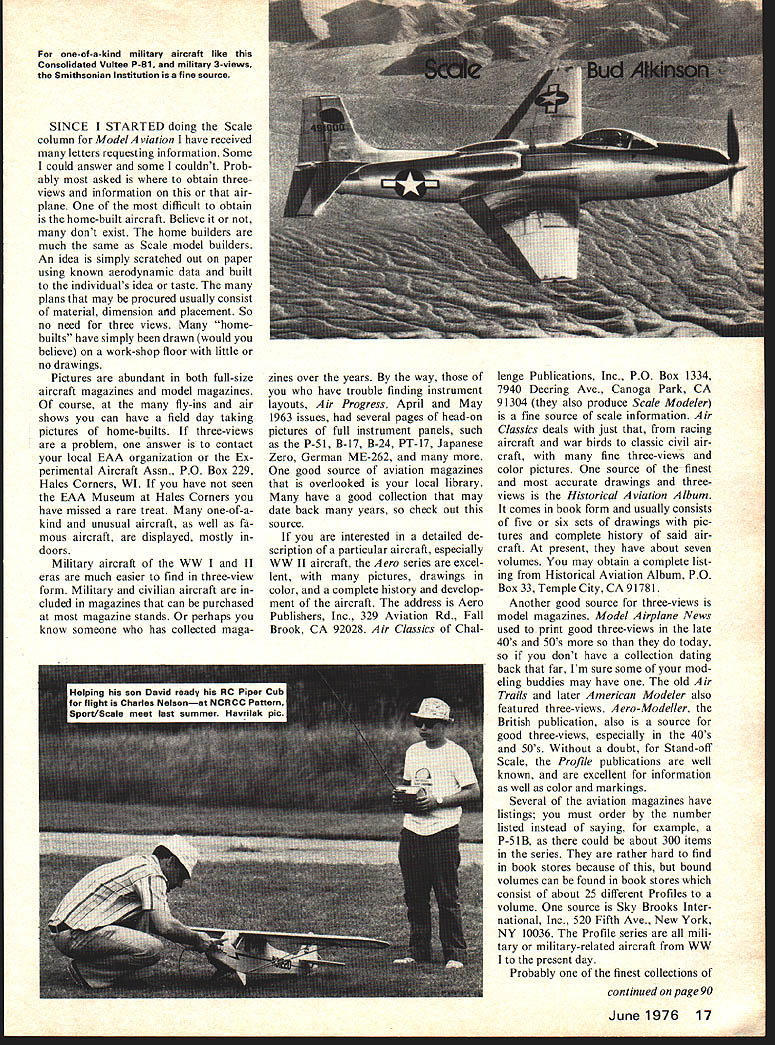
Of the cost and what information they have. It usually takes four to six weeks because they have many requests. The picture of the XP-81 with this column is an example of their excellent photographs. This is a rare bird — only two or three were built and it was a turbo-prop. Note the blacked out number on the tail and nose. This picture was taken in the later years of WWII. I obtained this picture from the Smithsonian Institution several years ago. Their address is: National Air Museum, Washington, D.C.
While on the subject of three-views and drawings, probably one of the largest collections of scale plans, kits, and affiliated parts, such as glass cowls, canopies, spinners, etc., is stocked by Bob Holman Plans, P.O. Box 741, San Bernardino, CA 92402. Bob has dozens of detailed scale plans from some of the world's best scale builders and is constantly expanding his scale kit line. There are just too many to mention here, so drop Bob a line and obtain his complete catalog of fine line of scale plans and kits.
My address is: 734 North Sixth St., Terrace, Blue Springs, MO 64015.
Transcribed from original scans by AI. Minor OCR errors may remain.

