
Radio Control: Scale
By Bob & Dolly Wischer
Trip to France and England
Our trip to the Paris Scale World Championships included many memorable experiences: scale models seen, modelers met, and events attended. Our report of the meet couldn't possibly have touched on every airplane and person, particularly the follow-up visit across the Channel to the Scale contest at Abingdon, England.
Le Bourget — highlights
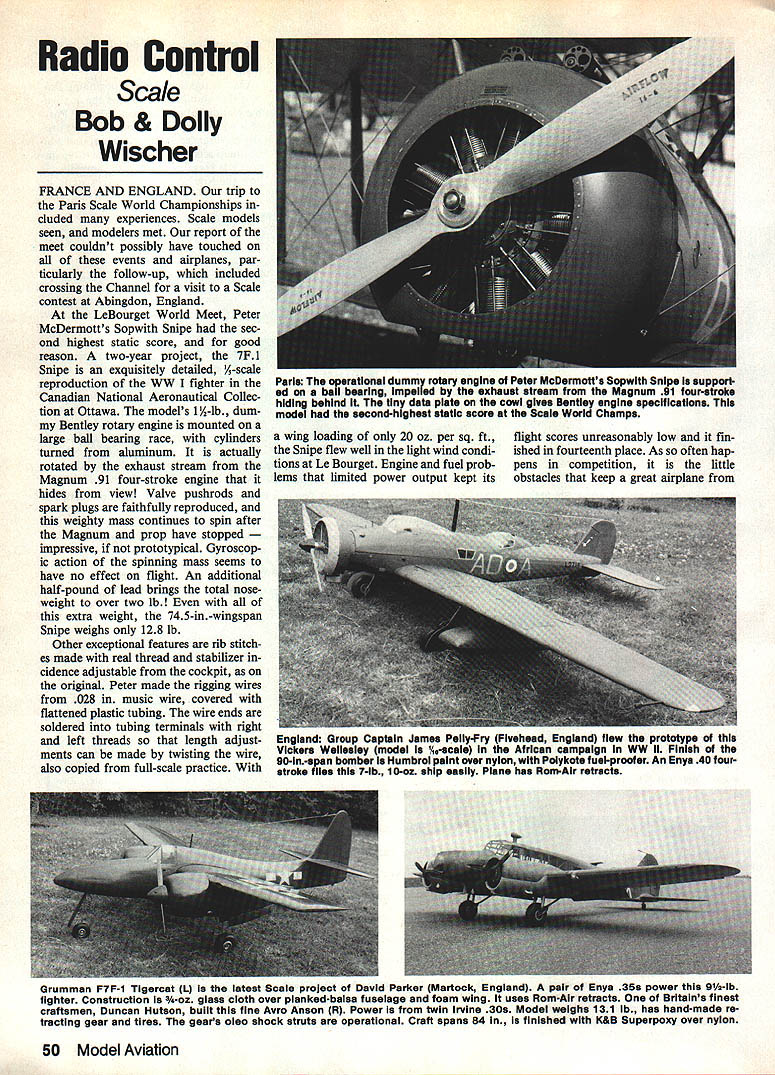
At the Le Bourget World Meet Peter McDermott's Sopwith Snipe earned the second-highest static score, and for good reason. The model is the result of a two-year project and is an exquisitely detailed reproduction of the WW I fighter in the Canadian National Aeronautical Collection at Ottawa.
Notable features of the Snipe:
- Exquisitely detailed finish with rib stitches made from real thread.
- Dummy Bentley rotary engine weighing about 1-1/2 lb mounted on a large ball-bearing race; cylinders turned from aluminum actually rotate.
- The dummy rotary is driven by the exhaust stream from a hidden Magnum .91 four-stroke engine. Valve pushrods and spark plugs are faithfully reproduced.
- The spinning dummy mass continues to turn after the Magnum and prop stop; gyroscopic action seemed to have no noticeable effect on flight.
- An additional half-pound of lead brings the total noseweight to over 2 lb.
- Rigging wires made from .028 in. music wire covered with flattened plastic tubing; wire ends soldered into threaded tubing terminals (right and left threads) to permit length adjustments by twisting the wire — copied from full-scale practice.
- Stabilizer incidence adjustable from the cockpit.
- Reported wing loading around 20 oz per sq. ft.
The model flew well in light-wind conditions at Le Bourget, but engine and fuel problems limited power output and kept its flight scores unreasonably low; it finished fourteenth. As often happens in competition, small obstacles can keep a great airplane from placing higher.
Also at Le Bourget, an Enya .90 four-stroke installation seemed to overheat in a completely cowled installation. Only periphery spinner inlets and a simulated coolant radiator under the wing provided cooling; outlets were through dummy Merlin exhaust pipes. The lack of ventilating air appeared to be the primary problem.
Abingdon Scale Contest
We met Peter McDermott again at the Abingdon Scale contest the week after the Paris meet. Abingdon is a partially disused military air base near Oxford with plenty of space to separate RC and CL areas. The contest used FAI rules with the bonus system in effect; on RC this essentially meant there were no trophy prize awards.
Weather at Abingdon contrasted with Paris — cool and blustery with a constant threat of rain. Peter's Bowers Fly Baby was a wise choice for the conditions. The winner of the contest was Mick Reeves with a superb new Hawker Hurricane; his best flight came during a gusty rainstorm. Mick’s high flight scores were largely attributable to the Hurricane’s ability to fly at the proper speed and attitude to provide a convincing scale appearance.
Abingdon’s cooler weather also appeared to benefit installations that had overheated at Le Bourget.
Notable models and builders at Abingdon
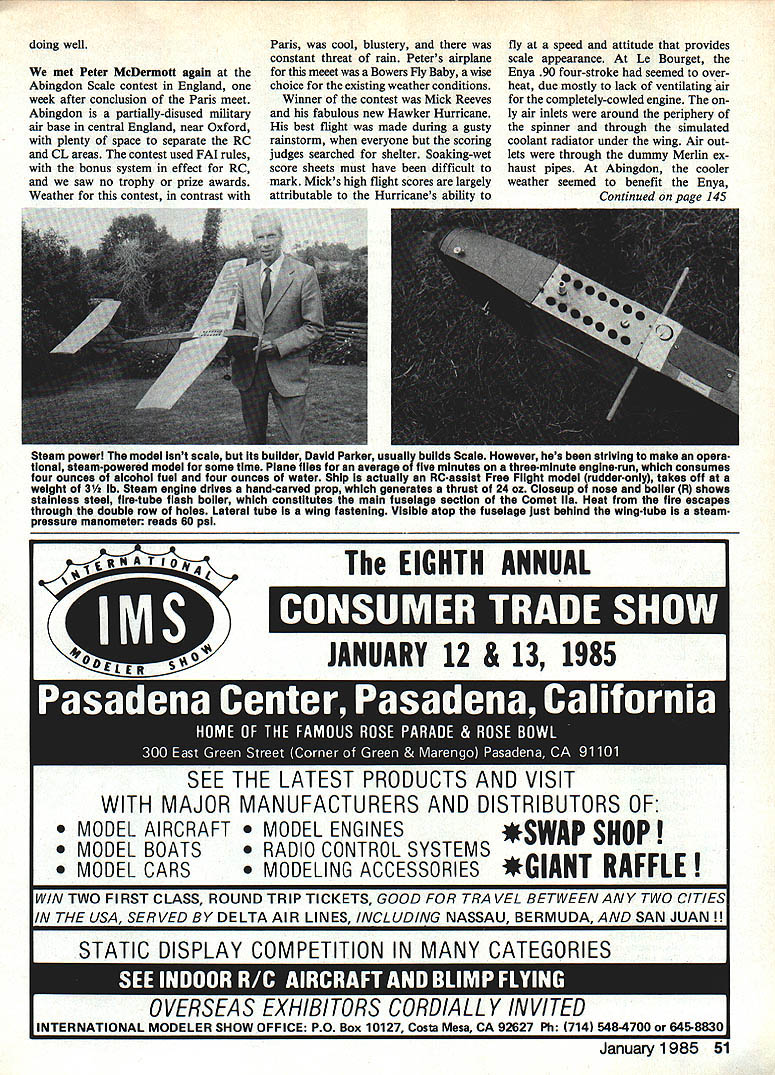
Group Captain James Pelly-Fry — Vickers Wellesley
- Modeled after the prototype James flew in the East African campaign early in WWII.
- James has recounted landing the Wellesley at night in the Sudan desert and waiting for dawn before returning to base.
- The prototype was a very large airplane for a single Bristol Pegasus XX (935 hp), with a 75 ft span.
- James’ model is reported as 1/6 scale with a 90-in wingspan, weighing about 7½ lb (wing loading ~20 oz/sq. ft).
- Powered by an Enya .40 four-stroke and built using geodetic construction (basket-weave stringers and ribs) for a light, strong framework.
- Equipped with Rom-Air retracts with a wide tread for ground stability.
David Parker — steam-powered Comet IIA and Grumman Tigercat
- David Parker is an inventive scratch-builder whose long-term project has been a steam-powered model airplane.
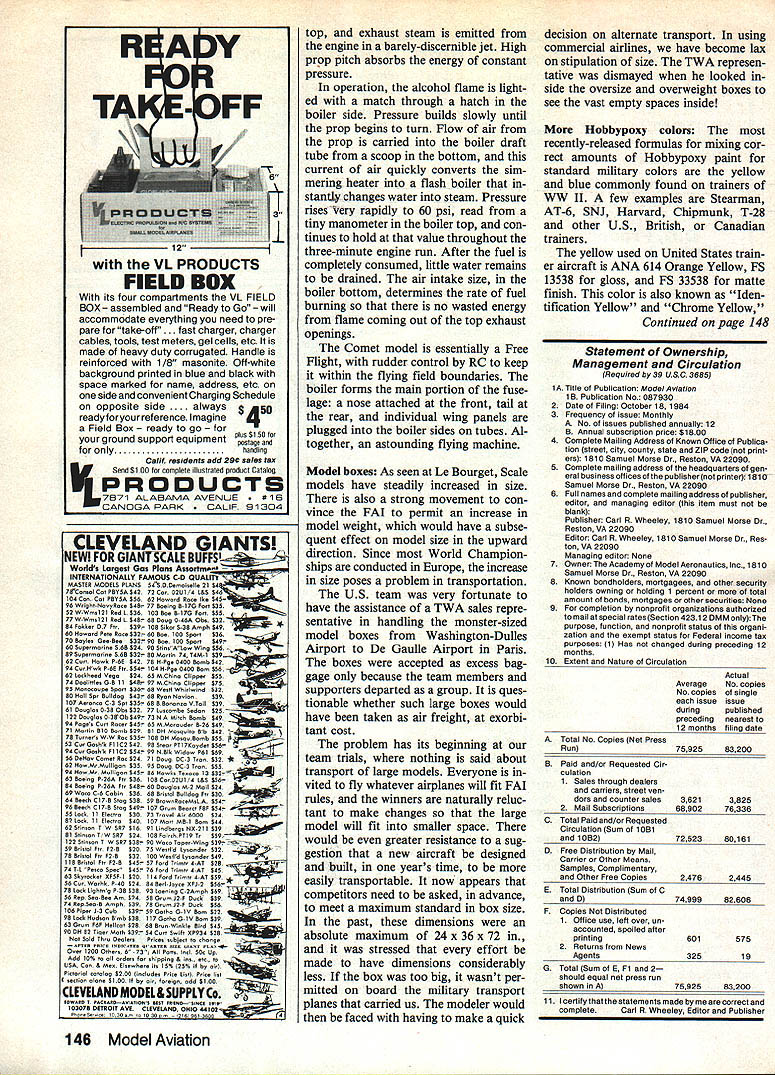
- The steam-powered Comet IIA has flown successful five-minute flights; a three-minute engine run consumes about 4 oz of ethyl alcohol fuel and 4 oz of water.
- Comet IIA particulars:
- Weight (with fuel and water): about 3.5 lb.
- Wingspan: 62 in; wing area ~630 sq. in.
- Boiler: stainless-steel fire-tube/flash or water-tube boiler forming the main fuselage section with heat exhausting through rows of holes.
- Engine: one-cylinder steam engine in the nose driving a hand-carved prop, producing about 24 oz of thrust.
- Boiler pressure: up to ~60 psi as read on a small manometer atop the fuselage.
- Operation: lighting the alcohol flame through a hatch; prop airflow is carried into the boiler draft tube from a scoop, quickly producing flash-boiler action and rapid pressure rise. Air-intake sizing controls fuel burn rate to avoid wasted energy.
- The Comet is essentially a free-flight model with RC-assist (rudder-only) to keep it in the field.
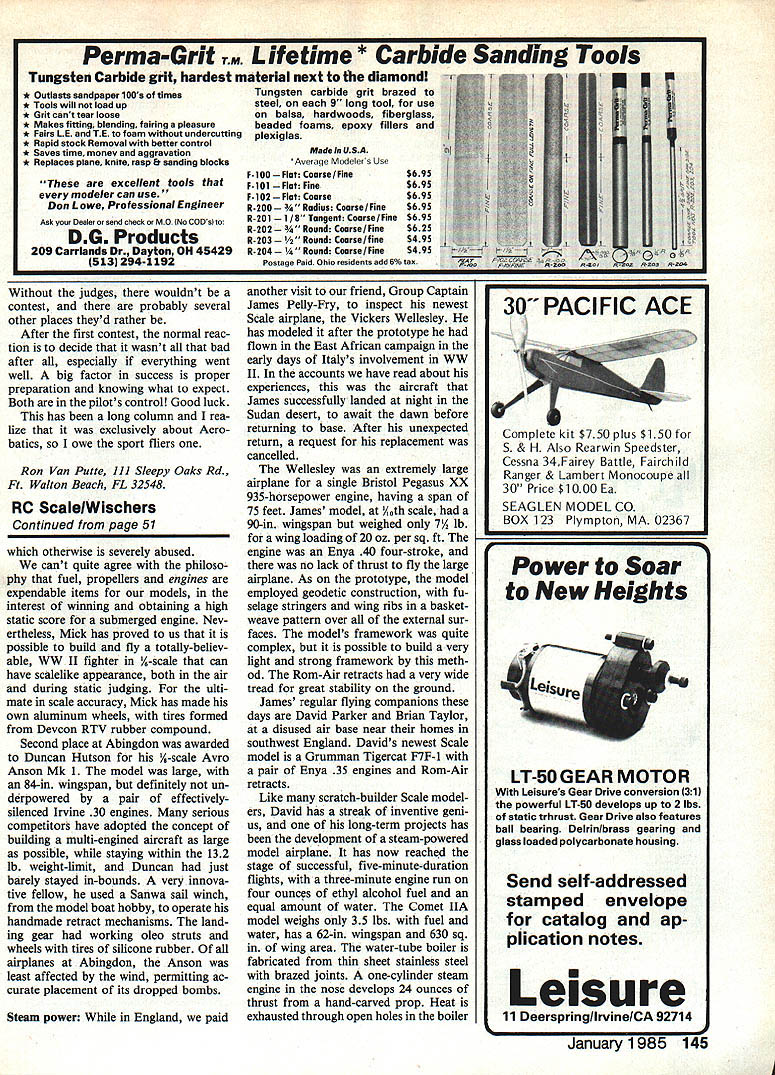
- David’s other projects include a Grumman F7F-1 Tigercat (pair of Enya .35 engines, Rom-Air retracts), built with glass-cloth over planked-balsa fuselage and a foam wing.
Duncan Hutson — Avro Anson Mk I
- Large model with an 84-in span; twin Irvine .30 engines (effectively silenced).
- Built right up to the 13.2-lb limit — a popular approach among senior competitors to build as large as possible while staying within the weight cap.
- Hand-made retract mechanisms operated by a Sanna sail winch (from model boat hobby).
- Landing gear featured working oleo struts and silicone rubber tires.
- Of all airplanes at Abingdon, the Anson was least affected by wind and permitted accurate placement of its dropped bombs.
Other mentions
- Grumman F7F-1 Tigercat by David Parker (pair of Enya .35s; construction: glass-cloth over planked-balsa; Rom-Air retracts).
- Several multi-engined and large-scale models demonstrated inventive solutions to systems, retracts, and engine silencing.
Model transport and boxes
Scale models have steadily increased in size, and there is a strong movement to persuade the FAI to permit an increase in model weight — a change that would encourage even larger models. Because most World Championships are conducted in Europe, increased model size raises significant transportation problems.
Our U.S. team was fortunate to have the assistance of a TWA sales representative in handling the monster-sized model boxes from Washington to De Gaulle Airport in Paris. The boxes were accepted as excess baggage only because the team members and supporters traveled as a group. It is questionable whether such large boxes would have been taken as air freight at reasonable rates.
The problem often starts at team trials in the U.S., where little is said about transport of large models. Winners are reluctant to redesign a successful aircraft to fit smaller transport dimensions. Competitors should be asked in advance to meet a maximum box-size standard. In the past an absolute maximum of 24 x 36 x 72 in. was enforced and it was stressed that efforts be made to keep dimensions considerably less. Oversize boxes were not permitted on some military transports, forcing last-minute alternate transport decisions. When using commercial airlines we have become lax in stipulating size limits — TWA representatives were often dismayed to find vast empty spaces inside oversize boxes.
Operation notes on the steam model
- To start the Comet boiler, the alcohol flame is lighted with a match through a hatch in the boiler side.
- Pressure builds slowly until the prop begins to turn; airflow from the prop is scooped into the boiler draft tube, converting the simmering heater into a flash boiler that rapidly turns water to steam.
- Pressure rises quickly to about 60 psi and holds throughout the three-minute engine run.
- After fuel is consumed, little water remains to be drained.
- Top exhaust emits steam as a barely-discernible jet; high prop pitch absorbs energy of constant pressure.
Closing
Our visit to Le Bourget and Abingdon confirmed the creativity, craftsmanship, and inventiveness of international scale modelers. From intricately rigged WWI reproductions to experimental steam propulsion, the meet featured an astounding variety of flying machines.
Bob and Dolly Wischer S-221 Lapham Peak Rd., Delafield, WI 53018
Transcribed from original scans by AI. Minor OCR errors may remain.

