
Radio Control: Scale
Bob & Dolly Wischer
Chicago Expo
New products
- Ace RC
- Nilite III: an on-board glow-plug lighter. A switch is mounted in the fuselage and may be actuated by the throttle servo or by a separate servo. The switch bracket also serves as a mount for the actuating rod and an adjustable cam that closes the circuit at the exact point in servo travel to ignite the plug as the throttle approaches idle.
- Nilite II: a pocket-size, metered glow ignitor that monitors glow-plug condition.
- Obeche (also spelled obechi) veneer: sheets suitable for wing skins. Advantages over balsa include greater density and lower cost.
- Indy RC Sales
- Two new OS four-stroke twin engines: a 2.40 (previously seen as a prototype) and a new 1.60. The 1.60 has the same external dimensions as the older Gemini 1.20 and appears to be a bored-out version of that twin.
- A dummy cylinder/head kit to give the appearance of a four-cylinder engine for models with exposed engines (e.g., Piper Cub J-3).
- Du-Bro Products
- Kwik-Fill fueling valve: a coupler for the fuel-supply pump that plugs into a fueling valve hidden under the cowl. When the pump is plugged in, supply to the carburetor is automatically shut off; unplugging reconnects the fuel line to the carburetor.
Show highlights
- Scale models dominated the display tables, and standard-size aircraft made a comeback compared with the usual abundance of Giants. At least a dozen models were of exceptional quality.
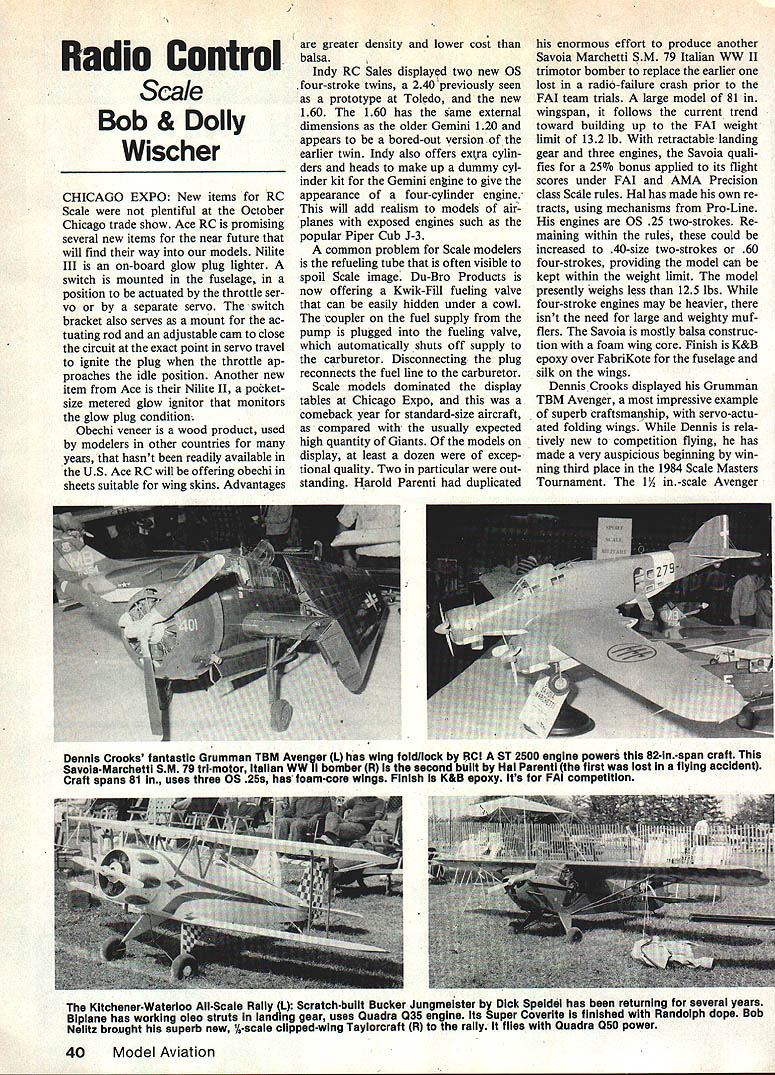
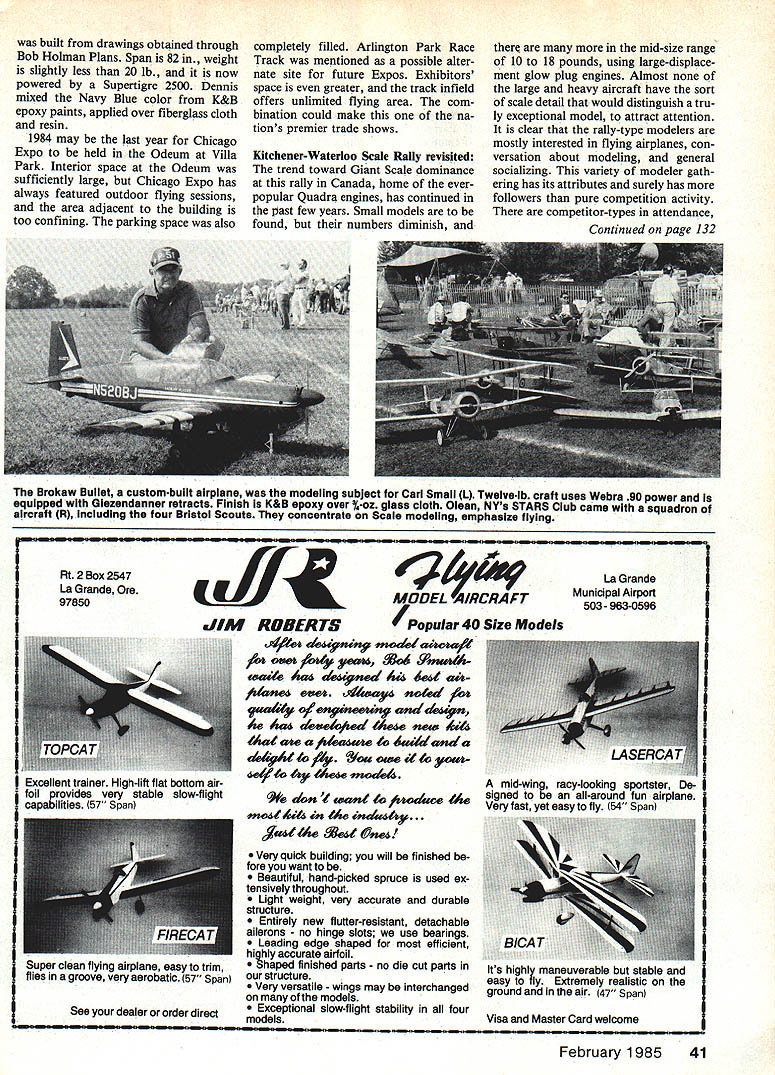
- Harold Parenti: another Savoia-Marchetti S.M.79 Italian WWII trimotor bomber to replace an earlier model lost in a radio failure. The model has an 81-inch wingspan and follows the trend toward building up to the FAI weight limit of 132 lb. With retractable landing gear and three engines, the Savoia qualifies for a 25% bonus under FAI and AMA Precision Class Scale rules. Parenti made his own retracts using Pro-Line retraction mechanisms and uses OS .25 two-stroke engines; engines could be increased (for example to .40 two-strokes or .60 four-strokes) provided the model remains within the weight limit. The model presently weighs less than 12.5 lb. Construction is mostly balsa with a foam wing core; finish is K&B epoxy over FabriKote on the fuselage and silk on the wings.
- Dennis Crooks: a superb Grumman TBM Avenger with servo-actuated folding wings. Crooks, relatively new to competition flying, earned third place in the 1984 Scale Masters Tournament.
Venue notes
- 1984 may have been the last year the Chicago Expo was held at the Odeum in Villa Park. While the interior space is sufficient, the adjacent outdoor flying area and parking are too confining. Arlington Park Race Track was mentioned as a possible future site, offering greater exhibitor space and a large infield for flying.
Kitchener–Waterloo Scale Rally
Overview
- The trend toward Giant Scale dominance continues at K-W, the Canadian rally known for Quadra-powered models. Small models are increasingly rare; many entries are mid-size (10–18 lb) using large-displacement glow engines.
- Rally-type attendees tend to favor flying, modeling conversation, and socializing rather than strict competition. 1984 was a light year with about 110 registered modelers.
Notable entries and regulars
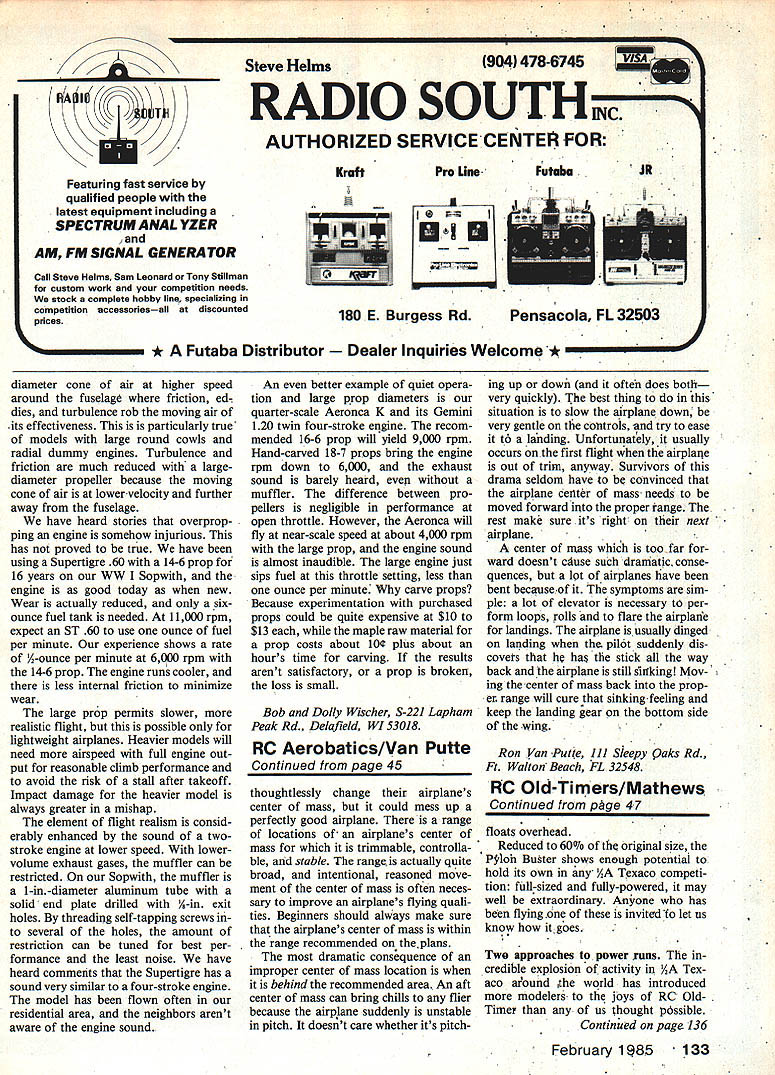
- Bob Neitz: displayed a highly detailed 1/3-scale, clipped-wing Taylorcraft powered by a Quadra 50cc. The model featured full cockpit detail, external fasteners, rib stitching and tapes with pinked serrations, and an interior visible through large plexiglass panels. Covering was lightweight Ceconite finished in Randolph butyrate dope. The model weighed about 30 lb.
- STARS Club (Olean, NY): regularly attends with trailer loads of large Quadra-powered models, including Boeing P-26, multiple Bristol Scouts, de Havilland DH-2, Encore, Curtiss Hawk and Falcon, and Fokker D-VIII. They often form a centerpiece display with a sun shade.
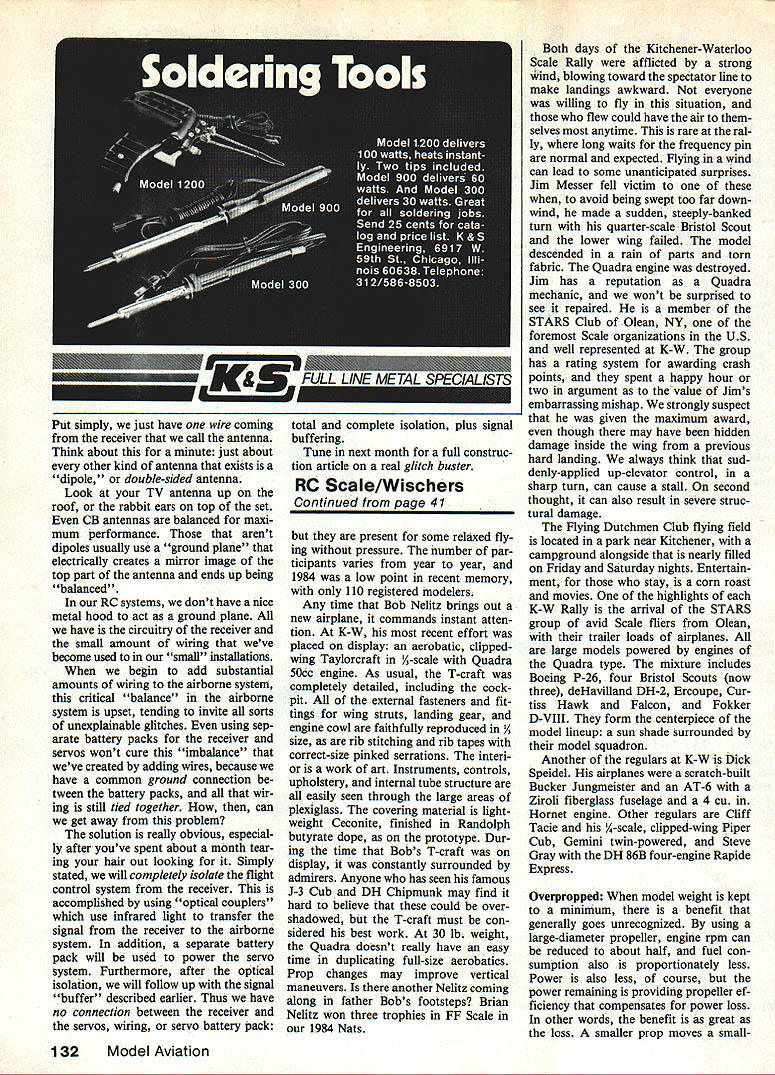
- Dick Speidel: scratch-built Bucker Jungmeister and an AT-6 with a Ziroli fiberglass fuselage and a 4-cu.in. Horie engine.
- Other regulars: Cliff Tice (1/3-scale clipped-wing Piper Cub, Gemini twin-powered) and Steve Gray (HOB 68 four-engine Rapide Express).
Weather, incidents, and competition
- Strong winds both days made landings awkward; some pilots chose not to fly. Long waits for frequency pins are usually expected at K-W, but the wind sometimes cleared the flying schedule.
- Jim Messer: suffered a structural failure when his quarter-scale Bristol Scout’s lower wing failed during a steeply banked turn to avoid being swept downwind. The model and Quadra engine were destroyed; Messer is known as a skilled Quadra mechanic and is expected to repair the engine. STARS members debated “crash points” for the mishap.
- The Flying Dutchmen Club field is in a park near Kitchener, with a nearby campground. Typical rally entertainment includes a corn roast and movies on Friday and Saturday nights.
Glitch buster — receiver-to-servo isolation (preview)
- Problem: As models grow with more wiring, the receiver’s single antenna and the airborne wiring layout upset the electrical “balance” that dipole or ground-plane antennas rely on, causing unexplained glitches. Adding separate battery packs does not eliminate the common-ground wiring that ties systems together.
- Solution: Completely isolate the flight-control (servo) system from the receiver using optical couplers. Infrared light transfers signals from the receiver to the airborne system. Use a separate battery pack for the servos and follow the optical isolation with a signal buffer. This yields total isolation between receiver and servos, wiring, and servo battery pack — greatly reducing glitches.
- Tune in next month for a full construction article on a real glitch buster.
Overpropped
- Principle: Keeping model weight low allows the use of a larger-diameter propeller, which reduces engine RPM and fuel consumption while maintaining effective propulsive efficiency. A smaller prop moves a small cone of air at higher speed close to the fuselage, where friction and turbulence reduce effectiveness. A larger prop moves a larger, slower cone of air farther from the fuselage, reducing turbulence losses.
- Durability: Contrary to some reports, overpropping has not proved injurious to engines. Example: a Supertigre .60 with a 14x6 prop has run reliably for many years.
- Examples and figures
- Supertigre .60 on a WW I Sopwith:
- 14x6 prop at ~11,000 rpm: ~1 oz fuel per minute.
- 14x6 prop at ~6,000 rpm: ~1/4 oz fuel per minute. Engine runs cooler with less internal friction and reduced wear.
- Benefits include quieter, more realistic flight for lightweight airplanes; heavier models may need higher airspeed and power to avoid stalls and to climb adequately.
- Quarter-scale Aeronca K with a Gemini 1.20 twin:
- Recommended 16x6 prop gives ~9,000 rpm.
- Hand-carved 18x7 props can reduce rpm to ~6,000; the engine becomes barely audible even without a muffler.
- The Aeronca can fly near scale speed at about 4,000 rpm with the large prop and uses less than 1 oz of fuel per minute at that setting.
- Note on props: Purchased props can be expensive ($10–$13 each in the past); carving props from maple raw material (≈$0.10) costs little time-wise and allows inexpensive experimentation.
Bob and Dolly Wischer S-221 Lapham Peak Rd. Delafield, WI 53018
Transcribed from original scans by AI. Minor OCR errors may remain.

