
Radio Control: Scale
By Bob & Dolly Wischer
Detail Analysis
On the pretext that the model is to be stand-off scale, the external detail is kept to as little as will be accepted by fellow modelers. If the airplane being modeled is a later jet type (a Boeing B-47, for example), external detail presents no burdensome task for the modeler because it is relatively clean on the outside. A Douglas DC-3 has a pair of magnificent wing-root fillets, non-existent on a B-47, and a model without the fillets wouldn't be a DC-3. In addition, Douglas has several hundred thousand button-head rivets cluttering every surface. Duplicating the large quantity of rivet detail constitutes a major commitment in time and energy. Opinions on the amount of detail to be applied vary depending upon the builder's purpose and aspirations.
In some instances, external detail is actually exaggerated to make certain that it receives maximum attention. An example is a sport-scale model intended for competition: the builder deliberately calls attention to the presence of panel lines, paint scheme, and other features by over-emphasizing their existence. This is done so that the detail can be seen easily from the 15-foot static viewing distance. The application of shapes, forms, and colors becomes a type of gamesmanship among competitors who are intent upon impressing static-score judges.
Non-competitors, who make up the preponderance of scale modelers, have a choice in the direction to be taken for detail application. Detail can be almost entirely eliminated for minimum effort during construction, with flight being the primary objective. A model with extensive detailing, depicted in proper size and placement, is subject to everyone's close scrutiny—some of it critical.
Absence of detail leaves the critics with little to discuss. Most scale modelers simply ignore the critics and enjoy the sport and hobby of scale modeling for personal enjoyment. Of course, there is also the great satisfaction of a job well done when the finished product is replete with every bit and piece in its place and reproduced to scale. Having the work admired by one's peers brings its own measure of reward. The FAI or precision-scale modeler is familiar with this feeling of accomplishment. Pride is a key element. If the modeler has sufficient desire to possess such a model, the patience, knowledge, and skill to produce it can be acquired.
Prime sources of how-to information are scale model construction articles in magazines. Designers expose their methods of procedure, fabrication ideas, and material-procurement sources. Hints about reproduction of details are of particular value when explained in the article's text, since some are difficult to depict on drawings alone.
Many modelers are constantly searching for ready-made items that can be applied to their aircraft. It has been our experience that these are rare and usually lead to some sort of compromise, but the search goes on. Time spent searching for a correctly shaped part in the housewares section of a hardware store is often better utilized in making the part from raw material. Hints and construction ideas for scale models that are not already common knowledge are welcome additions. Send a simple pencil sketch and a written description and we can reproduce it in ink. Lack of this sort of exchange in the past leads one to believe scale modelers are downright secretive. In fact, we have rarely seen well-made, ready-made scale details.
Commercial suppliers present problems; sometimes their items are misused. One spectacular quarter-scale model's dummy radial engine, seen at Toledo, used 1/4-scale plastic dummy cylinders to make what was supposedly a 1/4-scale engine. An empty cowl would have been no worse. We have even seen empty radial-engine cowls at the World Championship because dummy cylinders of the correct type and size weren't easily procurable. Radial-engine cowls of incorrect shape and leading edge are another eyesore often seen. Quite obviously this came about because the builder used an available shape though he could have modified it to the correct form. The leading-edge cross-sectional radius should be quite small; if it is too large the inevitable result is an overly thick cowl leading edge that spoils the appearance.
Other error-prone parts include:
- Landing gear that is too short
- Wheel diameters that are too small
- Tires with incorrect tread, or tires exhibiting tread where they should be smooth
In such cases the non-competitor is not greatly concerned, but these mistakes also appear at contests. Everything else about the model may be acceptable, but the glaring error drags its static score downward disproportionately. It's possible to have obvious errors in other areas, less noticeable than the airplane's nose or landing gear, and yet retain the overall characteristic shape reasonably well. Most of the common errors described resulted from using commercially available parts inappropriately, sometimes out of desperation to complete a long-term project.
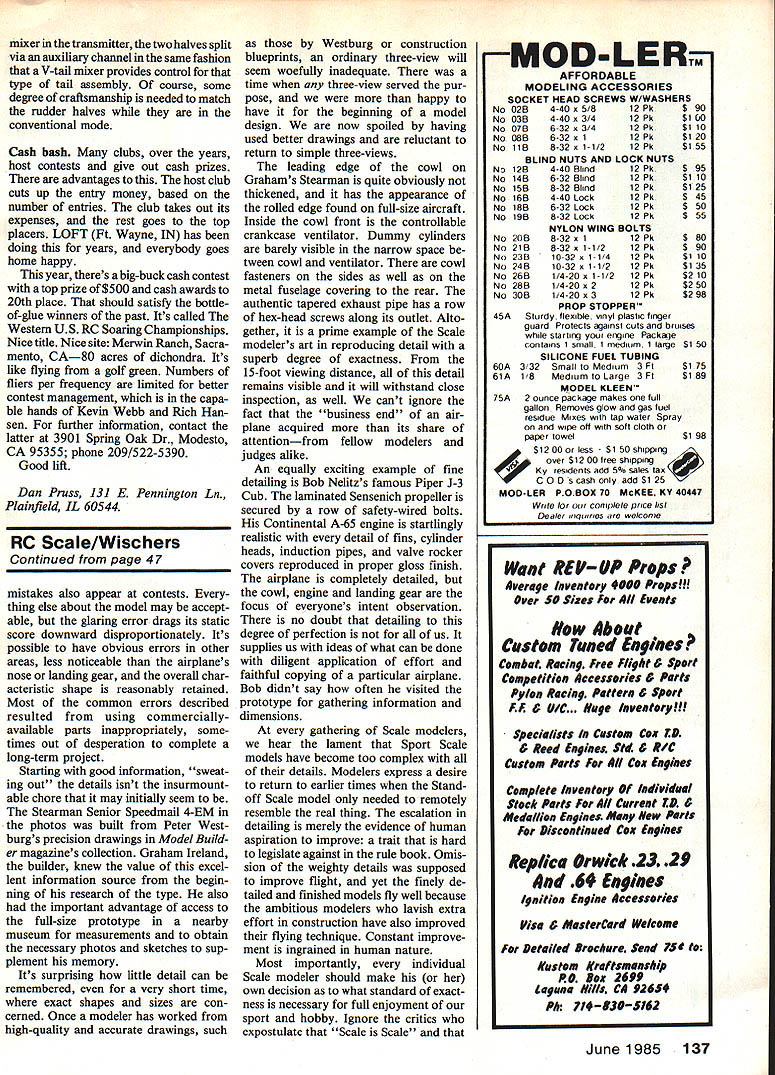
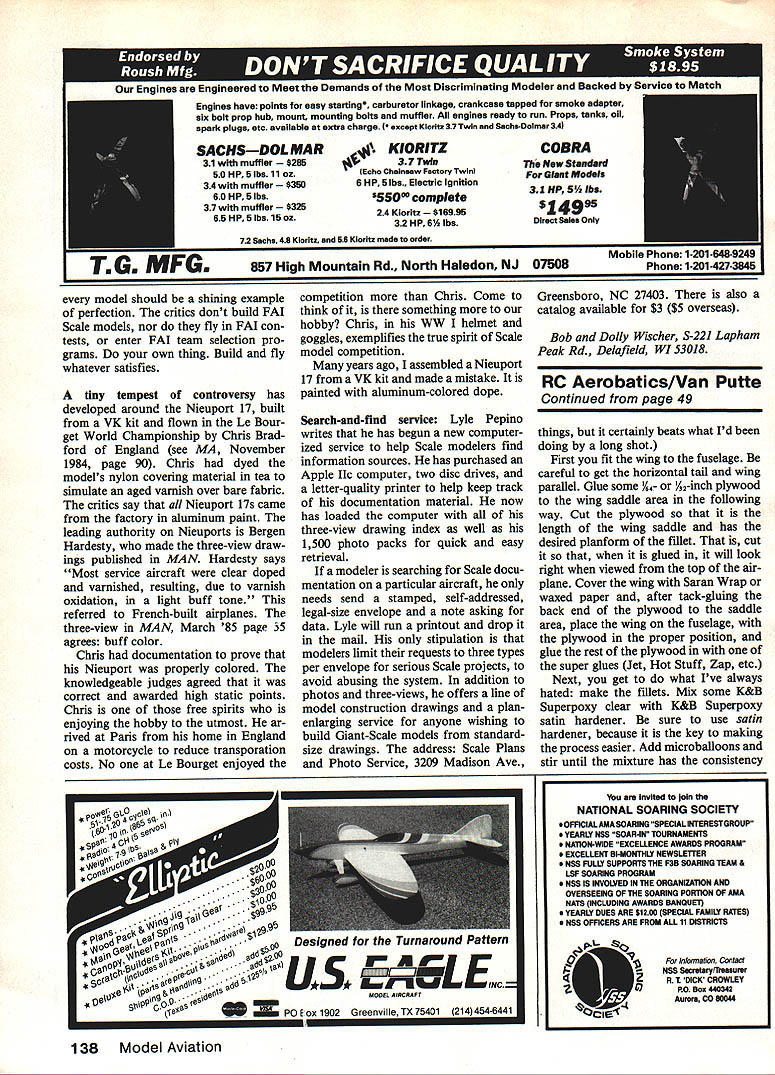
Starting with good information, "sweating out" the details isn't the insurmountable chore that it may initially seem to be. The Stearman Senior Speedmail 4-EM pictured was built from Peter Westburg's precision drawings in Model Builder magazine's collection. Graham Ireland, the builder, knew the value of this excellent information source from the beginning of his research of the type. He also had the important advantage of access to the full-size prototype and a nearby museum for measurements and to obtain the necessary photos and sketches to supplement the drawings.
It's surprising how little detail can be remembered, even for a very short time, where exact shapes and sizes are concerned. Once a modeler has worked from high-quality and accurate drawings, such as those by Westburg or construction blueprints, an ordinary three-view will seem woefully inadequate. There was a time when any three-view served the purpose, and we were more than happy to have it for the beginning of a model project. We are now spoiled by having used better drawings and are reluctant to return to simple three-views.
The leading edge of the cowl on Graham's Stearman is quite obviously not thickened; it has the appearance of the rolled edge found on full-size aircraft. Inside the cowl front is the controllable crankcase ventilator. Dummy cylinders are barely visible in the narrow space between cowl and ventilator. There are cowl fasteners on the sides as well as on the metal fuselage covering to the rear. The authentic tapered exhaust pipe has a row of hex-head screws along its outlet. Altogether, it is a prime example of the scale modeler's art in reproducing detail with a superb degree of exactness. From the 15-foot viewing distance, all of this detail remains visible and it will withstand close inspection as well. We can't ignore the fact that the "business end" of an airplane acquired more than its share of attention—from fellow modelers and judges alike.
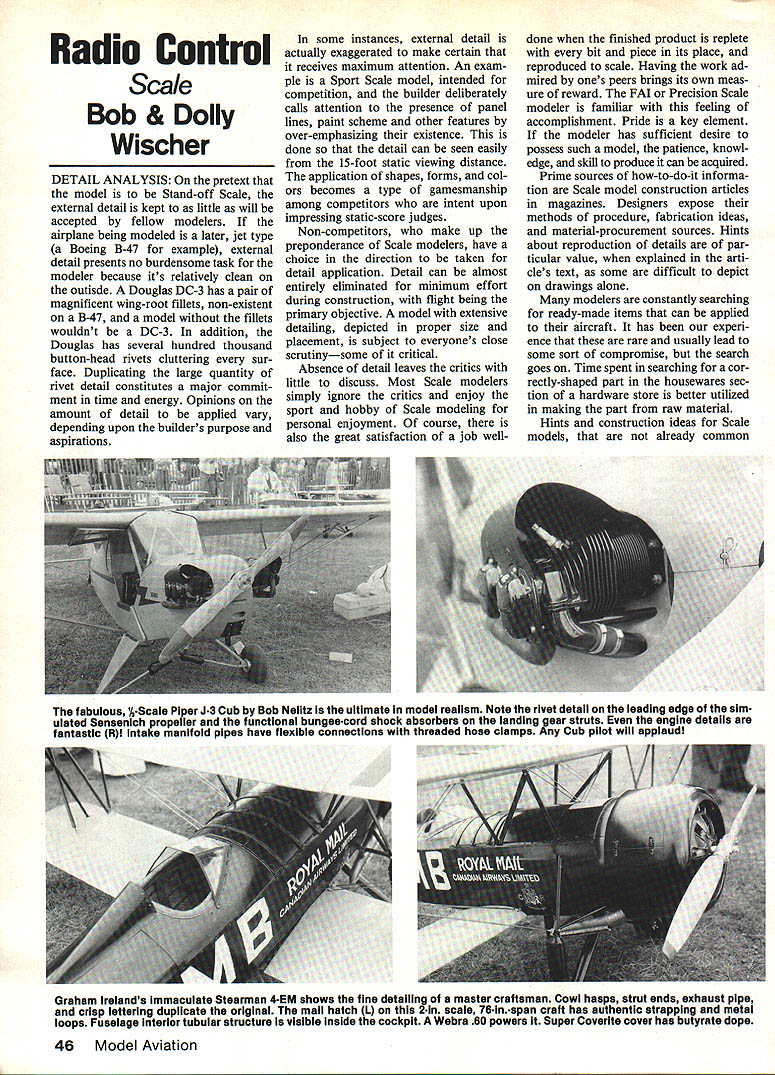
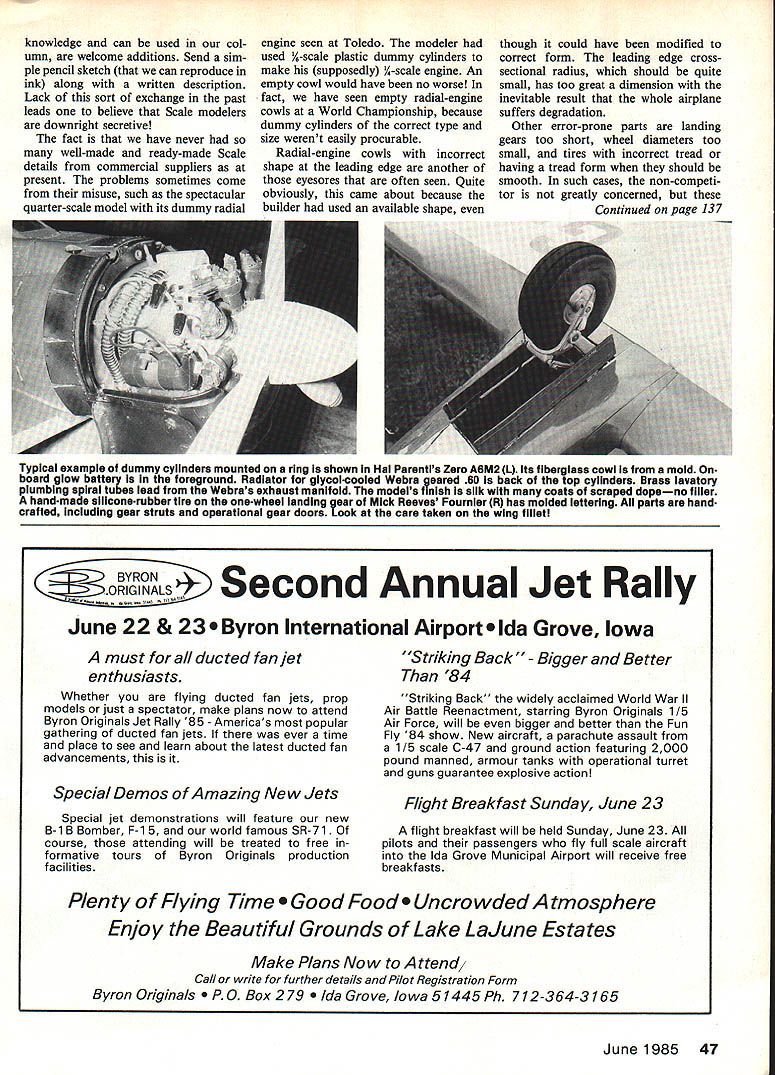
An equally exciting example of fine detailing is Bob Neitz's famous Piper J-3 Cub. The laminated Sensenich propeller is secured by a row of safety-wired bolts. His Continental A-65 engine is startlingly realistic with every detail of fins, cylinder heads, induction pipes, and valve rocker covers reproduced in proper gloss finish. The airplane is completely detailed, but the cowl, engine, and landing gear are the focus of everyone's observation. There is no doubt that detailing to this degree of perfection is not for all of us. It supplies us with ideas of what can be done with diligent application of effort and faithful copying of a particular airplane. Bob didn't say how often he visited the prototype for gathering information and dimensions.
At every gathering of scale modelers, we hear the lament that sport-scale models have become too complex with all of their details. Modelers express a desire to return to earlier times when the standard of scale modeling only needed to remotely resemble the real thing. The escalation in detailing is merely the growth of human aspiration to improve; a trait that is hard to legislate against in the rule book. Omission of the weighty details was supposed to improve flight, and yet the finely detailed and finished models are equally successful in the air. The ambitious modeler who has the patience and skill to produce these masterpieces has also improved his flying technique. Constant improvement in construction has also improved flying technique.
Most importantly, every individual scale modeler should make his or her own decision as to what standard of exactness is necessary for full enjoyment of the sport and hobby. Ignore the critics who expostulate that "scale is scale" and that every model should be a shining example of perfection. The critics don't build FAI scale models, nor do they fly in FAI contests, or enter FAI team selection programs. Do your own thing. Build and fly whatever satisfies.
Nieuport 17 controversy
A tiny tempest of controversy developed around the Nieuport 17 built from a VK kit and flown in the Le Bourget World Championship by Chris Bradford of England (see MA, November 1984, page 90). Chris had dyed the model's nylon covering material in tea to simulate an aged varnish over bare fabric. The critics said that all Nieuport 17s came from the factory in aluminum paint.
The leading authority on Nieuports is Bergen Hardesty, who made the three-view drawings published in MAN. Hardesty says, "Most service aircraft were clear doped and varnished, resulting, due to varnish oxidation, in a light buff tone." This referred to French-built airplanes. The three-view in MAN, March '85, page 35 agrees: buff color.
Chris had documentation to prove that his Nieuport was properly colored. The knowledgeable judges agreed that it was correct and awarded his static points. Chris is one of those free spirits who is enjoying the hobby to the utmost. He arrived at Paris from his home in England on a motorcycle to reduce transportation costs. No one at Le Bourget enjoyed the competition more than Chris. Come to think of it, is there something more to our hobby? Chris, in his WW I helmet and goggles, exemplifies the true spirit of scale model competition.
Many years ago I assembled a Nieuport 17 from a VK kit and made a mistake. It is painted with aluminum-colored dope.
Search-and-find service
Lyle Pepino writes that he has begun a new computerized service to help scale modelers find information sources. He has purchased an Apple II computer, two disk drives, and a letter-quality printer to help keep track of his documentation material. He has loaded the computer with all of his three-view drawing index as well as his 1,500 photo packs for quick and easy retrieval.
If a modeler is searching for scale documentation on a particular aircraft, he only has to send a stamped, self-addressed legal-size envelope and a note asking for data. Lyle will run a printout and drop it in the mail. His only stipulation is that modelers limit their requests to three types per envelope for serious scale projects, to avoid abusing the system. In addition to photos and three-views, he offers a line of model construction drawings and a plan-delinear service for anyone wishing to build giant-scale models or for standard-size drawings.
Address: Scale Plans and Photo Service, 3209 Madison Ave., Greensboro, NC 27403. A catalog is available for $3 ($5 overseas).
Bob and Dolly Wischer S-221 Lapham Peak Rd., Delafield, WI 53018.
Transcribed from original scans by AI. Minor OCR errors may remain.

