
Radio Control: Scale
Bob & Dolly Wischer
Toledo Airplanes
This was a bountiful year for high-quality airplanes at the Toledo show. Judges' selections of winners in all Scale classes were based upon a concerted search for minor imperfections and slight variations in quality between the top airplanes. All were fine examples of Scale modeling at its best.
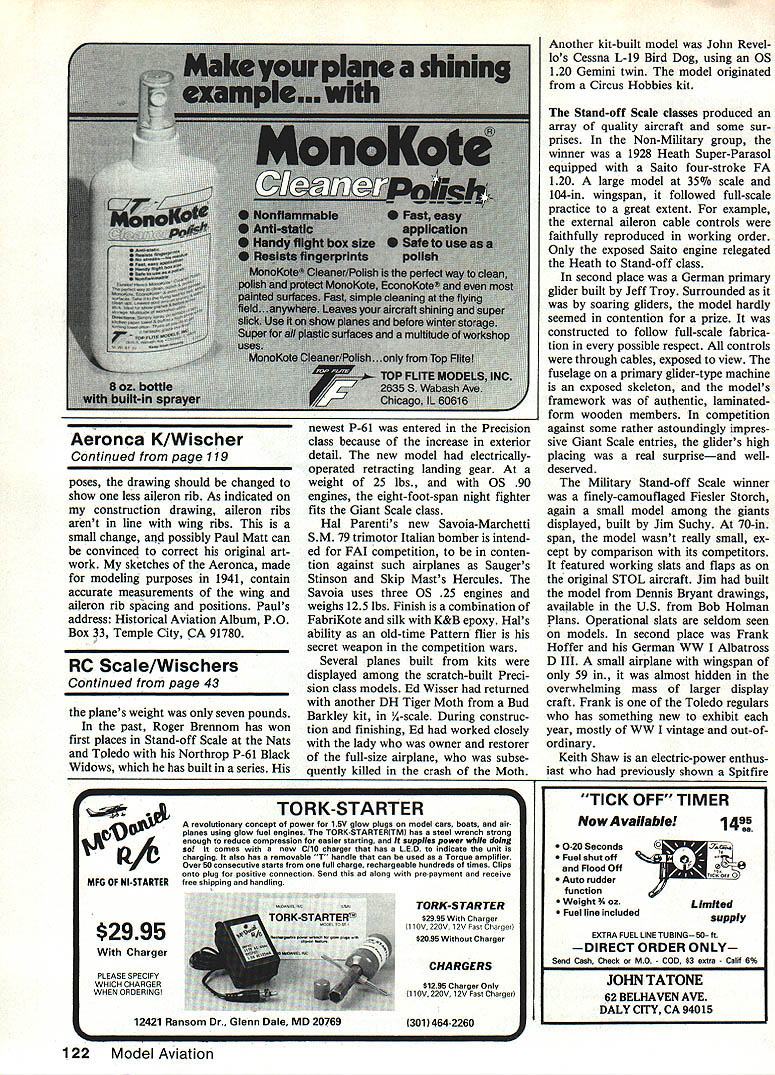
Winner of first place, as well as the Best-of-Show award, was Steve Sauger's familiar Stinson A Trimotor. A commonly heard remark from viewers around the table for Precision Scale models was that they are pretty, but never flown. This expressed opinion was securely put to rest at Toledo. Steve's Stinson has not only been flown, it has placed him on the FAI Scale team. We have watched while Steve made a landing with two dead engines. Only the right outboard continued to run, and there was no apparent loss of stability.
The prototype for Steve's Trimotor is an existing restoration which has paid regular visits to the EAA convention at Oshkosh. It is in Pennsylvania Central Airlines colors. Fineness of finish and detailing are trademarks of Steve's craftsmanship. In addition to the usual rib stitching that is now commonly found on accurate Scale models, Steve had also shown stitching on the fabric over the fuselage stringers—and had documentation color photos to prove it was correct. Although the scale is only 1/2-size, the model is quite large at a 90-in. span. The center engine is an OS .25, and the outboards are HB .25s. Small hatches, almost invisible in the cowl tops, are raised for access to the engines' glow plugs.
The model is an example of the current trend toward building FAI airplanes as large as possible while keeping weight just below the 132-lb. top limit, because large airplanes fly better. With its three engines and retracting gear, it is awarded a 25% bonus added to the flight score in FAI events. We hope to see the Stinson again at the Scale team trials on August 23–25, which are to be conducted at Tom Sawyer State Park near Louisville, Kentucky.
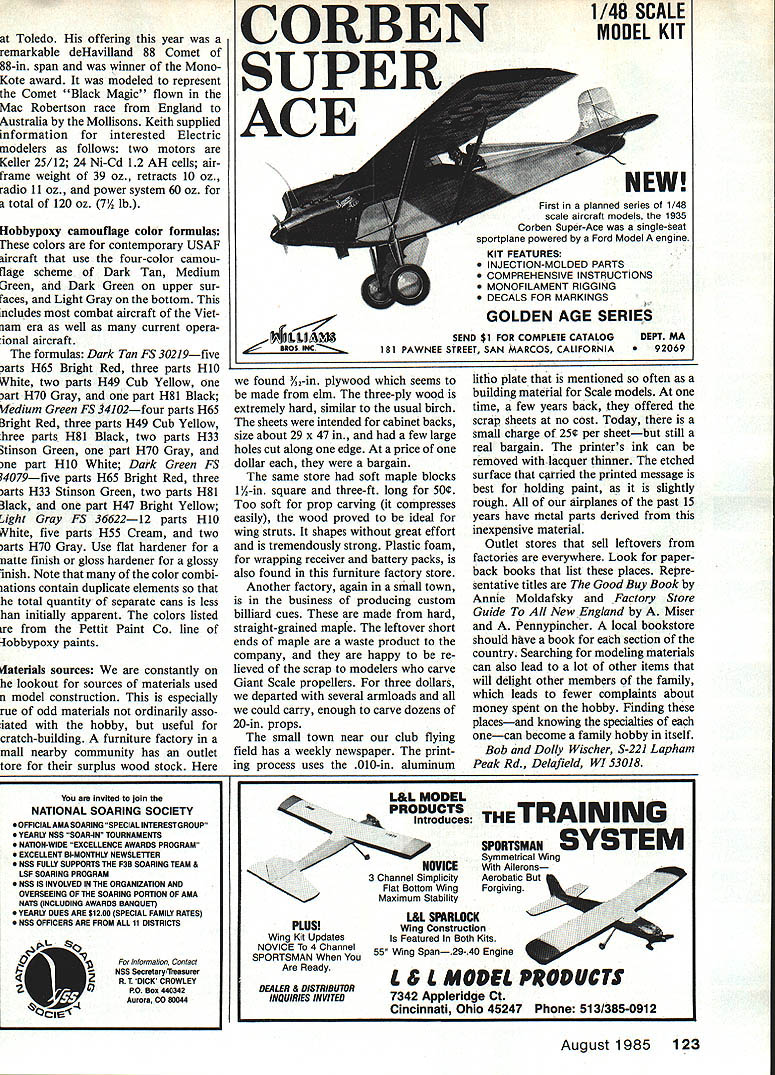
Placing second in Precision Scale class (Toledo rules) was a Mooney-Culver design, the 1937 Dart by Paul Weigand. At a 118-in. wingspan and 32 lbs. for a Quadra .50 engine, Paul had used the factory drawings to design the elaborate model. Many of its features were of outstanding quality. Finish was Randolph butyrate dope over Coverite, with a high gloss achieved by mixing clear dope with the final coat. Unusual for a model were its ball-bearing ailerons. Sheet vinyl was used to give a metal-like appearance wherever required on fuselage panels, windshield and canopy frames, interior trim, and to simulate sheet aluminum in the expansive wing fillets. Working oleos and landing-gear sliding-canopy windows added realism. The Dart hadn't flown at Toledo time, but its low wing loading of 32 oz. per sq. ft. would indicate that it is certainly flyable.
Jerry Gardner's famous 1/2-size Pitts S-1A appeared at Toledo for the second time and was awarded third place in Precision class. Two years ago it was shown as a skeleton, demonstrating that its structure duplicated the full-size to a degree never before seen in modeling. In every detail the model exactly duplicates materials and structure as on the prototype. The engine is a two-cylinder Limbach of 18 horsepower, swinging a 36-12 prop. All of this working mechanism and structure adds up to an overwhelming 80 lbs. of airplane — considerably in excess of AMA's Safety Code upper limit of 55 lb. The covering material, as on the prototype, is Ceconite, with a final finish of Ditzler paint.
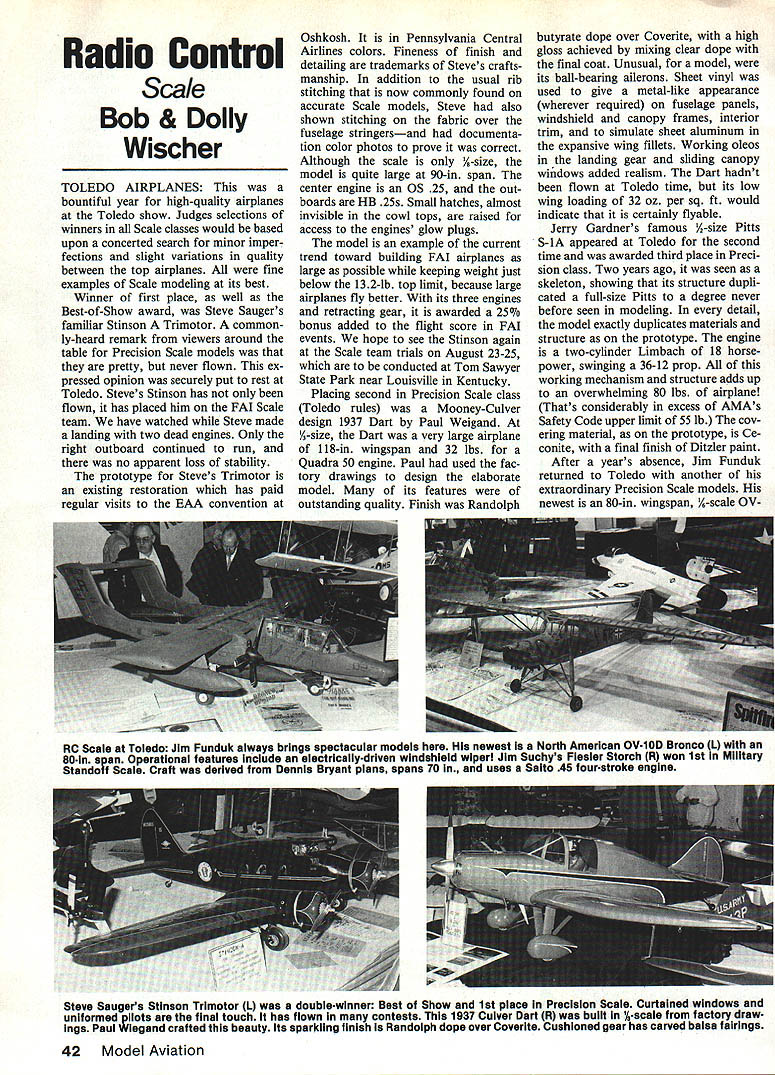
After a year's absence, Jim Funduk returned to Toledo with another of his extraordinary Precision Scale models. His newest is an 80-in. wingspan, 1/8-scale OV-10 Bronco, complete with working detail even including an electrically operated windshield wiper. In the past, Jim has displayed models that seemed unlikely to become airborne. His Bronco's first flight was made early in 1984. Of balsa and plywood construction, the model was covered with silkspan and dope in the interest of weight reduction and painted with acrylic lacquer. Jim had made his own retract mechanisms. As on the original, fuselage sections at nose and tail swing away on hinges to reveal internal detail. Jim has worked closely with a nearby Marine base to be certain of accuracy in duplicating every detail of structure and armament.
The 21-lb. Bronco is presently powered by a pair of OS .40 engines, and consideration is being given to an increase to a pair of .60s. Wing loading is now almost 39 oz. per sq. ft. Under ordinary circumstances of Toledo competition, Jim's Bronco would surely have been considered in the running for an award, but the large number of high-quality entries must have given the judges a difficult task to choose between them. At least five of the Precision Scale models were potential winners. Never before has Toledo been blessed with so many.
A sentimental favorite among the Precision entries was a float-equipped Bellanca Aircruiser by Orest Drobet. Built to one-inch scale with a 65-in. wingspan, it was a little jewel among the giants. The floats and portions of the fuselage were sheet-aluminum covered, which combined with the aluminum MonoKote to give the model an attractive sparkle. The floats were foam core and metal covered over balsa. Even with large areas of metal, the Bellanca was truly museum-quality — and that is its destination, a museum in Canada. The splendid Aircruiser will most likely never be flown. If an attempt were to be made, the engine would be a Wankel.
Another kit-built model was John Revello's Cessna L-19 Bird Dog, using an OS 1.20 Gemini twin. The model originated from a Circus Hobbies kit.
The Stand-off Scale classes produced an array of quality aircraft and some surprises. In the Non-Military group, the winner was a 1928 Heath Super-Parasol equipped with a Saito four-stroke FA 1.20. A large model at 35% scale and 104-in. wingspan, it followed full-scale practice to a great extent. For example, the external aileron cable controls were faithfully reproduced in working order. Only the exposed Saito engine relegated the Heath to Stand-off class.
In second place was a German primary glider built by Jeff Troy. Surrounded as it was by soaring gliders, the model hardly seemed in contention for a prize. It was constructed to follow full-scale fabrication in every possible respect. All controls were through cables, exposed to view. The fuselage on a primary-glider-type machine is an exposed skeleton, and the model's framework was of authentic, laminated-form wooden members. In competition against some rather astoundingly impressive Giant Scale entries, the glider's high placing was a real surprise — and well deserved.
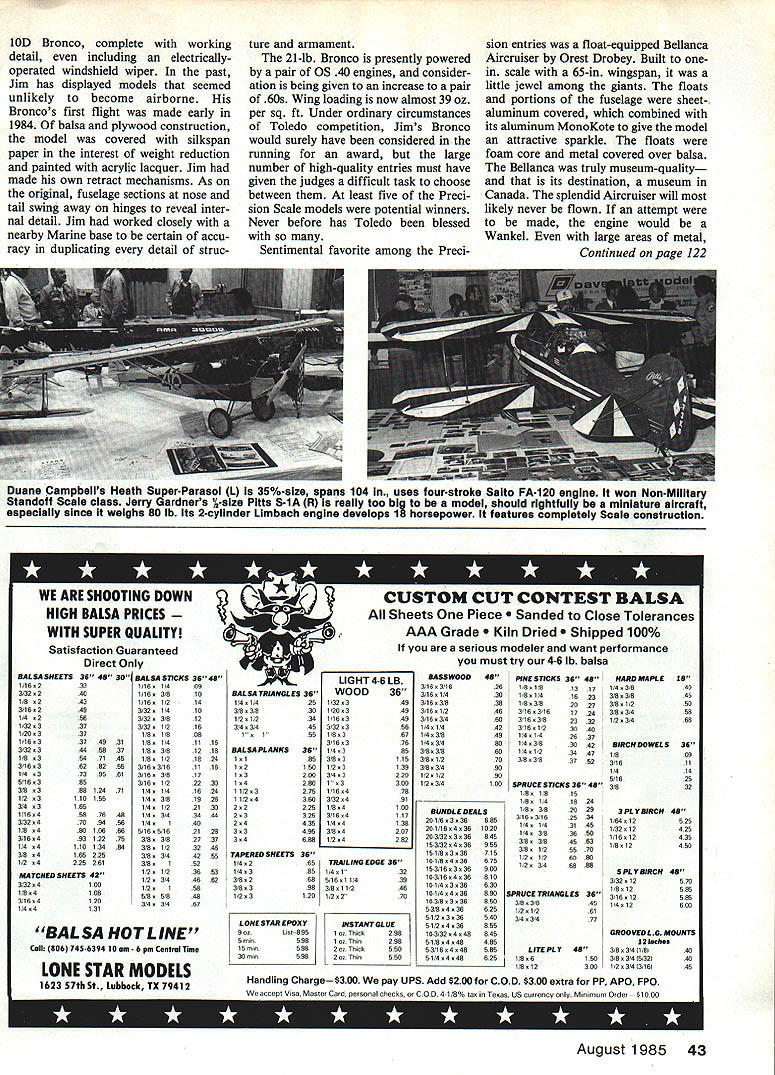
The Military Stand-off Scale winner was a finely camouflaged Fieseler Storch, again a small model among the giants, displayed and built by Jim Suchy. At a 70-in. span, the model wasn't really small except by comparison with its competitors. It featured working slats and flaps as on the original STOL aircraft. Jim had built the model from Dennis Bryant drawings, available in the U.S. from Bob Holman Plans. Operational slats are seldom seen on models. In second place was Frank Hoffer and his German WW I Albatross D.III. A small airplane with a wingspan of only 59 in., it was almost hidden in the overwhelming mass of larger display craft. Frank is one of the Toledo regulars who has something new to exhibit each year, mostly of WW I vintage and out-of-ordinary.
Keith Shaw is an electric-power enthusiast who has previously shown a Spitfire at Toledo. His offering this year was a remarkable de Havilland 88 Comet of 88-in. span and was winner of the Mono-Kote award. It was modeled to represent the Comet "Black Magic" flown in the MacRobertson race from England to Australia by the Mollisons. Keith supplied information for interested electric modelers as follows:
- Two motors: Keller 25/12
- Batteries: 24 Ni-Cd 1.2 AH cells
- Airframe weight: 39 oz.
- Retracts: 10 oz.
- Radio: 11 oz.
- Power system: 60 oz.
- Total: 120 oz. (7½ lb)
Hobbypoxy camouflage color formulas
These colors are for contemporary USAF aircraft that use the four-color camouflage scheme of Dark Tan, Medium Green, and Dark Green on upper surfaces, and Light Gray on the bottom. This includes most combat aircraft of the Vietnam era as well as many current operational aircraft. The colors listed are from the Pettit Paint Co. line of Hobbypoxy paints.
- Dark Tan FS 30219:
- 5 parts H65 Bright Red
- 3 parts H10 White
- 2 parts H49 Cub Yellow
- 1 part H70 Gray
- 1 part H81 Black
- Medium Green FS 34102:
- 4 parts H65 Bright Red
- 3 parts H49 Cub Yellow
- 3 parts H81 Black
- 2 parts H33 Stinson Green
- 1 part H70 Gray
- 1 part H10 White
- Dark Green FS 34079:
- 5 parts H65 Bright Red
- 3 parts H33 Stinson Green
- 2 parts H81 Black
- 1 part H47 Bright Yellow
- Light Gray FS 36622:
- 12 parts H10 White
- 5 parts H55 Cream
- 2 parts H70 Gray
Use flat hardener for a matte finish or gloss hardener for a glossy finish. Note that many of the color combinations contain duplicate elements so that the total quantity of separate cans is less than initially apparent.
Materials sources
We are constantly on the lookout for sources of materials used in model construction. This is especially true of odd materials not ordinarily associated with the hobby, but useful for scratch-building.
- Furniture factory outlet:
- 3/8-in. plywood (seems to be elm), three-ply, extremely hard, about 29 x 47 in.; many sheets had cutouts along one edge. Priced at one dollar each — a bargain.
- Soft maple blocks, 1½-in. square and three-ft. long, for 50¢. Too soft for prop carving (it compresses easily) but ideal for wing struts: shapes easily and is tremendously strong.
- Plastic foam useful for wrapping receiver and battery packs.
- Billiard-cue factory:
- Leftover short ends of hard, straight-grained maple are available for carving Giant Scale propellers. For three dollars we departed with several armloads — enough to carve dozens of 20-in. props.
- Local small-town newspaper:
- The printing process uses .010-in. aluminum litho plate, often available as scrap for a small charge (25¢ per sheet). Printer's ink can be removed with lacquer thinner. The etched surface holds paint well because it is slightly rough. Many of our airplanes of the past 15 years have metal parts derived from this inexpensive material.
Outlet stores that sell leftovers from fabricators are everywhere. Look for paperback books that list these places. Representative titles are The Good Buy Book by Annie Moldafsky and Factory Store Guide to All New England by A. Miser and A. Pennypincher. A local bookstore should have a book for each section of the country. Searching for modeling materials can also lead to a lot of other items that will delight other members of the family, which leads to fewer complaints about money spent on the hobby. Finding these places—and knowing the specialties of each one—can become a family hobby in itself.
—Bob and Dolly Wischer, S-221 Lapham Peak Rd., Delafield, WI 53018
Transcribed from original scans by AI. Minor OCR errors may remain.

