
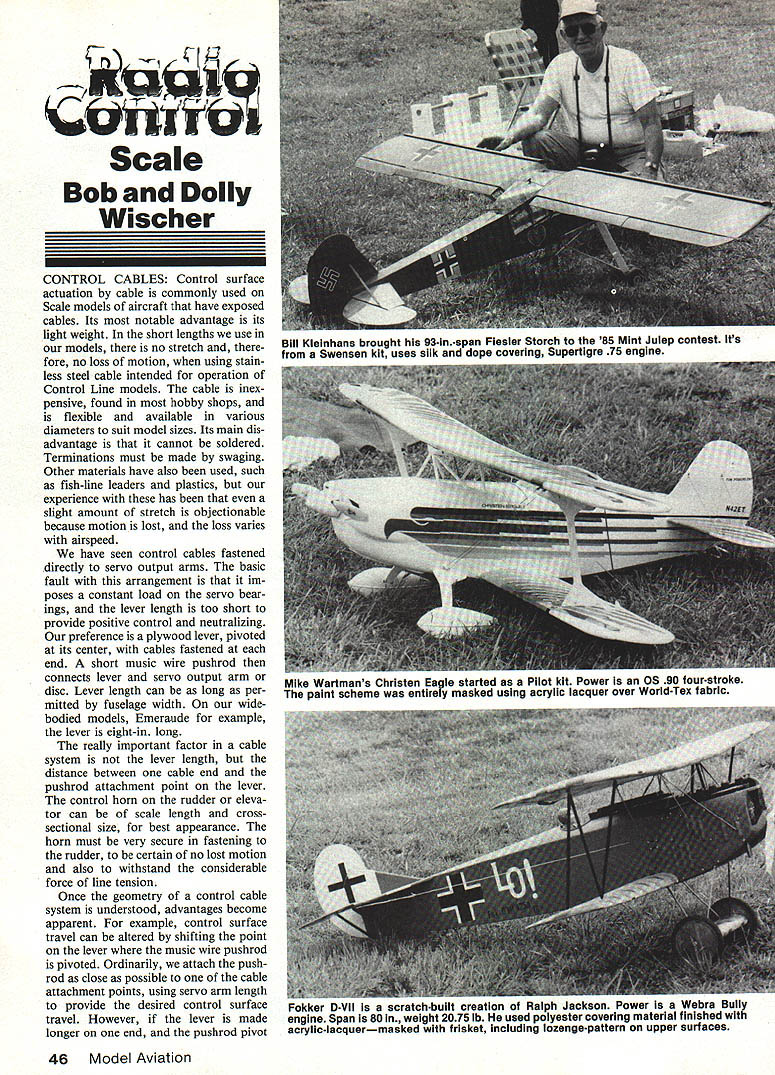
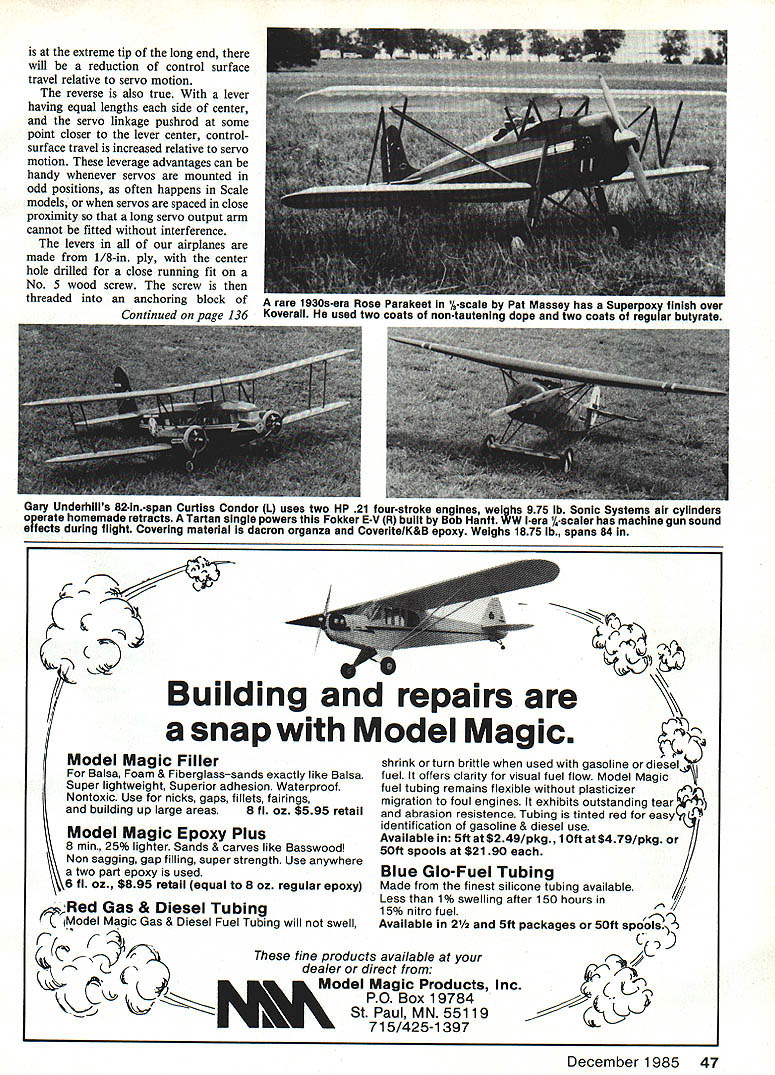
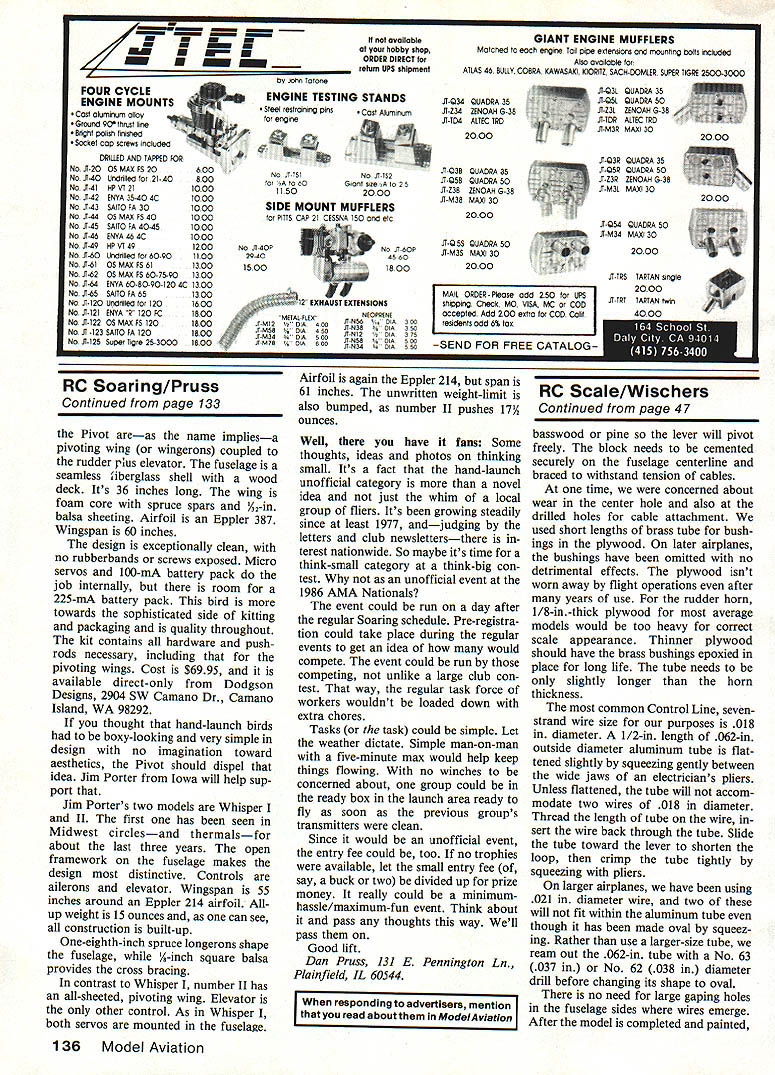
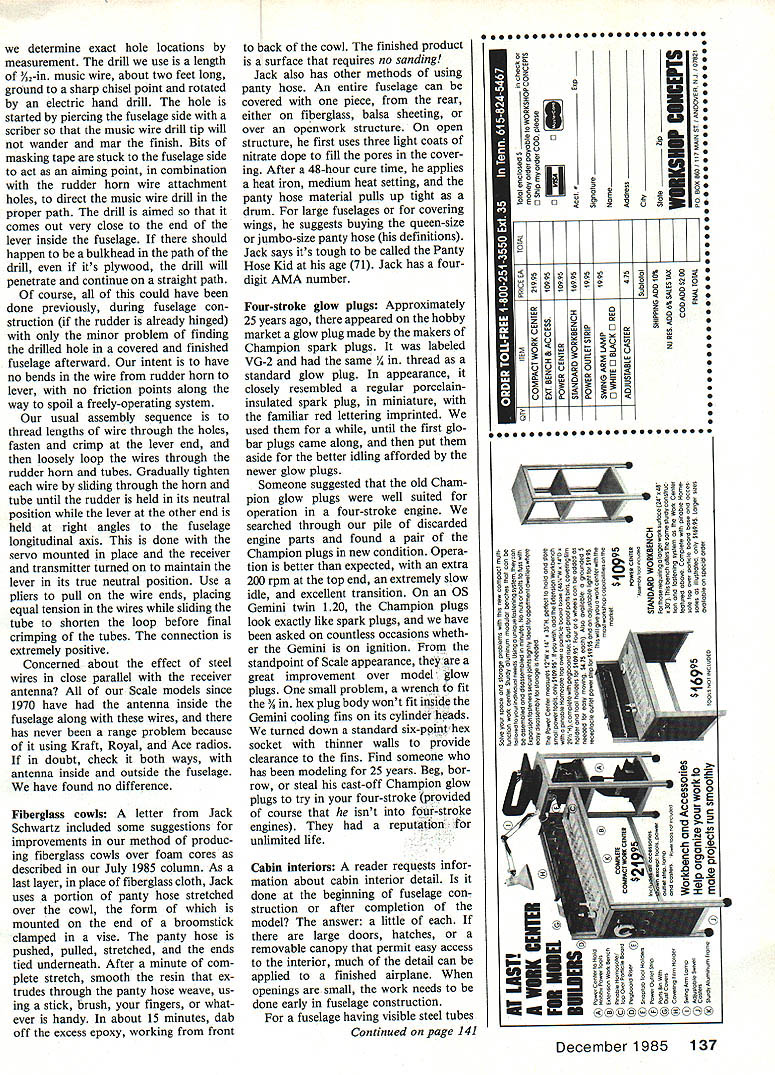
Radio Control: Scale
Bob and Dolly Wischer, S-221 Lapham Peak Rd., Delafield, WI 53018.
Control Cables
Control-surface actuation by cable is commonly used on scale models that have exposed cables. Its chief advantage is light weight. Over the short lengths used on models there is essentially no stretch and therefore no loss of motion when using stainless-steel cable intended for Control Line models. This cable is inexpensive, available at most hobby shops, flexible, and comes in various diameters to suit model sizes. Its main disadvantage is that it cannot be soldered; terminations must be made by swaging.
Other materials (fish-line leaders, plastics) have been tried, but even slight stretch is objectionable because motion is lost and the loss varies with airspeed.
Avoid fastening cables directly to servo output arms. That arrangement imposes a constant load on the servo bearings and the lever length is usually too short to provide positive control and neutralizing. Prefer a plywood lever pivoted at its center with cables fastened at each end, and a short music-wire pushrod connecting the lever to the servo output arm or disc. Lever length can be as long as fuselage width permits — on some wide-bodied models (Emeraude, for example) an eight-inch lever is used.
The critical factor in a cable system is the geometry: the distance between a cable end and the pushrod attachment point on the lever. The control horn on the rudder or elevator can be scale length and cross section for appearance, but it must be very securely fastened to prevent lost motion and to withstand line tension.
Once the geometry is understood, advantages become apparent. Control-surface travel can be altered by shifting the point on the lever where the music-wire pushrod pivots:
- Ordinarily attach the pushrod as close as possible to one of the cable attachment points and use servo-arm length to obtain the desired control-surface travel.
- If the lever is made longer on one end and the pushrod pivot moved toward the long end, control-surface travel is reduced relative to servo motion; the reverse is also true.
- A lever with equal lengths on each side of center and the pushrod nearer the center will increase control-surface travel relative to servo motion.
These leverage options are useful when servos are mounted in odd positions. When servos are crowded, a long servo output arm may not fit because of interference.
Levers are made from 1/8-in. plywood. Drill the center hole for a close-running fit and secure with a No. 5 wood screw threaded into an anchoring block.
Concerned about parallel steel control wires affecting the receiver antenna? In our experience (models since 1970) placing the antenna inside the fuselage alongside these wires has not caused range problems. If unsure, check range both ways — we have found no difference.
Fiberglass Cowls
Jack Schwartz suggested improvements to producing fiberglass cowls over foam cores. As the last layer, instead of fiberglass cloth he stretches a portion of panty hose over the cowl form mounted on the end of a broomstick clamped in a vise. The panty hose is pulled tight and the ends tied underneath. After a minute of full stretch, smooth the resin that extrudes through the weave using a stick, brush, or fingers. In about 15 minutes dab off excess epoxy, working from front to back. The finished surface often requires no sanding.
Jack also uses panty hose to cover an entire fuselage (rear first) over fiberglass, balsa sheeting, or an open-work structure. On open structures he first applies three light coats of nitrate dope to fill pores, lets it cure 48 hours, then uses a medium-heat iron to pull the panty hose tight like a drum. For large fuselages or wings he suggests using queen-size or jumbo panty hose. (Jack admits it’s tough being called the “Panty Hose Kid” at age 71. He has a foreign AMA number.)
Four-stroke Glow Plugs
About 25 years ago a glow plug labeled VG-2, made by the makers of Champion spark plugs, appeared on the hobby market. It had a 1/4-in. thread and resembled a miniature porcelain-insulated spark plug. We used them until the first dedicated four-stroke plugs arrived, then set them aside.
Someone suggested these old Champion plugs might suit four-stroke engines. We found a pair in new condition and the results exceeded expectations: an extra 200 rpm at the top end, an extremely slow idle, and excellent transition. On an OS Gemini twin 1.20 the Champion plugs look exactly like spark plugs and greatly improve scale appearance. One small problem: the 7/16-in. hex body of the plug requires a wrench that often won't fit inside the engine cooling fins. We turned down a standard six-point box socket with thinner walls to provide clearance. If you can, find an experienced modeler’s cast-off Champion plugs to try in your four-stroke — they had a reputation for long life.
Cabin Interiors
A reader asked whether cabin interior detail should be done at the beginning of fuselage construction or at the end. The answer: a little of both. If large doors, hatches, or a removable canopy permit easy access, much of the detail can be applied after the model is finished. When openings are small, do the work early during fuselage construction.
For fuselages showing visible steel tubes or formed aluminum bulkheads, those parts should be built into the structure before external sheeting is applied. Tubes can be represented with wood dowels fastened with ordinary model cement or glue. Aluminum tubes are possible but present fastening-joint problems unless the modeler can braze. All joints, wood or aluminum, must be absolutely secure or parts will rattle inside the fuselage after a bad landing. Paint these internal parts before covering the exterior surfaces.
Civil aircraft interiors are likely to be smoothly finished; most military types will show open structure. For a smooth interior, build in balsa or styrene sheet panels to the desired effect. Because it is difficult to work through small openings, apply paint as work progresses rather than trying to spray the inside of a completed cabin. On military models the inner surface of the covering material often becomes the cockpit wall.
Make the canopy removable for access to the cockpit. Working through a small cabin door is the worst situation. Consider building an access hatch in the fuselage bottom where it is less conspicuous; a top hatch with visible edges where smooth surfaces should be is least desirable.
Installing radio equipment in the cockpit complicates producing a presentable interior. Seats and floors must be removable for servicing and to provide access to servos, battery, and receiver. We use Velcro to hold seats and floors in place — small scraps about 1/4 in. x 1 in. work well. If the Velcro area is too large, a balsa seat may be pulled free from its glue. With small pieces, a light pull removes the seat for service but it remains secure in flight; a bad landing has never shaken a seat loose in one of our planes. A dummy pilot can be held by a seat belt or shoulder harness made from dressmaker’s ribbon, with ends anchored to seat edges using Velcro.
Other cabin details — instrument panels, control stick or wheel, upholstery — are usually installed last, after the model is painted but before enclosing with windows and windshield or canopy. The instrument panel often covers the fuel tank; we prefer to fasten the panel with small wood screws to permit removal for tank servicing.
Transcribed from original scans by AI. Minor OCR errors may remain.

