
Radio Control: Scale
Bob and Dolly Wischer
Unexpected stalls
Warped wings are deadly. Warps that result in a greater angle of incidence at the wing tip than at the root are the worst — this condition is known as washin. A model with washin on one wing may require large aileron trim or constant transmitter hold to keep it from rolling into a turn. The condition worsens when a high angle of attack is imposed, as when using elevator to increase climb or during a steep turn, and it affects the model differently at various speeds.
The elevator is the trim control used to set the wing's angle of attack — the angle at which the wing meets the oncoming airflow. A warped wing whose tip is already near stall will suddenly stop producing lift when Up elevator is applied, because its angle of attack is increased beyond the critical point. Heavier models stall earlier because the wing must be at a higher angle of attack initially to support the weight. If both wings are warped similarly, a stall will still occur, but the direction of the resulting snap roll is less predictable.
Angle of attack is affected by turns, loop maneuvers, and slow flight. In a loop, angle of attack is increased sharply to produce lift during the first half — kinetic energy (speed and thrust) is borrowed to change the model's path into a curve. After the top of the loop, gravity becomes the main energy source and considerable Up elevator is needed to round out the loop and return to level flight; gravity combined with centrifugal force imposes heavy loads on the wing at the bottom of the loop. The result is a greater angle of attack at the beginning and end of the maneuver. If too great, the wing stalls, followed by a snap roll and possible spin. Slow speed (from too-small an engine or closed-throttle operation) can likewise bring the wing near stall.
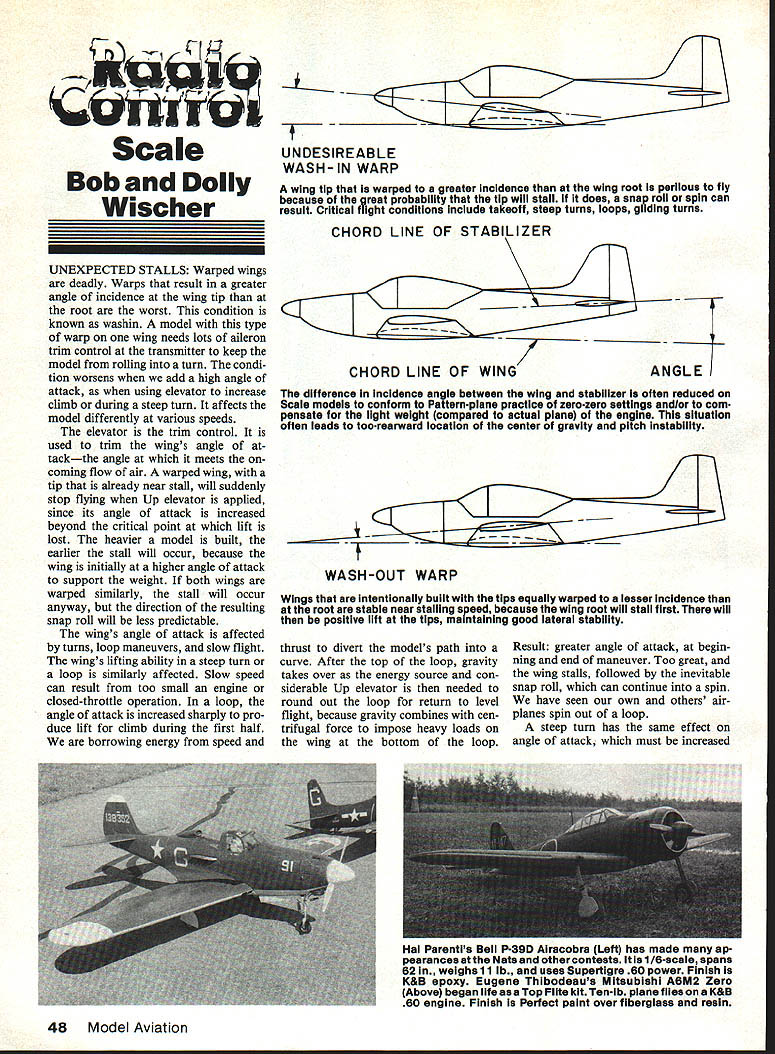
Undesirable wash-in (washin)
Wash-in (warp with the wing tip at greater incidence than the root) is perilous because the tip is likely to stall first. Critical flight conditions include takeoff, steep turns, loops, and gliding turns. A tip stall can lead to a sudden snap roll or spin, which is especially dangerous at low altitude.
Scale models sometimes adopt pattern-plane practice of zero-zero incidence settings or reduce the wing-to-stabilizer incidence difference to compensate for the relatively light engine. This can push the center of gravity too far rearward and cause pitch instability, exacerbating stall tendencies.
Wash-out (washout warp)
Wings intentionally built with the tips at lesser incidence than the root (washout) are more stable near stalling speed because the root will stall first while the tips continue to produce lift, maintaining lateral stability. Four to five degrees of washout may seem excessive on a straight wing, but on a straight or sharply tapered wing this amount is common.
Washout is not a cure-all. When flying inverted, washout effectively becomes washin. Its beneficial action depends on angle of attack and center of gravity location. With a rearward CG, a modeler often finds drastic Down elevator trim is needed to maintain level flight. Moving the elevator trim on the transmitter may be insufficient; the flier might be forced to change the linkage at the elevator servo to obtain the needed Down elevator. That reduces the wing tip angle of attack to the point where the tips merely go along for the ride and do not supply their share of lift. The model becomes laterally unstable, with tips rising and falling, and is difficult to control.
Center of gravity, nose weight, and longitudinal stability
To cure pitch instability, modelers often add nose weight. Although it seems counterintuitive to add weight to a heavily loaded wing, adding nose weight changes the longitudinal stability characteristics. Adding nose weight allows the Down elevator trim to be reduced or removed and up-trim applied for level flight. The stabilizer then produces a downforce that increases with airspeed, depressing the tail and reducing speed; if the nose rises and speed drops, the tail downforce diminishes and the tail rises, restoring positive longitudinal stability. This is the fore-and-aft stability formula used in full-size aircraft.
On scale models we tend to decrease the angular difference between wing and tail incidence because our engines weigh much less relative to total aircraft weight than full-size engines do. Decreasing that angular difference can lead to longitudinal instability, with the model hunting for level position (nose rising and falling). Adding nose weight and re-trimming the elevator typically cures the hunting and also helps lateral stability by restoring a positive angle of attack at the washed-out tips so they contribute lift more consistently.
Ailerons, adverse yaw, and tip stalling
Large ailerons with excessive travel can act like a warped wing. Ailerons are used to establish a steeply banked turn; recovery is by applying opposite aileron. The lowered aileron on the low wing produces large drag, which causes adverse yaw and tends to pull the nose down. The pilot often compensates with increasing aileron, and in a steep turn the angle of attack is already high because much of the wing's lift is being used to change direction rather than support weight. The lowered aileron can then act like a warp and stall that wing and its aileron. The result can be a snap roll into a spin — potentially fatal at low altitude when there is insufficient time or space to recover.
Remedies:
- Use less aileron and elevator travel in the servo linkage.
- Learn to use rudder together with aileron to help in steep turns.
Bob and Dolly Wischer S-221 Lapham Peak Rd., Delafield, WI 53018
Transcribed from original scans by AI. Minor OCR errors may remain.

