
Radio Control: Scale
Bob and Dolly Wischer
Bonus limits
The Paris CIAM meetings always prompt thoughts about the direct effect rules changes will have on modelers' future projects. FAI rule changes often lead trends, and a trend appears to be developing in the bonus system for RC Scale. Changes becoming effective next year can be expected to affect the outcome of team trials.
A proposed 20% maximum cumulative bonus should reduce strategic modeling—builders adding as many bonus features as possible to overwhelm competitors with high flight scores. Most present-day team models would not suffer too severely under a 20% limit. Three- and four-engine models would be reduced to an equal engine bonus of about 10%, so model quality and flight performance would determine winners rather than extra engine bonuses. The bonus system was recognized from the start as likely to need fine-tuning later to be workable.
There are likely to be additional changes next year. One proposal (to be brought to the 1987 CIAM meeting) would change bonuses as follows:
- Eliminate the separate bonus for biplanes (except a 5% bonus for pre-1920 biplanes with undercambered wing airfoils).
- Award a 10% bonus for triplanes.
- Eliminate the separate bonus for retractable landing gear.
- Give a 5% bonus for conventional two-wheel landing gear (whether retractable or fixed).
- No bonus for tricycle or monowheel gear.
The effect of this proposal would be to reduce the maximum bonus to about 15% total for a multi-engined model with two-wheel gear. The actual performance gap between simple and very complex two-wheel-geared models would be reduced to roughly 10%. Since simpler aircraft often fly better than more complex competitors, this brings models into closer parity.
Case study: SM-81 vs SM-79
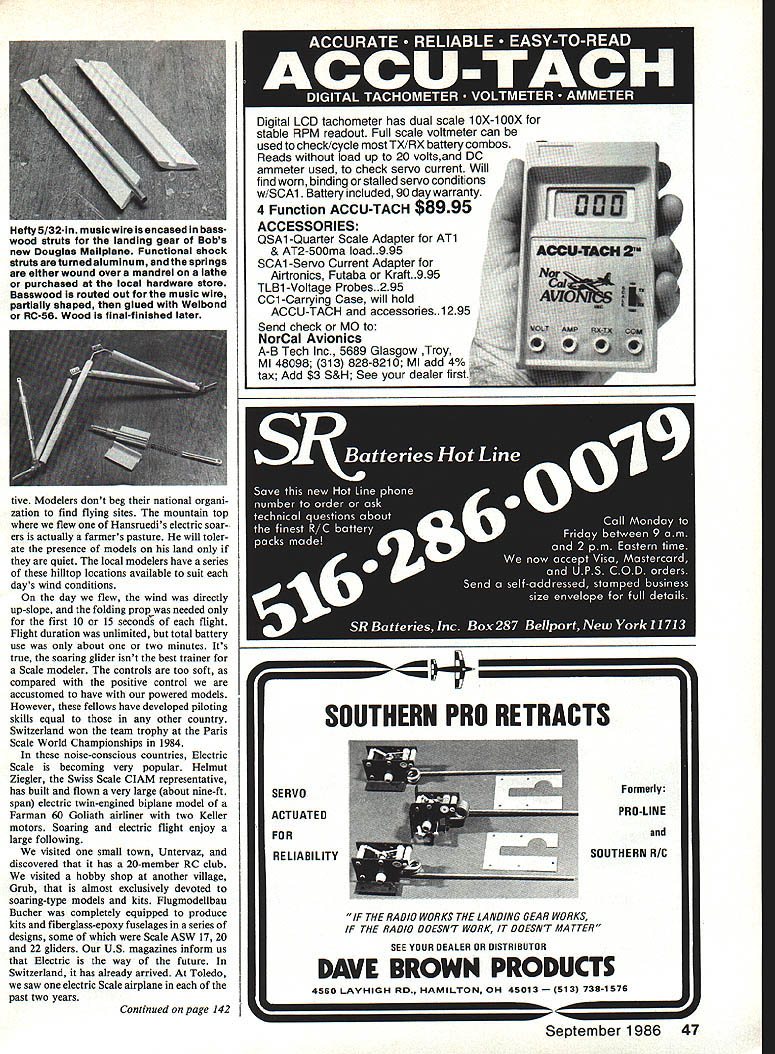
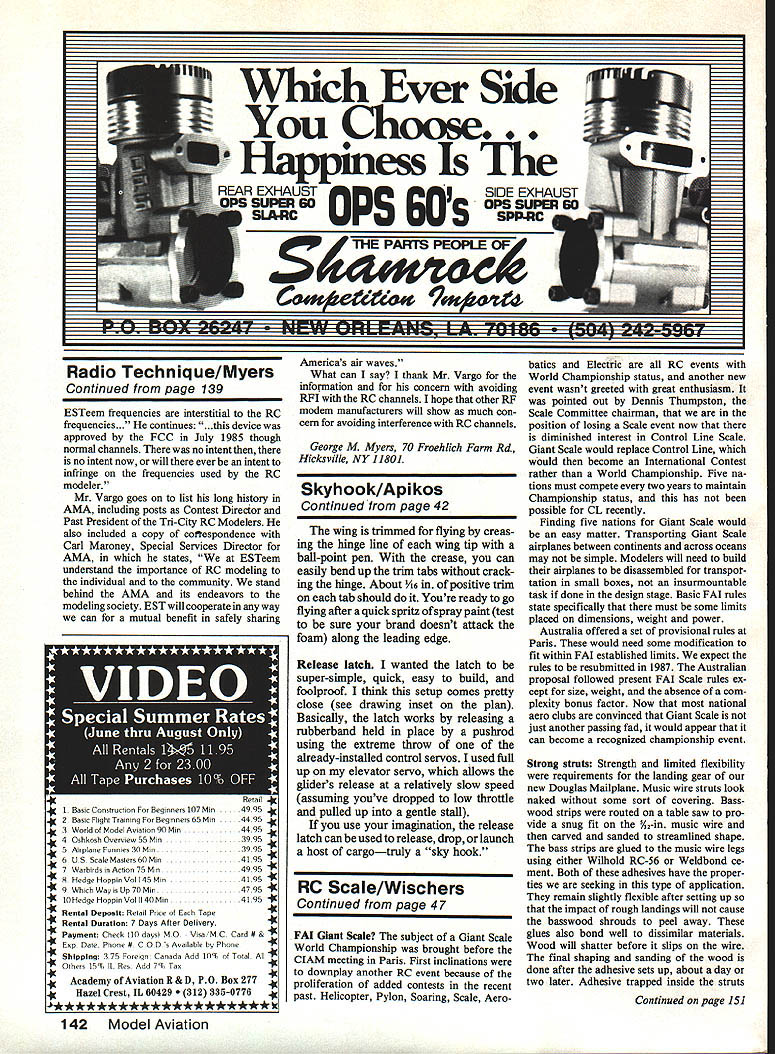
A good example of the impact is the recent head-to-head at the Mint Julep contest at Rough River, Kentucky, between Cliff Tacie's Savoia-Marchetti SM-81 and Hal Parentis's SM-79. Both are trimotors. Hal's bomber had retractable gear while Cliff's used a fixed two-wheel gear. Under present rules, Hal's retracts carried a 5% bonus and he took first place. Under the projected changes, both airplanes would have equal bonus advantage and Cliff would have won by a small margin.
Both competitors selected airplanes that take advantage of the bonus system—before and after changes. A trimotor rather than a twin gives insurance against a dead engine, and multi-engines combined with conventional landing gear provide maximum bonus advantage. Both models, although produced for FAI competition, are also well suited for AMA Sport Scale or Scale Masters–type contests. Retractable gear remains a valuable flight option that can score highly for flight performance.
Team selection differences
Team selection processes vary widely between nations:
- In the U.S., selection is made one year in advance of the World Championship. The modeler is not obligated to use the same airplane flown in the trials, allowing freedom to improve the entry (Skip Mast, for example, built an entirely new Hercules for Oslo).
- In Britain, selection is held earlier in the same year as the Championship, and the modeler must use the same airplane and is not permitted to change engines.
Weight limit and engine rules
With the planned increase in the weight limit to seven kilograms (15.43 lb) and relaxation of rules to permit larger-displacement engines (except for a single two-stroke engine), the FAI model is now remarkably similar to an AMA Sport Scale airplane. No measurements are taken; models are judged from a distance. We hope many more U.S. Scale modelers will participate in future FAI team selections.
Findings from the Paris meetings: Giant Scale and Control Line
- Several nations must compete every two years to maintain World Championship status; this has been difficult recently for Control Line Scale.
- Giant Scale was proposed as a replacement to allow Control Line to become an international contest rather than a World Championship. Transporting giant-scale airplanes between continents can be difficult; modelers will need to design for disassembly and packing in small boxes—feasible if considered during design.
- Basic FAI rules specifying size, weight and the absence of a complexity bonus would be needed. Australia offered provisional Giant Scale rules at Paris; these need modification to fit FAI limits and are expected to be resubmitted.
- Now that most national aero clubs see Giant Scale as more than a fad, it appears likely to become a recognized championship event.
Visiting Hansruedi Zeller and the Swiss scene
After the Paris meetings we visited Scale enthusiast Hansruedi Zeller in Switzerland. Hansruedi, a member of the Swiss Scale team competing in Oslo, models the de Havilland 88 Comet MacRobertson Racer. We were impressed by his very large basement workshop, numerous Scale models for competition and training, and a fleet of soaring gliders—some electric-powered.
Hansruedi lives in Thal, in densely populated northeastern Switzerland. Flying sites are not easy to find because of noise problems; this explains the heavy emphasis on soaring and electric power. Two-stroke engines are effectively banned as a power source because of poor public relations. Power models use mostly four-stroke engines with silencers or are electrically driven. Flying sites are obtained by individual initiative rather than by national organizations.
Flying sites are typically farmer pastures or hilltops. A farmer will tolerate model flying on his land only if the models are quiet. Local modelers maintain a series of hilltop locations to suit varying wind conditions.
On the day we flew, the wind was directly upslope and the folding prop was needed only for the first 10–15 seconds of each flight. Flight duration was unlimited, but battery use per flight was only about one or two minutes. Soaring gliders are not the best trainer for Scale modelers—the controls are softer than those of powered models—but Swiss pilots have developed skills equal to those in any country. Switzerland won the team trophy at the Paris Scale World Championships in 1984.
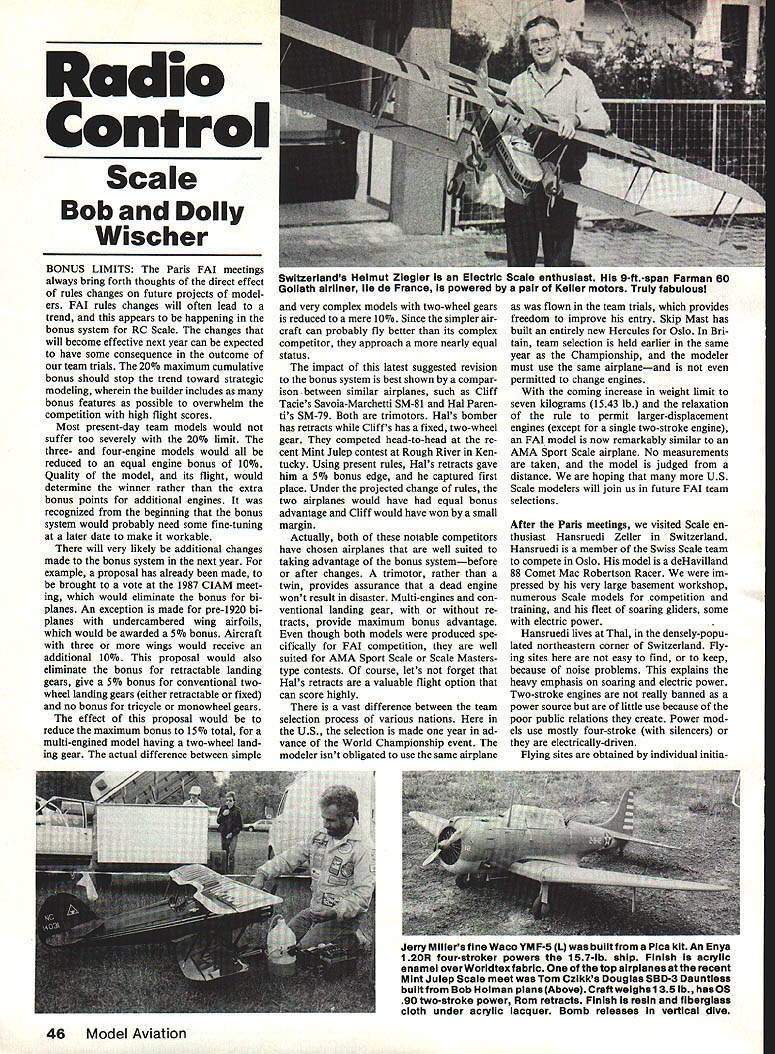
Electric Scale is becoming very popular in these noise-conscious countries. Helmut Ziegler, the Swiss Scale CIAM representative, built and flew a very large (about nine-foot span) electric twin-engined biplane model of the Farman 60 Goliath airliner with two Keller motors. Soaring and electric flight enjoy a large following.
We visited Untervaz, which has a 20-member RC club, and a hobby shop in Grub (Flugmodellbau Bucher) that is almost exclusively devoted to soaring-type models and kits. Bucher is fully equipped to produce kits and fiberglass-epoxy fuselages in a series of designs, including Scale ASW 17, 20 and 22 gliders. While U.S. magazines say electric is the way of the future, in Switzerland it has already arrived. At Toledo we have seen one electric Scale airplane in each of the past two years.
Landing gear for the Douglas Skymaster
Strong struts and limited flexibility were requirements for the landing gear on our Douglas Skymaster. Construction details:
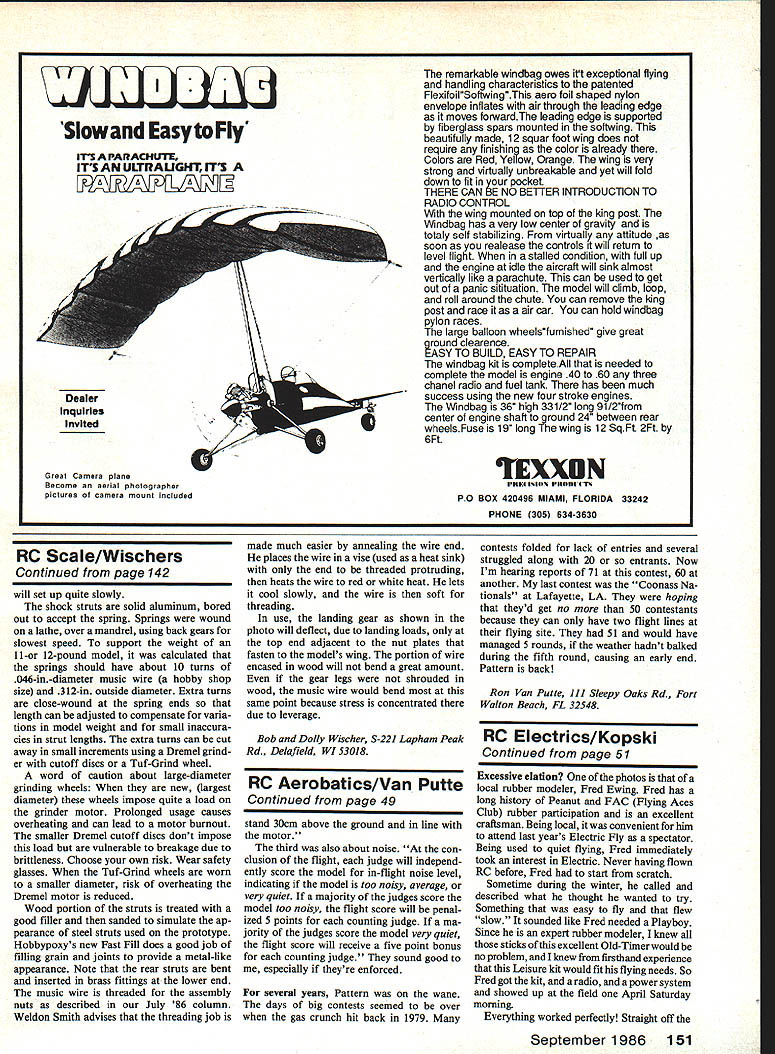
- Struts: Music wire legs covered with basswood strips routed on a table saw for a snug fit. The basswood strips were glued and sanded to a streamlined shape.
- Adhesives: Use glues that remain slightly flexible after setting so rough-landings won't cause the basswood to peel away.
- Reinforcement: Thin plywood strips distribute loads and act as fillers between the wire and basswood.
- Shock struts: Solid aluminum, bored to accept the spring.
- Springs: Wound on a lathe over a mandrel using back gears for slow speed. For supporting an 11–12 lb model we calculated about 10 turns of .046-inch diameter music wire with a .312-inch outside diameter. Extra turns are close-wound at the spring ends so length can be adjusted for weight variations and small strut-length inaccuracies. Extra turns can be cut away incrementally with a Dremel cutoff disc or Tuf-Grind wheel.
Safety and tips:
- Large-diameter grinding wheels impose a heavy load on grinder motors when new. Prolonged use can overheat and burn out the motor. Smaller Dremel cutoff discs impose less load but are brittle and may break. Choose your risk and wear safety glasses.
- Treat the wood portion of the struts with a good filler and sand to simulate a metal appearance. Hobbypoxy's Fast Fill works well for filling grain and joints.
- Rear struts are bent and inserted into brass fittings at the lower end. The music wire is threaded for assembly nuts; annealing the wire end makes threading much easier. Weldon Smith's method: place the wire in a vise (used as a heat sink) with only the end to be threaded protruding, heat the end to red or white heat, then let it cool slowly—the wire will be soft for threading.
In use, the landing gear will deflect under landing loads primarily at the top end adjacent to the nut plates that fasten the wing. The portion of wire encased in wood will not bend much. Even without wood shrouding, music wire bends most at that same top point because stress is concentrated there due to leverage.
Bob and Dolly Wischer S-221 Lapham Peak Rd. Delafield, WI 53018
Transcribed from original scans by AI. Minor OCR errors may remain.

