
Radio Control: Scale
Bob and Dolly Wischer
A case for Scale anatomy
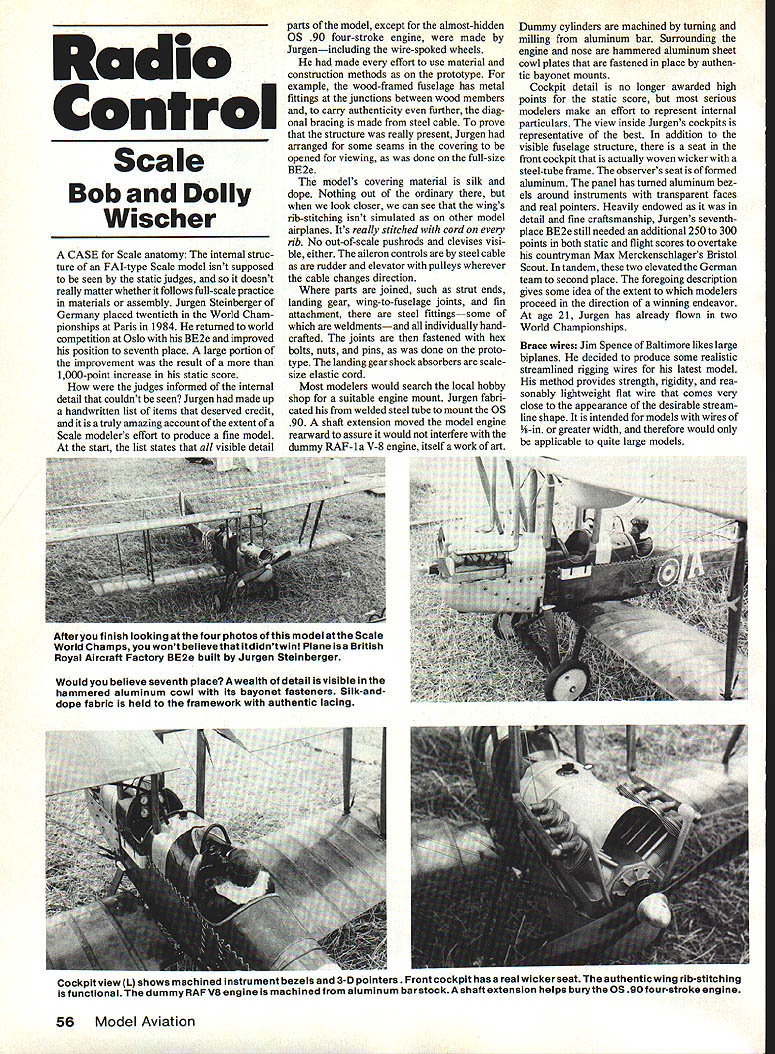
A CASE for Scale anatomy: The internal structure of an FAI-type Scale model isn't supposed to be seen by the static judges, and so it doesn't really matter whether it follows full-scale practice in materials or assembly. Jurgen Steinberger of Germany placed twentieth in the World Championships at Paris in 1984. He returned to world competition at Oslo in his BE2e and improved his position to seventh place. A large portion of the improvement was the result of a more than 1,000-point increase in his static score.
How were the judges informed of the internal detail that couldn't be seen? Jurgen had made up a handwritten list of items that deserved credit, and it is a truly amazing account of the extent of a Scale modeler's effort to produce a fine model.
At the start, the list states that all visible detail parts of the model, except for the almost-hidden OS .90 four-stroke engine, were made by Jurgen — including the wire-spoked wheels.
He had made every effort to use material and construction methods as on the prototype. For example, the wood-framed fuselage has metal fittings at the junctions between wood members and, to carry authenticity even further, the diagonal bracing is made from steel cable. To prove that the structure was really present, Jurgen had arranged for some seams in the covering to be opened for viewing, as was done on the full-size BE2e.
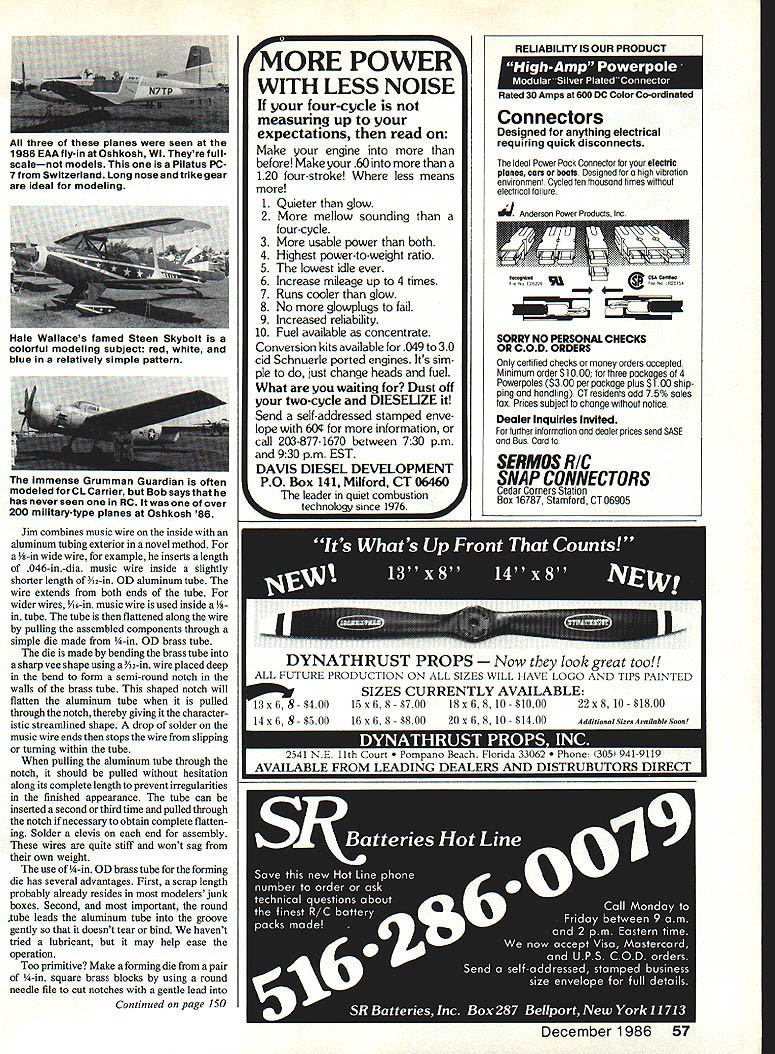
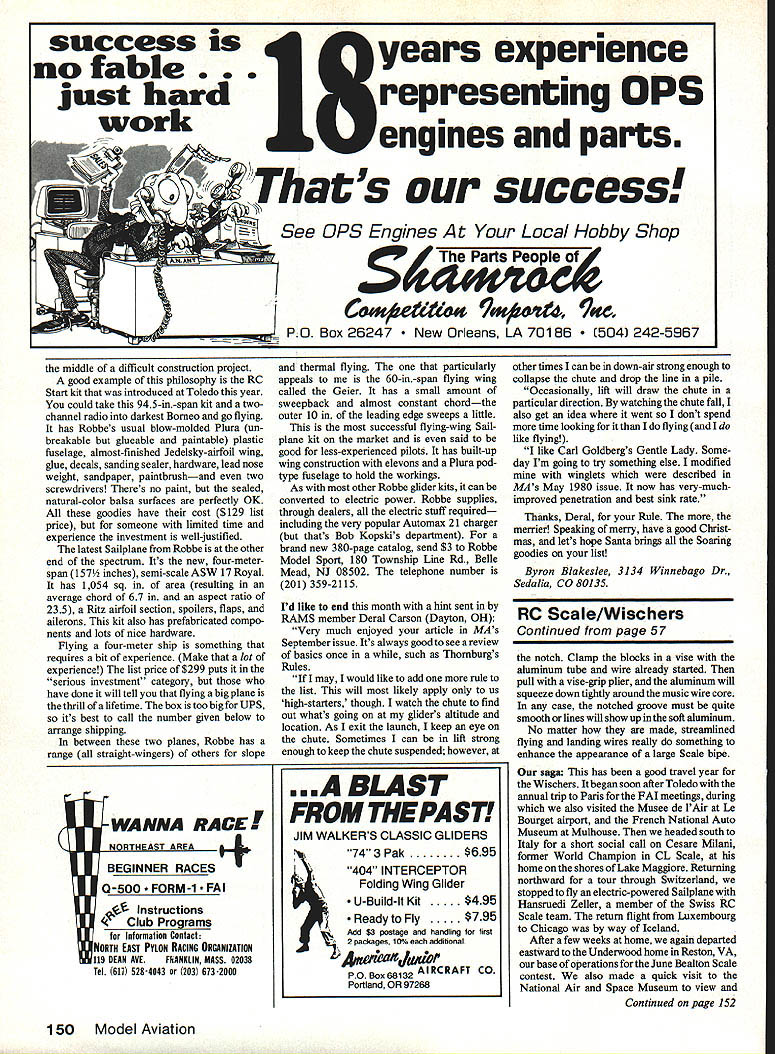
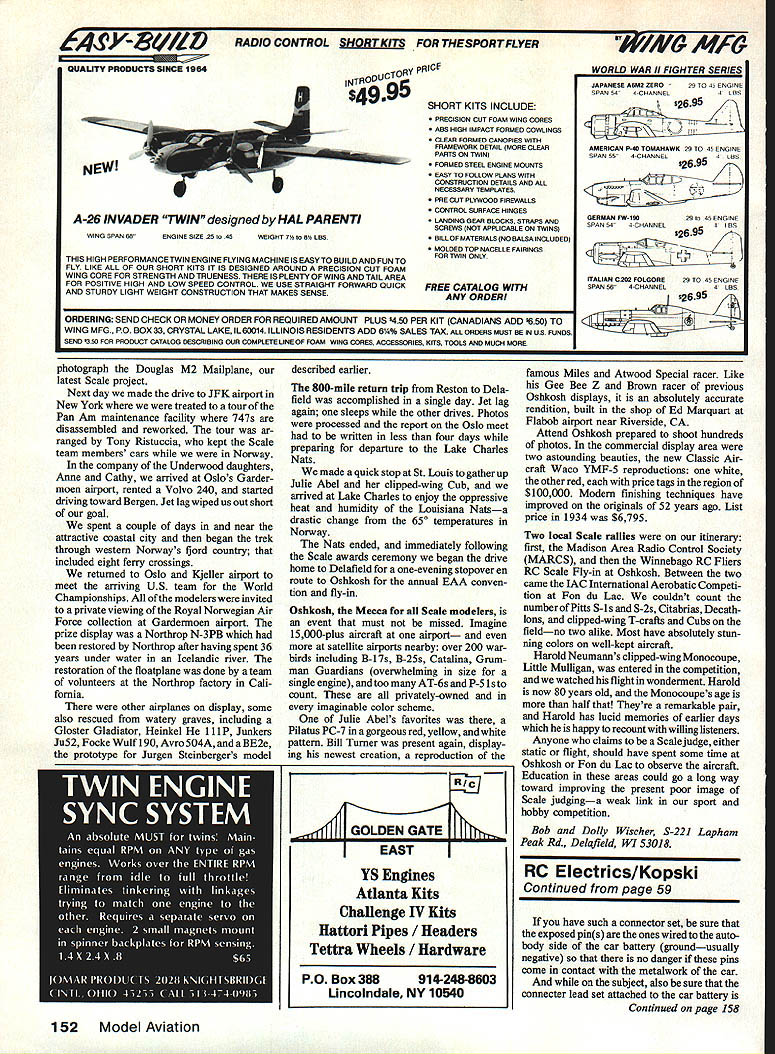
The model's covering material is silk and dope. Nothing out of the ordinary there, but when we look closer, the wing's rib-stitching isn't simulated as on other model airplanes — it's really stitched with cord on every rib. No out-of-scale pushrods and clevises are visible, either. The aileron controls are by steel cable, the rudder and elevator with pulleys wherever the cable changes direction.
Where parts are joined — strut ends, landing gear, wing-to-fuselage joints, fin attachment — there are steel fittings, some of which are weldments, and all individually handcrafted. The joints are then fastened with hex bolts, nuts, and pins, as was done on the prototype. The landing gear shock absorbers are scale-size elastic cord.
Most modelers would search the local hobby shop for a suitable engine mount. Jurgen fabricated his from welded steel tube to mount the OS .90. A shaft extension moved the model engine rearward to assure it would not interfere with the dummy RAF 1a V‑8 engine, itself a work of art. Dummy cylinders are machined by turning and milling from aluminum bar. Surrounding the engine and nose are hammered aluminum cowl plates fastened in place by authentic bayonet mounts.
Cockpit detail is no longer awarded high points for the static score, but most serious modelers make an effort to represent internal particulars. The view inside Jurgen's cockpits is representative of the best. In addition to the visible fuselage structure, there is a seat in the front cockpit that is actually woven wicker with a steel-tube frame. The observer's seat is of formed aluminum. The panel has turned aluminum bezels around instruments with transparent faces and real pointers.
Heavily endowed as it was in detail and fine craftsmanship, Jurgen's BE2e still needed an additional 250 to 300 points in both static and flight scores to overtake countryman Max Merckenschlager's Bristol Scout tandem; the two elevated the German team to second place. The foregoing description gives some idea of the extent to which modelers proceed in the direction of a winning endeavor.
At age 21, Jurgen has already flown in two World Championships.
Brace wires
Jim Spence of Baltimore likes large biplanes. He decided to produce some realistic streamlined rigging wires for his latest model. His method provides strength, rigidity, and reasonably lightweight fairing that comes very close to the appearance of the desirable streamline shape. It is intended for models with wires of 1/8‑in. or greater width, and therefore would only be applicable to quite large models.
Jim combines music wire on the inside with an aluminum tube on the outside. For a 1/8‑in. wide wire, for example, he inserts a length of 0.046‑in.-dia. music wire inside a slightly shorter length of 3/32‑in. O.D. aluminum tube. The wire extends from both ends of the tube. For wider wires, 1/4‑in. music wire is used inside a 5/32‑in. tube.
The tube is then flattened along the wire by pulling the assembled components through a simple die made from 1/4‑in. O.D. brass tube. The die is made by bending the brass tube into a sharp vee shape using a 3/32‑in. wire placed deep in the bend to form a semi‑round notch in the walls of the brass tube. This shaped notch will flatten the aluminum tube when it is pulled through the notch, thereby giving it the characteristic streamlined shape. A drop of solder on the wire ends holds the tube and wire from slipping during the final operation.
When pulling the aluminum tube through the die, hold the wire so it is centered in the flattened tubing. If necessary, a second end of the die can be inserted part-way through the tube and pulled through the notch to obtain complete flattening. Solder a clevis on each end for assembly. These wires are quite stiff and won't sag from their own weight.
The use of a 1/4‑in. O.D. brass tube for the forming die has several advantages:
- A scrap length probably already resides in most modelers' junk boxes.
- The round tube will hold the aluminum tube in the groove gently so that it doesn't tear or bind.
A lubricant may help ease the operation. To make the forming die from brass blocks: use a round needle file to cut notches with a gentle lead into a pair of 1/4‑in. brass blocks, clamp the blocks in a vise with the aluminum tube and wire started in the groove, then bend the brass tube into a vee around the notched mandrel and pull the tube‑and‑wire assembly through the formed die using pliers or a drill for steady force. Trim and solder the ends for final assembly. Smooth any burrs or lines in the notched groove; otherwise lines will show up in the soft aluminum. No matter how they are made, streamlined flying and landing wires really do enhance the appearance of a large Scale biplane.
Our saga
This has been a good travel year for the Wischers. It began soon after Toledo with the annual trip to Paris for the FAI meetings, during which we also visited the Musée de l'Air at Le Bourget airport and the French National Auto Museum at Mulhouse. Then we headed south to Italy for a short social call on Cesare Miani, former World Champion in CL Scale, at his home on the shores of Lake Maggiore. Returning homeward for a tour through Switzerland, we stopped to fly an electric‑powered sailplane with Harald Zeller, a member of the Swiss RC Scale team. The return flight from Luxembourg to Chicago was by way of Iceland.
After a few weeks at home, we again departed eastward to the Underwood home in Reston, VA, our base of operations for the June Belton Scale contest. We also made a quick visit to the National Air and Space Museum to view and photograph the Douglas M‑2 Mailplane, our latest Scale project.
Next day we made the drive to JFK airport in New York where we were treated to a tour of the Pan Am maintenance facility where 747s are disassembled and reworked. The tour was arranged by Tony Rusticucci, who kept the Scale team's members' cars while we were in Norway.
In the company of the Underwood daughters, Anne and Cathy, we arrived at Oslo's Gardermoen airport, rented a Volvo 240, and started driving toward Bergen. Jet lag wiped us out short of our goal.
We spent a couple of days in and near the attractive coastal city and then began the trek through western Norway's fjord country; that included eight ferry crossings.
We returned to Oslo and Kjeller airport to meet the arriving U.S. team for the World Championships. All of the modelers were invited to a private viewing of the Royal Norwegian Air Force collection at Gardermoen airport. The prize display was a Northrop N‑3PB which had been restored by Northrop after having spent 36 years under water in an Icelandic river. The restoration of the floatplane was done by a team of volunteers at the Northrop factory in California.
Other airplanes on display (some also rescued from watery graves) included:
- Gloster Gladiator
- Heinkel He 111P
- Junkers Ju 52
- Focke‑Wulf 190
- Avro 504A
- BE2e (the prototype for Jurgen Steinberger's model described earlier)
The 800‑mile return trip from Reston to Delafield was accomplished in a single day. Jet lag again; one sleeps while the other drives. Photos were processed and the report on the Oslo meet had to be written in less than four days while preparing for departure to the Lake Charles Nats.
We made a quick stop at St. Louis to gather up Julie Abel and her clipped‑wing Cub, and we arrived at Lake Charles to enjoy the oppressive heat and humidity of the Louisiana Nats — a drastic change from the 65° temperatures in Norway.
The Nats ended, and immediately following the Scale awards ceremony we began the drive home to Delafield for a one‑evening stopover en route to Oshkosh for the annual EAA convention and fly‑in.
Oshkosh, the Mecca for all Scale modelers, is an event that must not be missed. Imagine 15,000-plus aircraft at one airport — and even more at satellite airports nearby; over 200 warbirds including B‑17s, B‑25s, Catalina, Grumman Guardians (overwhelming in size for a single engine), and too many AT‑6s and P‑51s to count. These are all privately owned and in very imaginative color schemes.
One of Julie Abel's favorites was the Martinsyde G.100 in a gorgeous red, yellow, and white pattern. Bill Turner was present again, displaying his newest creation, a reproduction of the famous Miles and Atwood Special racer. Like his Gee Bee Z and Brown racer of previous Oshkosh displays, it is absolutely accurate in detail, built in the shop of Ed Marquart at Flabob Airport near Riverside, CA.
Attend Oshkosh prepared to shoot hundreds of photos. In the commercial display area were two outstanding beauties, the new Classic Aircraft Waco YMF‑5 reproductions; one white, the other red, each with price tags in the region of $100,000. Modern finishing techniques have greatly improved on the originals of 52 years ago. List price in 1934 was $6,795.
Two local Scale rallies were on our itinerary:
- Madison Area Radio Control Society (MARCS)
- Winnebago RC Fliers RC Scale Fly‑In at Oshkosh
Between the two came the IAC International Aerobatic Competition at Fond du Lac. We couldn't count the number of Pitts S‑1s and S‑2s, Citabrias, Decathlons, and clipped‑wing T‑crafts and Cubs on the field — no two alike. Most have absolutely one‑of‑a‑kind paint jobs.
Harold Neiland Neumann's clipped‑wing Monocoupe, Little Million, was entered in the competition, and we watched his flight in wonderment. Harold is now 80 years old and the Monocoupe is more than half that age! The aircraft had a fresh bright paint job and Harold's handling was as good as in earlier days.
Anyone who claims to be a Scale judge, either static or flight, should have spent some time at Oshkosh or Fond du Lac to observe the aircraft. Education in these areas could go a long way toward improving the rather poor image of Scale judging — a weak link in our sport and hobby competition.
Bob and Dolly Wischer S‑221 Lapham Peak Rd., Delafield, WI 53018.
Transcribed from original scans by AI. Minor OCR errors may remain.

