
Radio Control: Scale
Bob and Dolly Wischer
Kitchener‑Waterloo again
The annual Flying Dutchmen Club Scale Rally at Kitchener‑Waterloo in eastern Ontario always attracts a multitude of Scale aircraft. A total of 162 planes attended the 1986 meet in early September. The rally is scheduled for the first weekend after Labor Day. We don't expect to see many World War I airplanes at this meet because the date conflicts with the WW I contest at Rhinebeck, New York.
The Canadian twin cities of Kitchener and Waterloo form one corner of a prosperous triangle that also includes Cambridge to the south and Guelph to the east. In this area and the surrounding countryside a large contingent of Scale modelers gathers each year.
The Scale Rally annually displays the newest creations and flying and serves as an exchange of Scale hints and ideas. The meet has grown to include modelers from many U.S. states. Some travel long distances — for example, from Wisconsin (about 580 miles) or on a stretched 100‑mile southern excursion around Lake Michigan through Chicago and Detroit. Other U.S. attendees come from Michigan, Ohio, New York, and Pennsylvania. The STARS Club of Olean, N.Y., is always well represented and helps keep the sky filled with airplanes.
Frequency control and flight operations
The Flying Dutchmen Club uses an excellent system of frequency control:
- Six tall steel posts are driven into the ground with placards listing grouped frequencies.
- The placards include frequencies that have known conflicts or adjacent‑channel issues.
- Underneath each placard, colored triangular pieces of plywood hang on pegs.
- When a modeler is ready to fly, he parks his model adjacent to the post listing his frequency, removes the triangle from its peg, and exchanges it for the transmitter impound.
- When the flight is finished, the transmitter is returned to the impound and the triangle is returned to the post.
A maximum of six models can be airborne at the same time. The system works extremely well with minimal delays between flights and is essentially self‑policing; announcements that a frequency is available are unnecessary.
Engines are started at the posts and models are taxied out to a line about 300 feet from the spectators. Club members monitor takeoffs and landings to ensure no one flies behind the line. The club members know how to make a Scale rally proceed without a glitch.
Merritt Zimmerman and the wet‑sump Cirrus demonstration
One attraction at the K‑W Rally was Merritt Zimmerman, who brought his newest Cirrus engine to demonstrate a wet‑sump lubrication system. The engine was mounted and run in the fuselage of a new 1/3‑scale D.H.60 Moth. Zimmerman now uses a pump to supply crankcase oil; a dip pan beneath the connecting rods provides splash lubrication. This arrangement eliminates the need to add oil to the fuel and keeps the model cleaner after flight because the exhaust carries no oil residue.
Bob Nelitz's Bucker Bu‑131 Jungmann
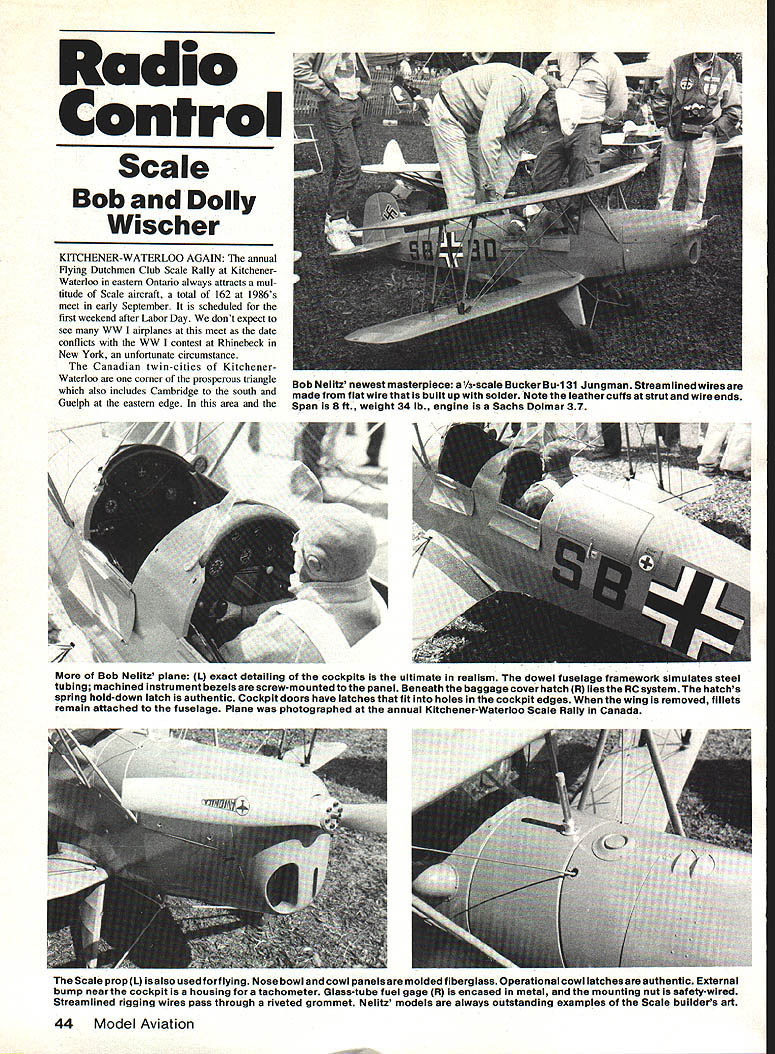
Bob Nelitz' newest masterpiece is a 1/3‑scale Bucker Bu‑131 Jungmann with outstanding Scale detailing:
- Streamlined rigging wires made of built‑up, soldered flat wire; rigging wires pass through riveted grommets.
- Leather cuffs at the strut‑wire ends.
- Span: 8 ft.; weight: 34 lb.; engine: Sachs‑Dolmar 37 U.
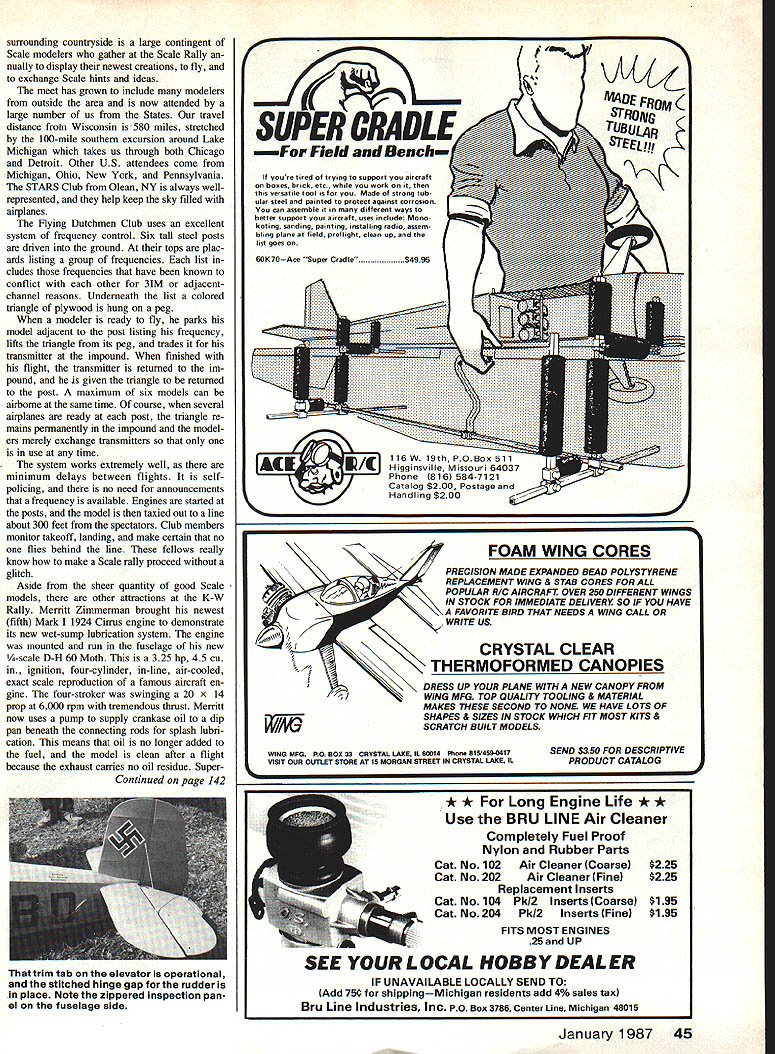
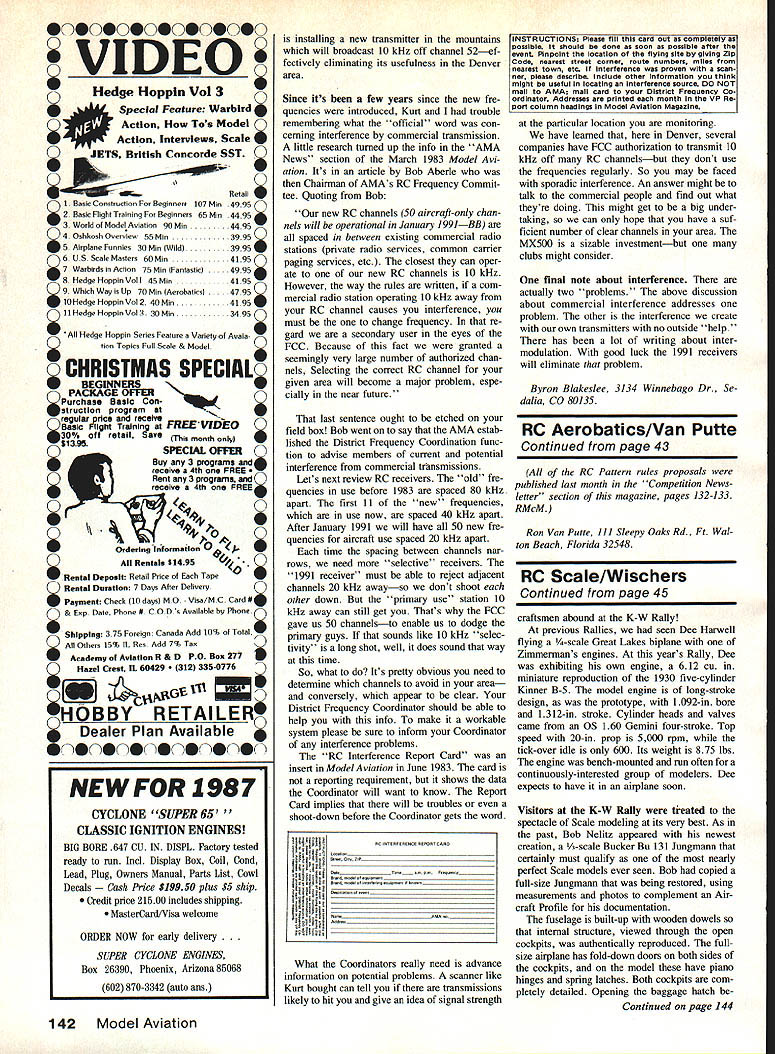
- Cockpit shows exact detailing for realism: dowel fuselage framework simulating steel tubing, machined instrument bezels, screw‑mounted panel.
- Beneath the baggage‑cover hatch resides the R/C system; the hatch has a spring hold‑down latch.
- Cockpit doors have latches; fitted holes along cockpit edges where the wing is removed; fillets remain attached to the fuselage.
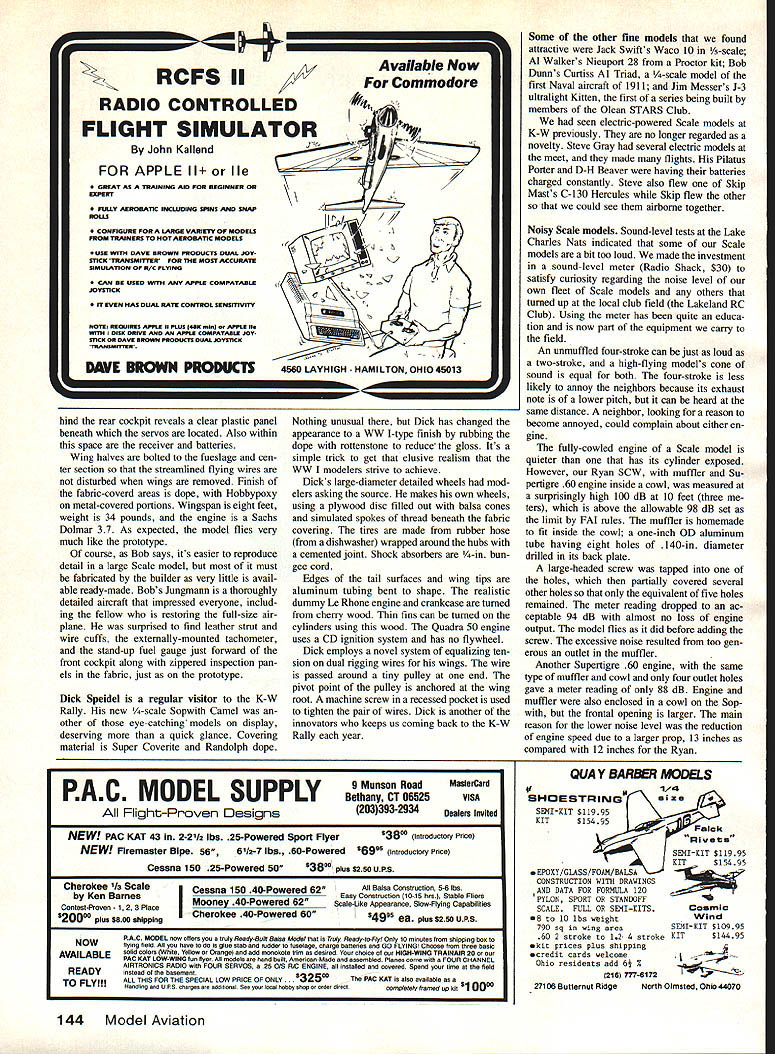
- Nose bowl cowl panels are molded fiberglass with operational cowl latches; an external bump near the cockpit houses the tachometer.
- Glass‑tube fuel gauge is encased with the metal mounting nut safety‑wired.
Nelitz models are consistently outstanding examples of Scale builders' art. A Canada Scale prop is used for flying.
Other notable models
Some other fine models at the rally included:
- Jack Swift's Waco 10 in 1/5‑scale.
- Al Walker's Nieuport 28 (from a Proctor kit).
- Bob Dunn's Curtiss A‑1 Triad, a 1/4‑scale model of the first naval aircraft of 1911.
- Jim Messer's J‑3 ultralight Kitten, the first of a series being built by members of the Olean STARS Club.
Electric‑powered models
Electric‑powered Scale models are no longer a novelty at K‑W. Steve Gray had several electric models at the meet, which made many flights while their batteries were constantly charged. His Pilatus Porter and D.H. Beaver were in frequent use. Steve also flew one of Skip Mast's C‑130 Hercules while Skip flew the other so both could be viewed airborne together.
Noisy Scale models and sound‑level testing
Sound‑level tests at the Lake Charles Nats indicated some Scale models are too loud. We purchased a sound‑level meter (Radio Shack, $30) to evaluate the noise level of our own Scale models and any others that appeared at the local club field (the Lakeland RC Club). Using the meter has been educational and is now part of our field equipment.
Key observations:
- An unmuffled four‑stroke can be just as loud as a two‑stroke; the cone of sound at distance is similar for both.
- A four‑stroke's lower‑pitch exhaust note is less likely to annoy neighbors, but it can still be heard at the same distance.
- The fully‑cowled engine of a Scale model is quieter than one with exposed cylinders.
- Example: our Ryan SCW with a muffler and Super Tigre .60 engine inside a cowl measured a surprisingly high 100 dB at 100 ft (30 m), which exceeds the FAI limit of 98 dB. The muffler was homemade and very small — a one‑inch OD aluminum tube with eight holes of 0.140‑in. diameter in its back plate. A large‑headed screw was tapped into one hole, partially covering several others so only the equivalent of five holes remained. The meter reading dropped to an acceptable 94 dB with almost no loss of engine output; the model flew as it did before the modification. The excessive noise was traced to too generous an outlet in the muffler.
- Another Super Tigre .60, with the same type of muffler and cowl but only four outlet holes, gave a reading of 88 dB. Both engines were enclosed in cowls, but the Sopwith's front opening is larger. The main reason for the lower noise level was reduced engine speed due to a larger prop (13 in. vs 12 in. for the Ryan).
- Switching to larger props (for our .60 engines, from 11 x 7 to 12 x 6 and finally to 13 x 5½) has reduced noise, allowed lower throttle settings, and added realism. Larger mufflers are often impractical inside tight cowls, so prop and speed changes are effective alternatives.
- Unmuffled chainsaw engines are by far the worst offenders.
Sound‑level measurement tips
For accurate and meaningful readings:
- Mount the meter on a tripod.
- Measure the distance from the meter to the model's nose (exhaust side) with a steel tape.
- Read the meter from several feet away so a human body does not affect readings by reflection or absorption.
- Ensure there are no reflecting surfaces beyond the model and no other engines operating nearby (ground or air). Even nearby voices will affect the meter.
- Use a location with low ambient noise and open surroundings to get reliable comparative readings.
Comparative in‑flight readings are possible, but accurate distance estimation can be difficult. Instrument measurements reveal sound penetration at a distance more reliably than the ear. It has become clear that so‑called "quiet" four‑stroke engines benefit from mufflers.
Bob and Dolly Wischer S‑221 Lapham Peak Rd. Delafield, WI 53018
Transcribed from original scans by AI. Minor OCR errors may remain.

