
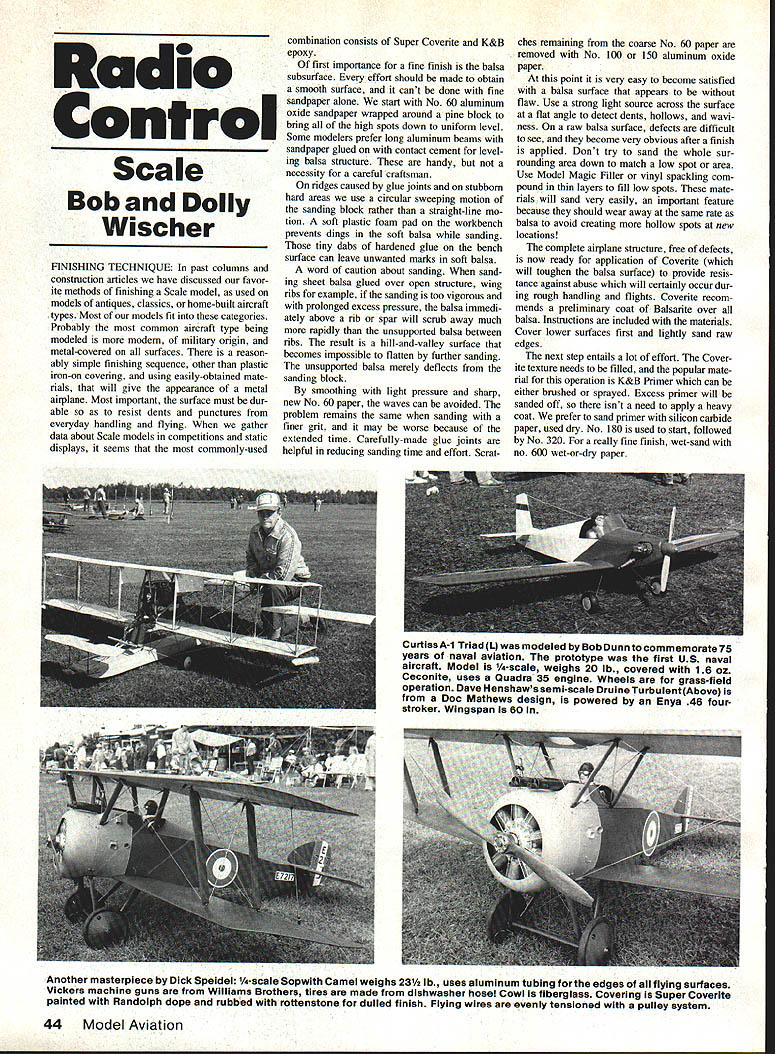
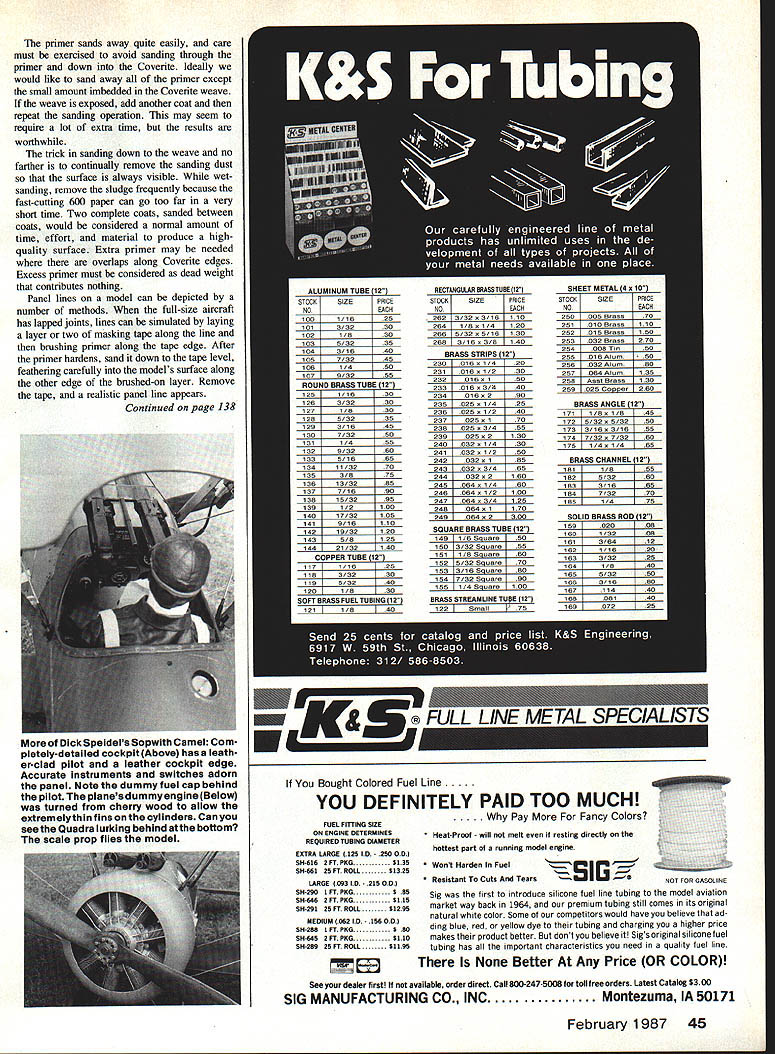
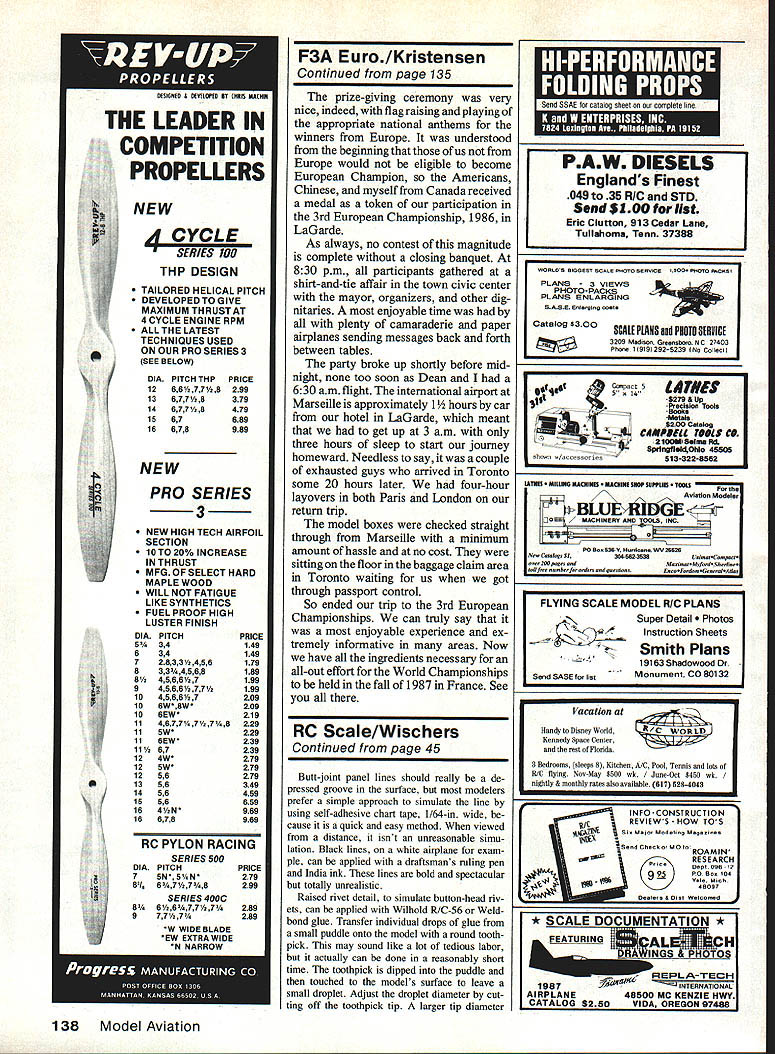
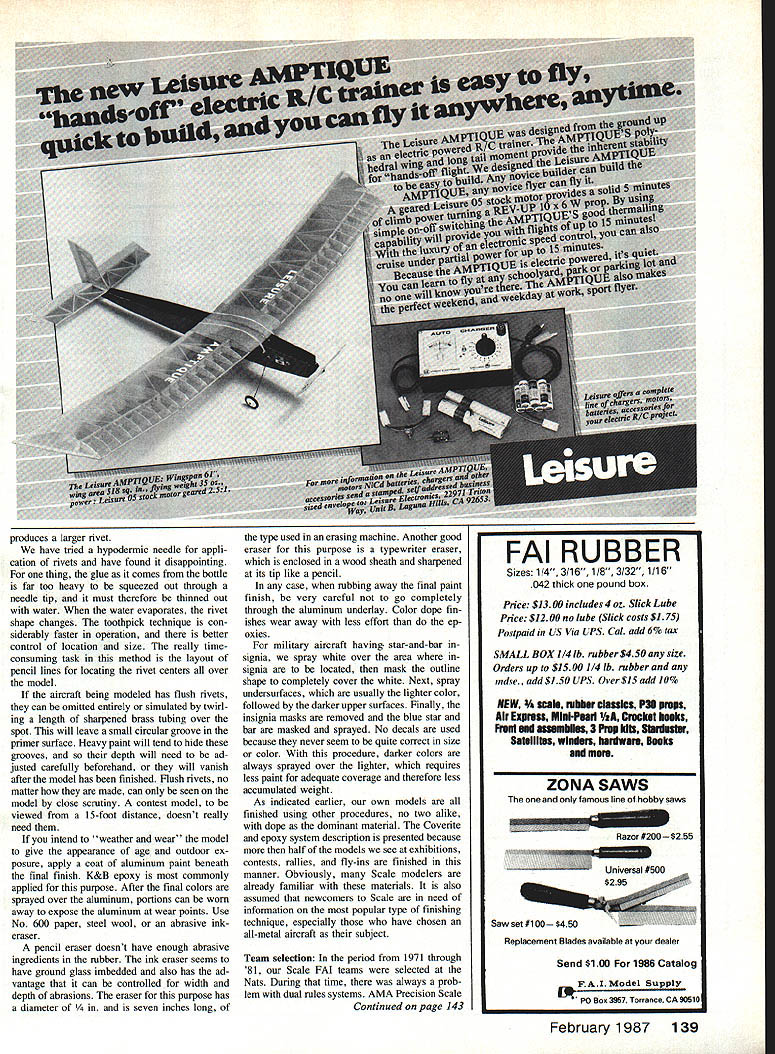
Radio Control: Scale
Bob and Dolly Wischer
Finishing Technique
In past columns and construction articles we have discussed our favorite methods of finishing a scale model, as used on models of antiques, classics, or home-built aircraft types. Most of our models fit into these categories. Probably the most common aircraft type being modeled is more modern, of military origin, and metal-covered on all surfaces. There is a reasonably simple finishing sequence, other than plastic iron-on covering, using easily obtained materials that will give the appearance of a metal airplane. Most important, the surface must be durable so as to resist dents and punctures from everyday handling and flying. When we gather data about scale models in competitions and static displays, it seems that the most commonly used combination consists of Super Coverite and K&B epoxy.
Of first importance for a fine finish is the balsa subsurface. Every effort should be made to obtain a smooth surface, and it can't be done with fine sandpaper alone. We start with No. 60 aluminum-oxide sandpaper wrapped around a pine block to bring all of the high spots down to a uniform level. Some modelers prefer long aluminum beams with sandpaper glued on with contact cement for leveling balsa structure. These are handy, but not a necessity for a careful craftsman.
On ridges caused by glue joints and on stubborn hard areas we use a circular sweeping motion of the sanding block rather than a straight-line motion. A soft plastic foam pad on the workbench prevents dings in the soft balsa while sanding. Those tiny dabs of hardened glue on the bench surface can leave unwanted marks in soft balsa.
A word of caution about sanding: when sanding sheet balsa glued over open structure—wing ribs, for example—if the sanding is too vigorous and prolonged, excess pressure will cause the balsa immediately above a rib or spar to scrub away much more rapidly than the unsupported balsa between ribs. The result is a hill-and-valley surface that becomes impossible to flatten by further sanding. The unsupported balsa merely deflects from the sanding block. By smoothing with light pressure and sharp, new No. 60 paper, the waves can be avoided. The problem remains the same when sanding with a finer grit, and it may be worse because of the extended time. Carefully made glue joints are helpful in reducing sanding time and effort. Scratches remaining from the coarse No. 60 paper are removed with No. 100 or 150 aluminum-oxide paper.
At this point it is very easy to become satisfied with a balsa surface that appears to be without flaw. Use a strong light source across the surface at a flat angle to detect dents, hollows, and waviness. On a raw balsa surface, defects are difficult to see, and they become very obvious after a finish is applied. Don't try to sand the whole surrounding area down to match a low spot or area. Use Model Magic filler or vinyl spackling compound in thin layers to fill low spots. These materials will sand very easily; an important feature because they should wear away at the same rate as balsa to avoid creating more hollow spots at new locations.
The complete airplane structure, free of defects, is now ready for application of Coverite (which will toughen the balsa surface) to provide resistance against abuse which will certainly occur during rough handling and flights. Coverite recommends a preliminary coat of Balsarite over all balsa. Instructions are included with the materials. Cover lower surfaces first and lightly sand raw edges.
The next step entails a lot of effort. Coverite texture needs filling. The popular material for this operation is K&B primer, which can be either brushed or sprayed. Excess primer will be sanded off; there isn't a need to apply a heavy coat. We prefer to sand primer with silicon-carbide paper, used dry:
- Start with No. 180, followed by No. 320.
- For a really fine finish, wet-sand with No. 600 wet-or-dry paper.
The primer sands away quite easily, and care must be exercised to avoid sanding through the primer and down into the Coverite. Ideally we would like to sand away all of the primer except the small amount imbedded in the Coverite weave. If the weave is exposed, add another coat and then repeat the sanding operation. This may seem to require a lot of extra time, but the results are worthwhile.
The trick in sanding down to the weave—and no farther—is to continually remove the sanding dust so that the surface is always visible. While wet-sanding, remove the sludge frequently because the fast-cutting 600 paper can go too far in a very short time. Two complete coats, sanded between coats, would be considered a normal amount of time, effort, and material to produce a high-quality surface. Extra primer may be needed where there are overlaps along Coverite edges. Excess primer must be considered as dead weight that contributes nothing.
Panel lines on a model can be depicted by a number of methods. When the full-size aircraft has lapped joints, lines can be simulated by laying a layer or two of masking tape along the line and then brushing primer along the tape edge. After the primer hardens, sand it down to the tape level, feathering carefully into the model's surface along the other edge of the brushed-on primer. Remove the tape, and a realistic panel line appears.
RC Scale / Wischers
Panel and Rivet Details
Butt-joint panel lines should really be a depressed groove in the surface, but most modelers prefer a simple approach to simulate the line by using self-adhesive chart tape, 1/64 in. wide, because it is a quick and easy method. When viewed from a distance, it isn't an unreasonable simulation. Black lines, on a white airplane for example, can be applied with a draftsman's ruling pen and India ink. These lines are bold and spectacular but totally unrealistic.
Raised rivet detail, to simulate button-head rivets, can be applied with Velhold R/C-56 or Weldbond glue. Transfer individual drops of glue from a small puddle onto the model with a round toothpick. This may sound like a lot of tedious labor, but it actually can be done in a reasonable time. The toothpick is dipped into the puddle and then touched to the model's surface to leave a small droplet. Adjust the droplet diameter by cutting off the toothpick tip. A larger tip diameter gives a larger rivet. Allow the glue drops to dry thoroughly before painting.
We have tried a hypodermic needle for application of rivets and have found it disappointing. For one thing, the glue as it comes from the bottle is far too heavy to be squeezed out through a needle tip, and it must therefore be thinned out with water. When the water evaporates, the rivet shape changes. The toothpick technique is considerably faster in operation, and there is better control of location and size. The really time-consuming task in this method is the layout of pencil lines for locating the rivet centers all over the model.
If the aircraft being modeled has flush rivets, they can be omitted entirely or simulated by twirling a length of sharpened brass tubing over the spot. This will leave a small circular groove in the primer surface. Heavy paint will tend to hide these grooves, and so their depth will need to be adjusted carefully beforehand, or they will vanish after the model has been finished. Flush rivets, no matter how they are made, can only be seen on the model by close scrutiny. A contest model, to be viewed from a 15-foot distance, doesn't really need them.
Weathering, Wear, and Insignia
If you intend to "weather and wear" the model to give the appearance of age and outdoor exposure, apply a coat of aluminum paint beneath the final finish. K&B epoxy is most commonly used for this purpose. After the final colors are applied over the aluminum, portions can be worn away to expose the aluminum at wear points. Use No. 600 paper, steel wool, or an abrasive ink eraser.
A pencil eraser doesn't have enough abrasive ingredients in the rubber. The ink eraser seems to have ground glass imbedded and also has the advantage that it can be controlled for width and depth of abrasions. The eraser for this purpose has a diameter of 1/4 in. and is seven inches long, of the type used in an erasing machine. Another good eraser for this purpose is a typewriter eraser, which is enclosed in a wood sheath and sharpened at its tip like a pencil.
In any case, when rubbing away the final paint finish, be very careful not to go completely through the aluminum underlay. Color dope finishes wear away with less effort than do the epoxy finishes.
For military aircraft having star-and-bar insignia, we spray white over the area where the insignia are to be located, then mask the outline shape to completely cover the white. Next, spray undersurfaces, which are usually the lighter color, followed by the darker upper surfaces. Finally, the insignia masks are removed and the blue star and bar are masked and sprayed. No decals are used because they never seem to be quite correct in size or color. With this procedure, darker colors are always sprayed over the lighter, which requires less paint for adequate coverage and therefore less accumulated weight.
As indicated earlier, our own models are all finished using other procedures, no two alike, with dope as the dominant material. The Coverite and epoxy system described is presented because more than half the models we see at exhibitions, contests, rallies, and fly-ins are finished in this manner. Obviously, many scale modelers are already familiar with these materials. It is also assumed that now comes the extra work in need of information on the most popular type of finishing technique, especially those who have chosen an all-metal aircraft as their subject.
Team Selection
In the period from 1971 through 1981, our Scale FAI teams were selected at the Nats. During that time, there was always a problem with dual rules systems. Rules were not in agreement with FAI rules. Some Nats contenders could win high places and yet were not team material because models were overweight or engines were too large. Contestants were required to declare beforehand that they wished to try for a team position, and there was a fee to be paid before flying began.
The last two team selections were conducted by NASA (National Association of Scale Aeromodelers). It had been reasoned that the Scale organization could do a better job of team selection when divorced completely from Nats judging—utilizing more careful processing and single flights before a single set of judges. At the Nats, there may be as many as four models airborne at the same time. With the distractions that result there was the very real possibility that all FAI models would not be judged under the same conditions.
However, it might be pointed out that teams selected at the Nats have had a history of placing high in World Championship competition, and that this system of selection couldn't be labeled a failure. If team selection were to revert to the Nats, NASA would lose one of the main reasons for its existence. The organization's purpose was to place control of Scale competition rules and team selection in the hands of the Scale modelers.
In the recent past, our AMA rules for Precision Scale class were altered to conform with FAI rules in the hope that this would foster more competition in the FAI class. The opposite has actually occurred, as there are now fewer entries (only three at the last Nats). The rules were not completely changed to FAI, either, as heavy models with all large engines continue to be permitted in AMA Precision Scale. The change was a halfway measure that didn't serve a purpose. FAI rules for World Championships are now being updated to permit heavier models with larger, four-stroke engines. Ducted-fan models remain at a disadvantage with their two-stroke engines.
As always in an event such as RC Scale, judging has proven to be the weak link in the system. The first-place airplane in our last team selection went on to finish a miserable twenty-second place in the World Championship in Norway, far below the other two U.S. entries, which placed tenth and fourteenth. No U.S. team has ever done so poorly. This suggests that something went drastically wrong in the NASA team selection at Louisville. It would seem that NASA hasn't been able to really improve on the judging we had in previous years at the Nats.
Emotions and enthusiasm too often warp a judge's opinion in favor of an airplane that he likes personally, even though the model's chances in world competition may not be the best. Scale modelers, as judges, are as disposed to have preconceived notions on scoring as non-scale judges may be with respect to flight maneuvers. The fact is that no one can truly know the flight capabilities of an aircraft and, therefore, cannot make a clear-cut decision.
When we choose to compete in a judged event, we must be fully aware that chance and opinion play as important a part as performance. Small wonder that scale rallies attract many more participants than competitions, and low-key contests are favored.
The advantage of using the Nats as a team-selection site is that each section of the country eventually is given a chance to be host as the Nats is moved around. Recent team selections under NASA have tended to be in one area. Serious contenders will enter both Nats and team trials. Having a single event saves a long cross-country trip for most entrants, not to mention time saved, particularly carefully hoarded vacation time. As mentioned earlier, disadvantages of the Nats for team selection are the rules disparities and the multiple judges and flight lines.
Bob and Dolly Wischer S-221 Lapham Peak Rd., Delafield, WI 53018
Transcribed from original scans by AI. Minor OCR errors may remain.

