
Radio Control: Scale
Bob and Dolly Wischer
The scratch-builders
Definitions of what is meant by the term "true scratch-builder" have considerable variation.
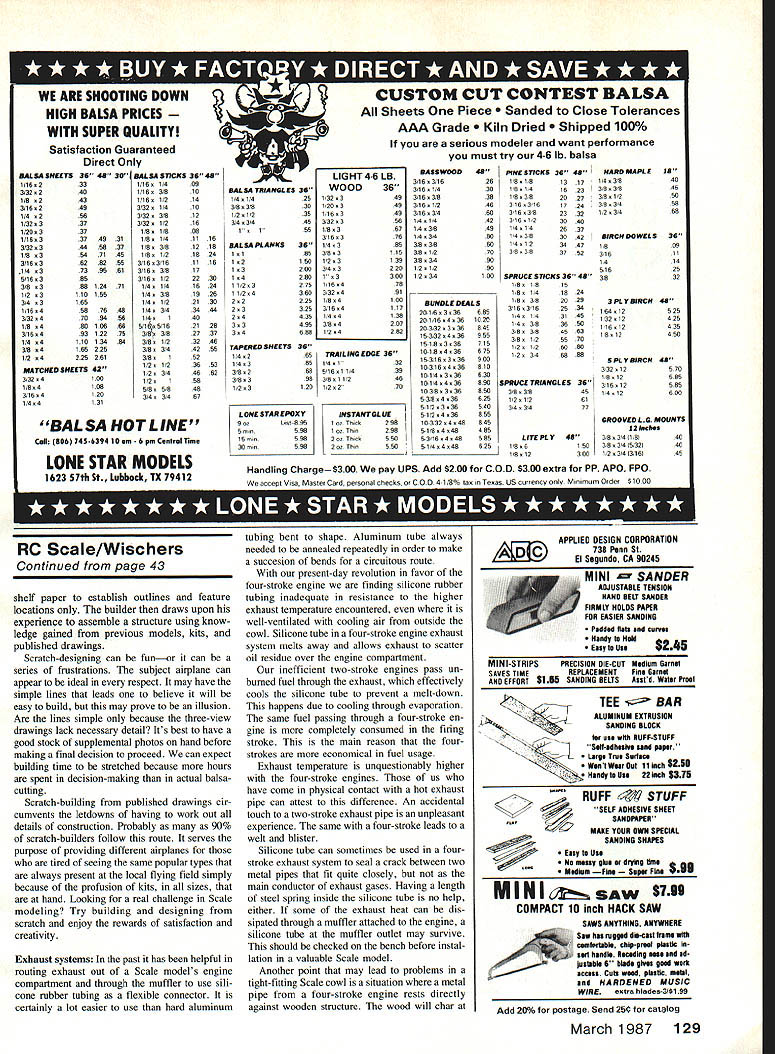
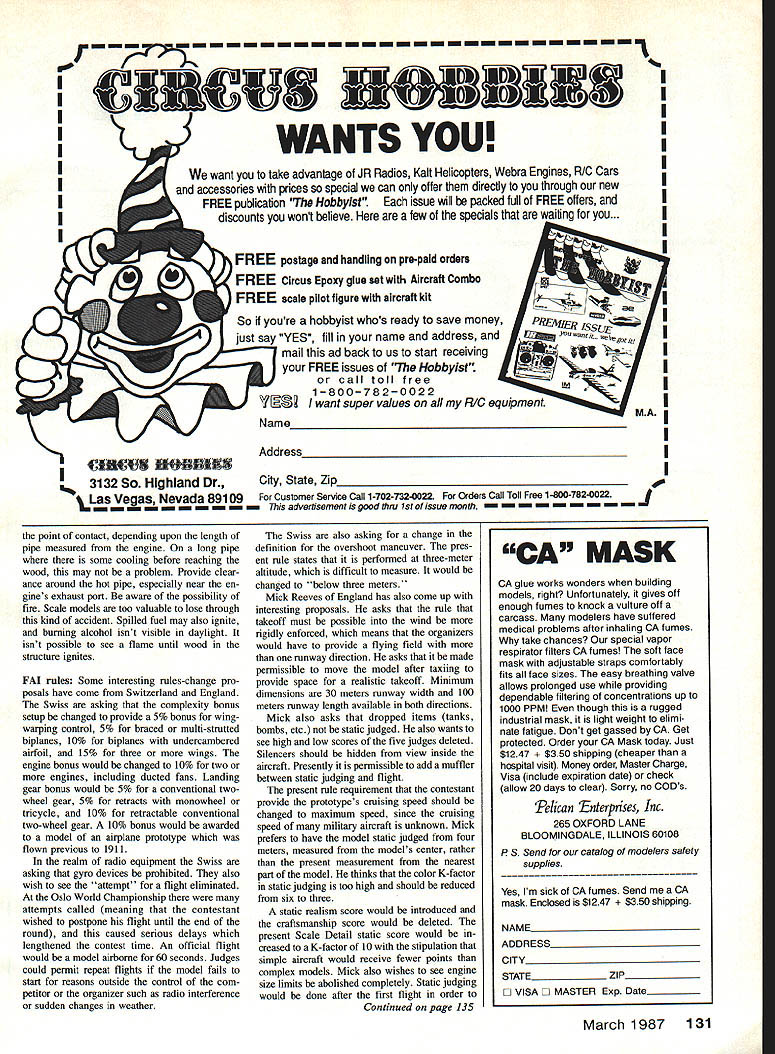
Most commonly, scratch-builders build from published drawings made by another person who is the designer. A small group prefers to build their own designs to satisfy a creative urge or in the quest for a truly different airplane model. An even smaller number design and build ultimate examples of scale model airplanes that are near perfection and achieve national acclaim.
Only a small portion of the world's airplanes have been modeled, and some of the obscure types are among the most attractive. Lack of information—three-views, photos, and general documentation—can quickly sidetrack the modeler's desire to construct one of the lesser-known aircraft. Desire is the key element here. The modeler who really wants something entirely different will always find a way to pursue research on his selected prototype. There are those who would rather dig out buried information than build models (which suggests that a joint effort between researcher and builder may be worthwhile).
We have heard the argument that there is no true scratch-builder because the person didn't make his own engine, radio, balsa, paint, or covering material. If this theme is carried to the extreme, those who claim to be scratch-builders would be mining bauxite ore for aluminum with primitive, handmade tools and growing their own balsa trees. However, we do sometimes hear of modelers cutting their balsa and spruce from lumberyard planks. They can expect a mountain of scrap and sawdust.
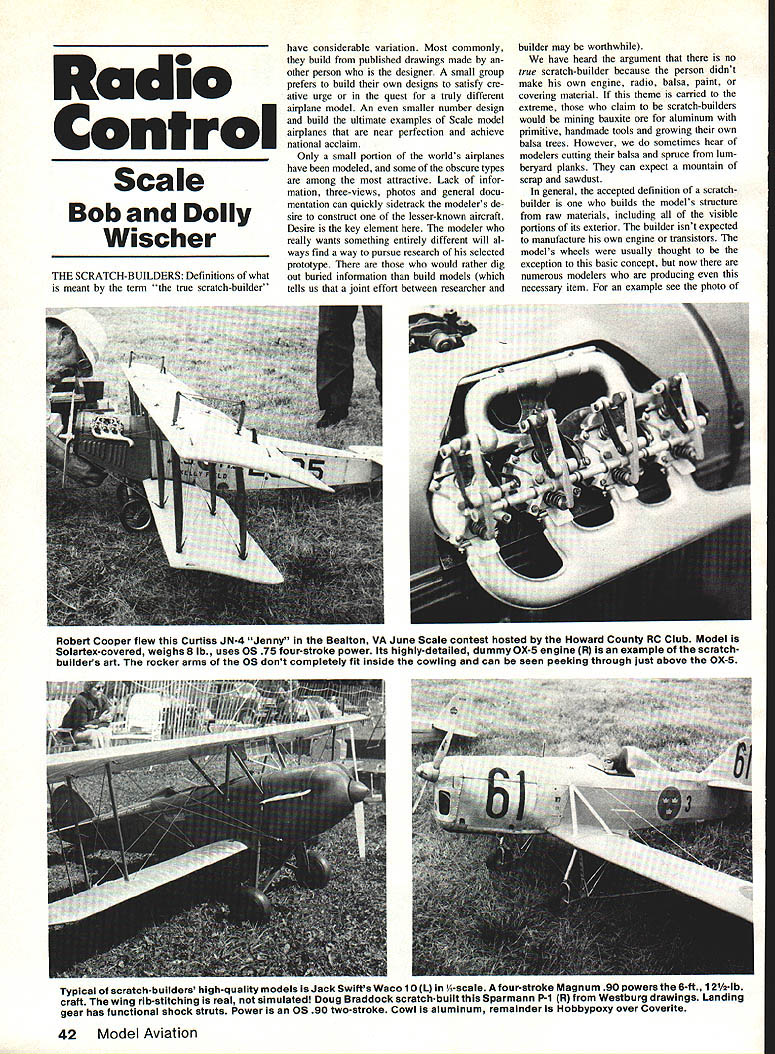
In general, the accepted definition of a scratch-builder is one who builds the model's structure from raw materials, including all of the visible portions of its exterior. The builder isn't expected to manufacture his own engine or transistors. The modeler's wheels were usually thought to be the exception to this basic concept, but now there are numerous modelers who are producing even this necessary item.
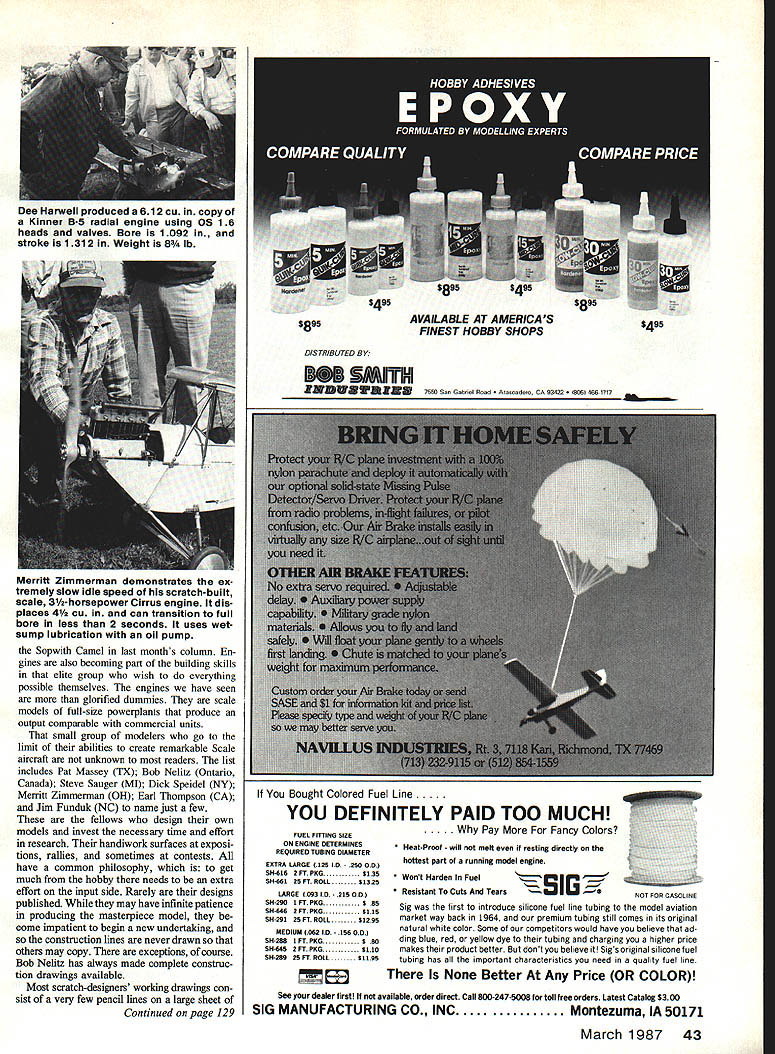
Engines are also becoming part of the building skills in that elite group who wish to do everything possible themselves. The engines we have seen are more than glorified dummies. They are scale models of full-size powerplants that produce an output comparable with commercial units.
That small group of modelers who go to the limit of their abilities to create remarkable scale aircraft are not unknown to most readers. The list includes:
- Pat Massey (TX)
- Bob Nelitz (Ontario, Canada)
- Steve Sauger (MI)
- Dick Speidel (NY)
- Merritt Zimmerman (OH)
- Earl Thompson (CA)
- Jim Funduk (NC)
These are the fellows who design their own models and invest the necessary time and effort in research. Their handiwork surfaces at expositions, rallies, and sometimes at contests. All have a common philosophy: to get much from the hobby there needs to be an extra effort on the inside plane. Rarely are their designs published. While they may have infinite patience in producing the masterpiece model, they become impatient to begin a new undertaking, and so the construction lines are never drawn so that others may copy. There are exceptions, of course. Bob Nelitz has always made complete construction drawings available.
Most scratch-designers' working drawings consist of a very few pencil lines on a large sheet of shelf paper to establish outlines and feature locations only. The builder then draws upon his experience to assemble a structure using knowledge gained from previous models, kits, and published drawings.
Scratch-designing can be fun—or it can be a series of frustrations. There is never quite as much apparent to be ideal in every respect. It may have the same lines that lead one to believe it will be easy to build, but this may prove to be an illusion. Are the lines simple only because the three-view drawings lack necessary detail? It's best to have a good stock of supplemental photos on hand before making a final decision to proceed. Expect building time to be stretched because more hours are spent in decision-making than in actual building and cutting.
Scratch-building from published drawings circumvents the letdowns of having to work out all details of construction. Probably as many as 90 percent of scratch-builders follow this route. It serves the purpose of providing different airplanes for those who are tired of seeing the same popular types that are always present at the local flying field simply because of the profusion of kits, in all sizes, that are at hand. Looking for a real challenge in scale model building? Try building and designing from scratch and enjoy the rewards of satisfaction and creativity.
Exhaust systems
In the past it has been helpful in routing exhaust out of a scale model's engine compartment and through the muffler to use silicone rubber tubing as a flexible connector. It is certainly a lot easier to use than hard aluminum tubing bent to shape. Aluminum tube always needed to be annealed repeatedly in order to make a succession of bends for a circuitous route.
With our present-day revolution in favor of the four-stroke engine, we are finding silicone rubber tubing inadequate in resistance to the higher exhaust temperatures encountered, even where it is well ventilated with cooling air from outside the cowl. Silicone tube in a four-stroke engine exhaust system melts away and allows exhaust to scatter a residue over the engine compartment.
Our inefficient two-stroke engines pass unburned fuel through the exhaust, which effectively coats the silicone tube and prevents a melt-down. This happens due to cooling through evaporation. The same fuel passing through a four-stroke engine is more completely consumed in the firing strokes. This is the main reason that the four-strokes are more economical in fuel usage.
Exhaust temperature is unquestionably higher with the four-stroke engines. Those of us who have come in physical contact with a hot exhaust pipe can attest to the difference. An accidental touch to a two-stroke exhaust pipe is an unpleasant experience. The same with a four-stroke leads to a severe burn.
Silicone tube can sometimes be used in a four-stroke exhaust system to seal a crack between two metal pipes that fit quite closely, but not as the main connector of exhaust gases. Having a length of steel spring inside the silicone tube is of little help. If some of the exhaust heat can be dissipated through a muffler attached to the engine, a silicone tube at the muffler outlet may survive. This should be checked on the bench before installation in a valuable scale model.
Another point that may lead to problems is a tight-fitting scale cowl where a metal pipe from a four-stroke engine rests directly against wooden structure. The wood will char at the point of contact and the pipe will loosen. Insulate the pipe from the wood with a gasket or a short length of heat-resistant tubing, and provide a means to keep the pipe from abrading the structure. Consider the point of contact, depending upon the length of pipe measured from the engine. On a long pipe where there is some cooling before reaching the wood, this may not be a problem. Provide clearance around the hot pipe, especially near the engine's exhaust port. Be aware of the possibility of fire. Scale models are too valuable to lose through this kind of accident. Spilled fuel may also ignite, and burning alcohol isn't visible in daylight. It isn't possible to see a flame until wood in the structure ignites.
FAI rules
Some interesting rules-change proposals have come from Switzerland and England.
Swiss proposals:
- Complexity bonus setup:
- 5% bonus for twin-boom or single-wing control
- 5% for braced or multi-strutted biplanes
- 10% for biplanes with undercambered airfoil
- 15% for three or more wings
- Engine bonus: 10% for two or more engines, including ducted fans
- Landing gear bonus:
- 5% for a conventional two-wheel gear
- 5% for retracts with monowheel or tricycle
- 10% for retractable conventional two-wheel gear
- 10% bonus for a model of an airplane prototype that was previously proven to fly
- In radio equipment, prohibition of gyro devices
- Elimination of the "attempt" for a flight; an official flight would be a model airborne for 60 seconds. Judges could permit repeat flights if the model fails to start for reasons outside the control of the competitor or the organizer (e.g., radio interference or sudden changes in weather)
- Change the overshoot maneuver definition: present rule states it is performed at three-meter altitude; proposed change is "below three meters"
Mick Reeves (England) proposals:
- Make the rule that takeoff must be possible into the wind more rigidly enforced, requiring organizers to provide a flying field with more than one runway direction
- Permit moving the model after taxiing to provide space for a realistic takeoff
- Minimum dimensions for field: 30 meters runway width and 100 meters runway length available in both directions
- Dropped items (tanks, bombs, etc.) should not be static judged
- Delete the high and low scores of the five judges
- Hide scores from view during judging
- Permit adding a muffler between static judging and flight (presently allowed)
- Change the static requirement from model's static clearance to maximum speed, since cruising speeds have increased substantially; the present minimum takeoff speed is not indicative of full-speed performance
- Measure the K-factor from the model's center rather than from the nearest part of the model; reduce the K-factor in static judging from six to three
- Introduce a static roll criterion and delete the craftsmanship score
- Increase the present scale diesel static score to a K-factor of 10, with simple aircraft receiving fewer points than complex models
- Abolish engine size limits completely
- Perform static judging after the first flight to condense time requirements for a World Championship to 4½ days
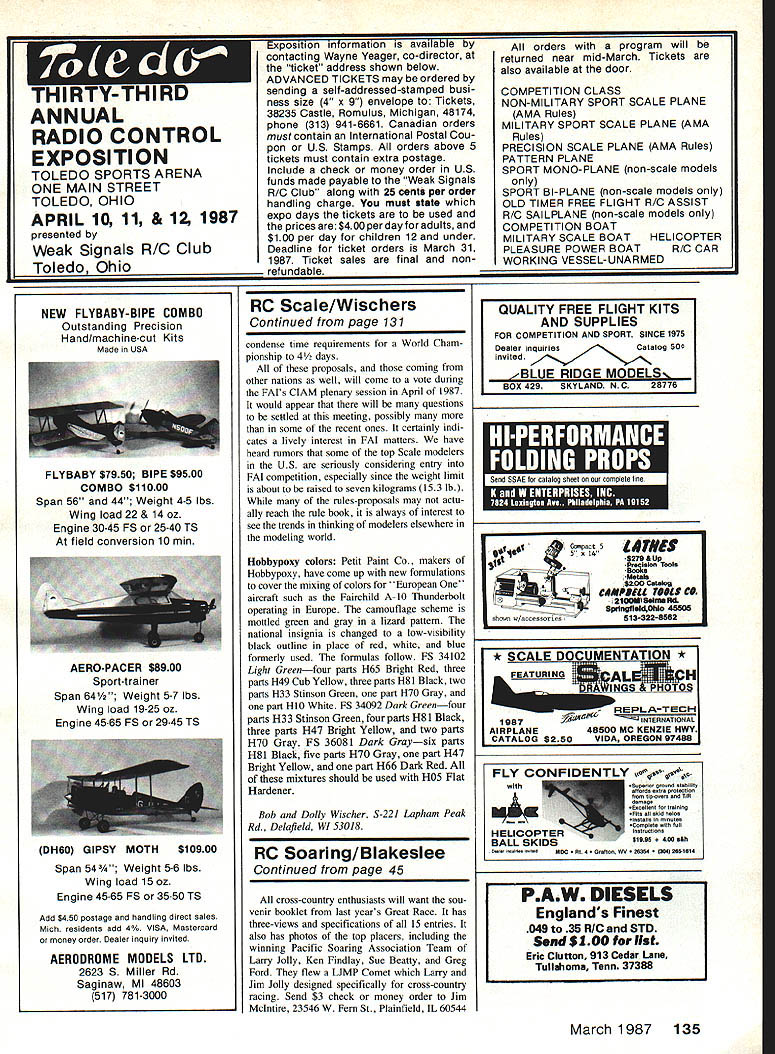
All of these proposals, and those coming from other nations as well, will come to a vote during the FAI's CIAM plenary session in April 1987. It appears there will be many questions to be settled at this meeting. We have heard rumors that some of the top scale modelers in the U.S. are seriously considering entry into FAI competition, especially since the weight limit is about to be raised to seven kilograms (15.3 lb.). While many of the rules proposals may not actually reach the rule book, it is always of interest to see the trends in thinking of modelers elsewhere in the modeling world.
Hobbypoxy colors
Petit Paint Co., makers of Hobbypoxy, have come up with new formulations to cover the mixing of colors for "European One" aircraft such as the Fairchild A-10 Thunderbolt operating in Europe. The camouflage scheme is mottled green and gray in a lizard pattern. The national insignia is changed to a low-visibility black outline in place of red, white, and blue formerly used. The formulas follow. All mixtures should be used with H05 Flat Hardener.
- FS 34012 Light Green:
- 4 parts H65 Bright Red
- 3 parts H49 Cub Yellow
- 3 parts H81 Black
- 2 parts H33 Stimson Green
- 1 part H70 Gray
- 1 part H10 White
- FS 34092 Dark Green:
- 4 parts H33 Stimson Green
- 4 parts H81 Black
- 3 parts H47 Bright Yellow
- 2 parts H70 Gray
- FS 36081 Dark Gray:
- 6 parts H81 Black
- 5 parts H70 Gray
- 1 part H47 Bright Yellow
- 1 part H66 Dark Red
Bob and Dolly Wischer S-221 Lapham Peak Rd., Delafield, WI 53018
Transcribed from original scans by AI. Minor OCR errors may remain.

