
Radio Control: Scale
Bob and Dolly Wischer
Oshkosh, again
The EAA (Experimental Aircraft Association) convention and fly‑in at Oshkosh was, again, an overwhelming success. After the first day the Oshkosh airport was completely covered with aircraft; only show planes were welcome and others were diverted to satellite fields at Fond du Lac and Appleton. By noon of the second day Fond du Lac was also saturated, bringing the total number of aircraft at the fly‑in to an estimated 15,000–17,000. Commuting daily between home and Wittman Field, we never cease to be smitten by the sight as we drive off the highway ramp toward a sea of glistening aluminum. Frequent Wisconsin summertime thundershowers can turn turf to mud at Oshkosh.
Because warbirds were scattered among fields, there was no way to count them accurately; we can only guess until totals are published in Sport Aviation. Our estimates are:
- 30 P‑51s
- 60 T‑6s
- 35 T‑34s
- 30 T‑28s
These figures are probably low.
Other warbirds also appeared in quantities never seen before. We saw four different Spitfires — no two alike — including a late Mark 21 with a Griffon engine and five‑bladed prop; its 2,350 hp gives it a distinctly different sound in the air compared with ordinary Merlins. A two‑seat Spitfire trainer with Rolls‑Royce Merlins became so common after the third day that many spectators ceased to gaze skyward at each passing gaggle. Numerous jet aircraft were present as well, including 13 U.S. Marine Corps Harriers. Harrier demonstrations near the crowd had many people clasping their hands over their ears — they are noisy indeed.
Foreign warbird types were seen in greater numbers this year. A Swiss Pilatus P‑2 trainer with a 12‑cylinder Argus engine (reported at about 550 hp) was one of the more unusual sights. Except for the Marine Harriers and a U.S. Navy F‑14 Tomcat, most of the exhibited warbirds were privately owned. Some were painted to resemble WWII aircraft, while many sported high‑gloss Imron finishes that produced truly glamorous flying machines. Any modeler searching for a spectacular prototype to copy had a wide choice.
Special exhibits and notable machines
- Gustav Whitehead No. 21 reproduction: The reproduction of Whitehead’s No. 21 — an aircraft claimed by some to have flown before the Wrights — was on display. It has been flown with modern ultralight engines and now awaits finished reproductions of Whitehead’s original power plants. The controversy surrounding the claim generated much attention.
- Voyager (round‑the‑world): The Voyager, with tattered wingtips still exposed from its flight, was brought to Oshkosh on an immense flatbed trailer after its legs were removed. The slow, multi‑day trip required special permits through many states. After the convention it continued on to the National Air and Space Museum in Washington, D.C. Dick Jensen, Jeana (Voyager co‑pilot) and Burt Rutan spoke to capacity crowds in the outdoor theater; EAA members are rightly proud of this home‑built achievement.
- Metal Masters Tsunami (Unlimited Class racer): Owner John Sandberg and builder Bruce Boland attended with the racer, which had flown before the afternoon air show and gave a hint of its speed capabilities. A notable feature is the belly cooling system that emits a slight plume of steam: cooling water is pumped from spray bars over the radiator core and emitted rearward as steam to reduce cooling drag. The cooling air intake is mostly closed off to minimize drag; at very high speeds the propeller itself acts as a brake.
Observations useful to scale modelers
- Stabilizer incidence and stick forces: On Tsunami the stabilizer leading edge was raised in four increments until a near‑zero incidence was achieved to remove heavy loads on the control stick at high speed. Scale modelers will recognize this process: raising the stabilizer reduces down‑elevator servo load and the drag of a downward‑deflected elevator.
- High‑speed directional fixes: Modelers at Oshkosh were using wedges of balsa taped in strategic locations on fins and rudders to eliminate yaw problems and directional instabilities at high speed. Only at Oshkosh can the average modeler make such close observations of these details.
Notable scale and scratch‑built models
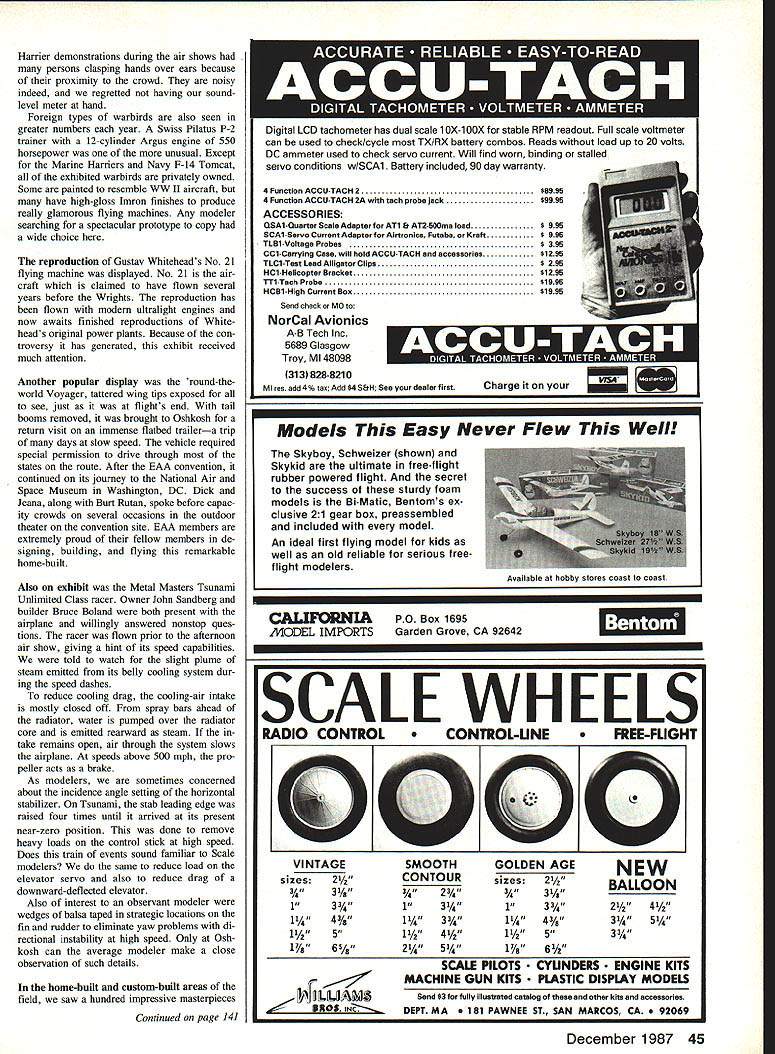
- Dr. Linton Keith — Northrop A‑17 (giant scale): Built from L. Wylam plans, engine OS .108 cu. (two‑stroke), weight 155 lb, wingspan 84", scale factor 1/68.
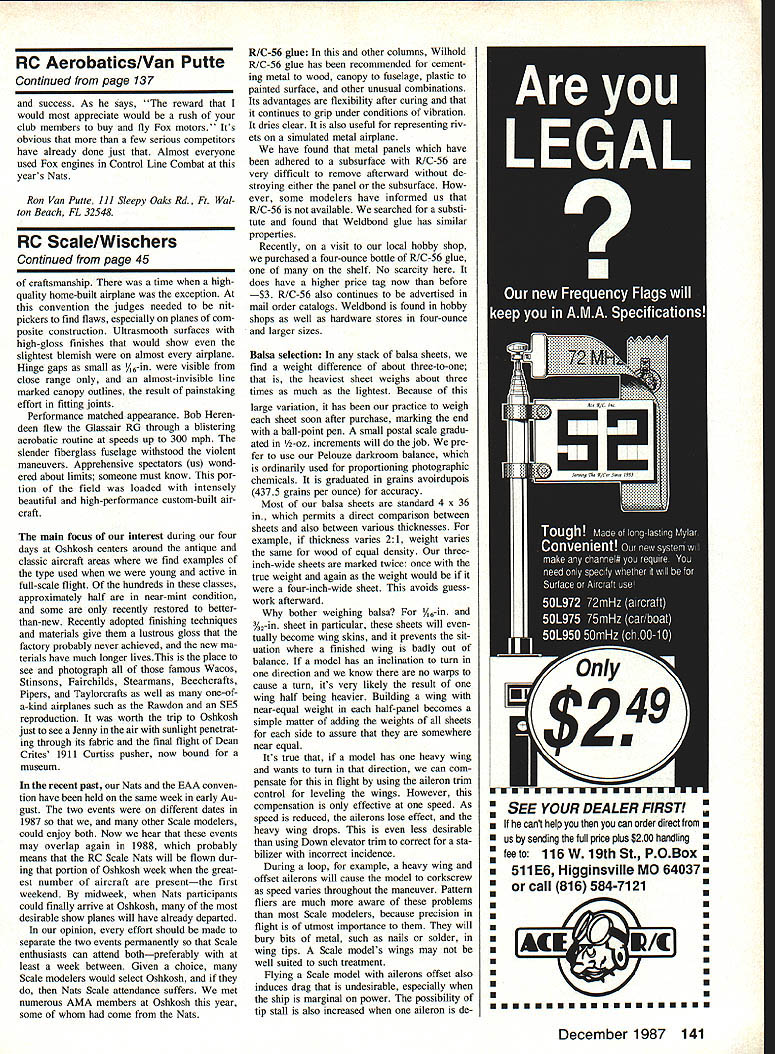
- Billy McIntosh — Ercoupe R (scratch‑built): Mid‑1930s design, scratch‑built from photos; metallic MonoKote finish; span 72", weight 85 lb; powered by an OS .60 four‑stroke; scale factor about 1/6. (The Ercoupe has no rudder pedals.)
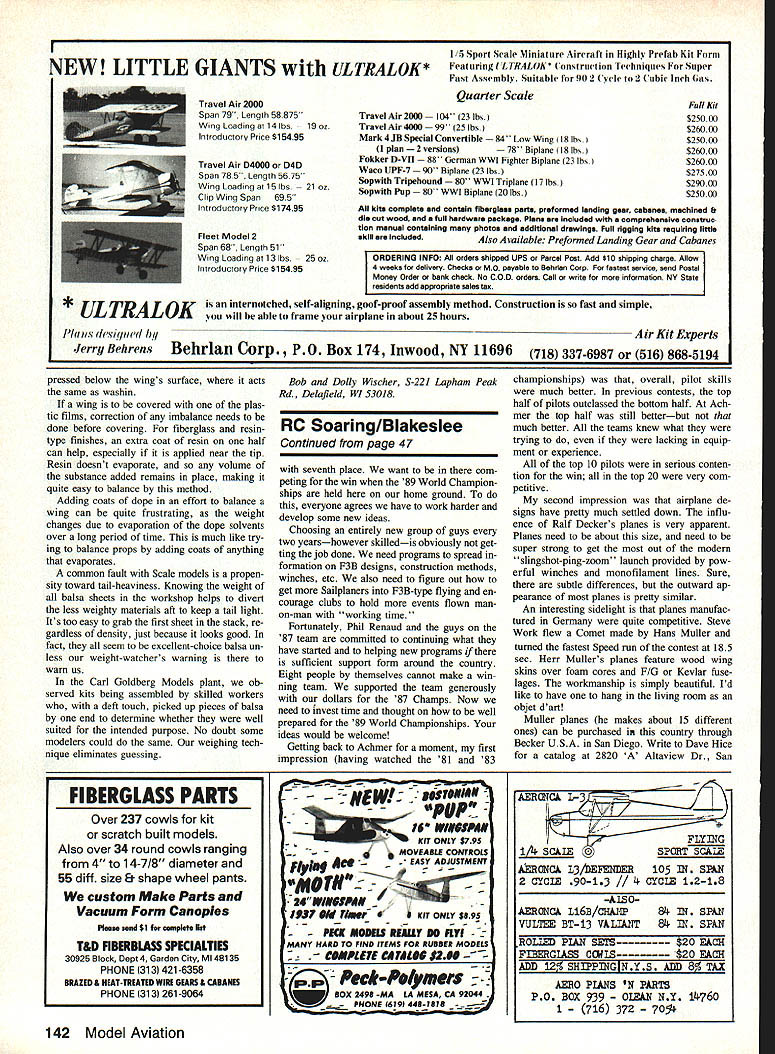
- Dennis Cain — Navy N2Y‑1 Fleet (quarter scale): Built from a Concept Models kit; powered by a Super Tigre 3000; finish Sig Koveral clear, nitrate dope and K&B epoxy; weight 21 lb; includes a realistic dummy engine made from bass plywood.
- Gus Rebensburg — Chilton DW‑1R: Built from Dennis Tapafield’s plans; weight 15 lb, span 84", powered by an OS .120 four‑stroke. Features include spring shock absorbers in the landing gear and three‑piece split flaps; finish was Randolph dope over glass cloth.
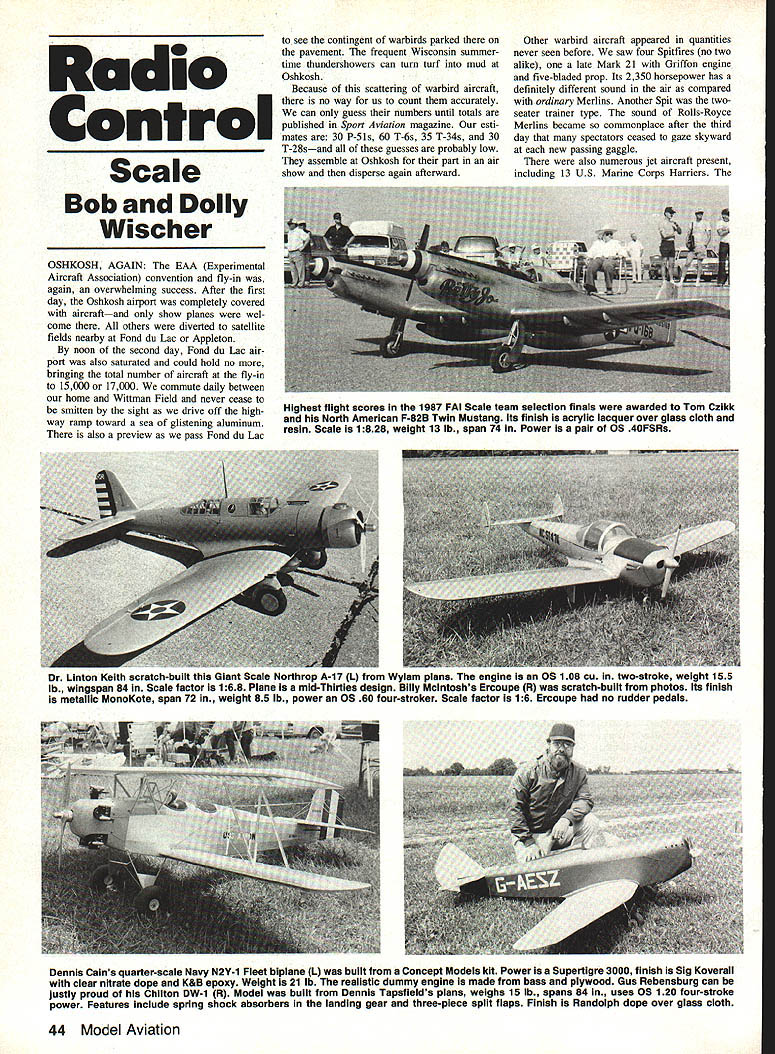
- Tom Czikk — North American F‑82B Twin Mustang (Model Aviation FAI Scale team selection finals): Highest flight scores in 1987 finals; acrylic lacquer finish over glass cloth and resin; scale 1/28; weight 13 lb; span 74"; powered by a pair of OS .40 FSR engines.
Closing
In the home‑built and custom‑built areas we saw a hundred impressive masterpieces. Oshkosh again provided a wealth of detail and inspiration for full‑scale aviators and scale modelers alike.
Transcribed from original scans by AI. Minor OCR errors may remain.

