
Radio Control
Scale
Bob and Dolly Wischer S-221 Lapham Peak Rd. Delafield, WI 53028
Scale-like models are often greeted with the comment "It's meant to be seen, not flown," implying the time, effort, and money invested make flight too risky. That attitude helps explain the scarcity of well-finished, highly detailed Scale models: builders are repeatedly asked whether the model will really fly, usually by people who find it hard to believe such a careful creation will be exposed to possible damage.
Most modelers, however, are satisfied with a scalelike model that looks realistic in the air even if it won't stand up to close scrutiny. Details and fine finish rarely show in flight, so many prefer an easier route to realism. The superscale builder knows the risk of damage from frequent flying or bad weather and often builds simpler scalelike models for practice and fun so the top-quality aircraft can be reserved for contests and special flights. Practice keeps piloting reflexes sharp and reduces the risk of losing skill from infrequent flying.
From the persevering Scale modeler's viewpoint, many easily built kits simply don't resemble the full-size aircraft closely enough. Some prefer scratch-building or buying one of the many Scale kits and leaving it somewhat unfinished to limit the build time before first flight. A more effortless approach is to assemble a semi-finished kit, such as the EZ series or the semi-finished Scale offerings from Hobby Shack, trading cash for effort.
Recommended kits and types
- Great Planes Aeromaster Bipe — a longstanding choice for tail-dragger biplane aerobatics.
- Quarter Master Sport Bipe (DGA Designs plans or semikit) — large, impressive; needs a powerful engine (Quadra or larger multicylinder glow engines).
- Balsa USA Phaeton 90 — for larger engines; good scalelike appearance and flyability.
- Balsa USA Phaeton II — for .40–.60 engines; popular as a semiscale practice biplane.
- Sig Smith Miniplane — semiscale taildragger for .40 engines; quite close to true scale dimensions and a good flier.
Examples of scratch or kit-built scale projects
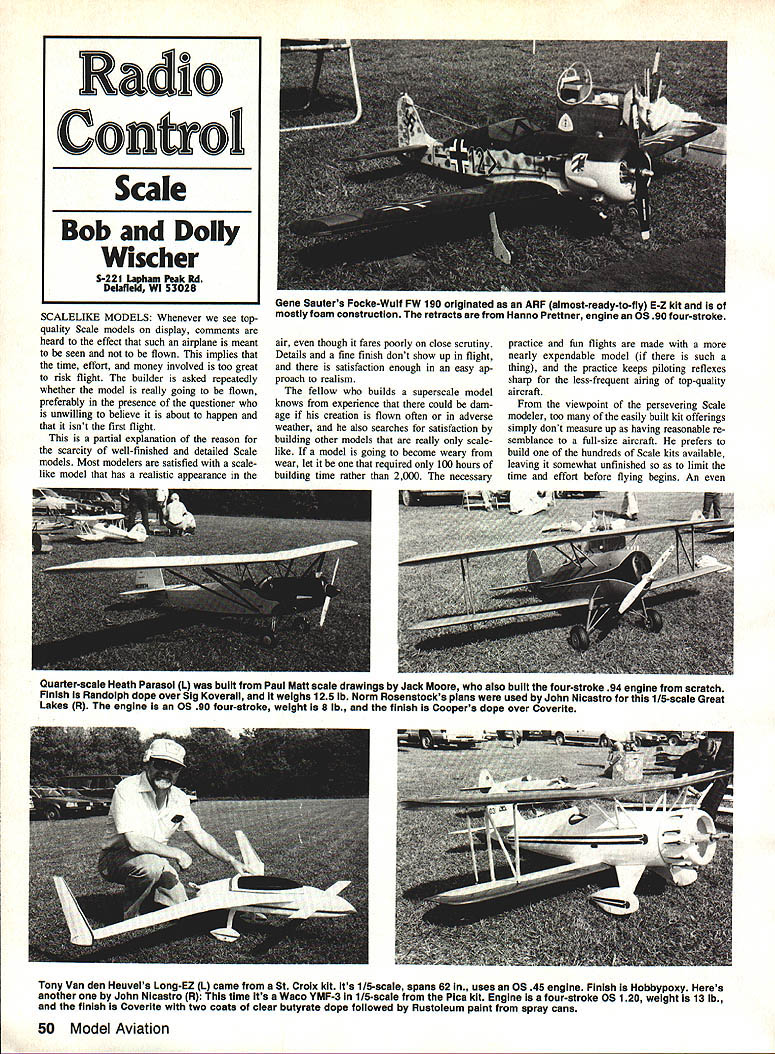
- Quarter-scale Heath Parasol (Paul Matt) — built from scale drawings; four-stroke .94 engine; finish: Randolph dope over Sig Koverall; weight 12.5 lb.
- 1/5-scale Great Lakes (Norm Rosenstock from John Nicastro plans) — OS 90 four-stroke; weight 8 lb; finish: Cooper's dope over Coverite.
- Long-EZ (Tony Van den Heuvel, St. Croix kit) — 1/5-scale, 62" span; OS 45 engine; finish: Hobbypoxy.
- Waco YMF-3 (John Nicastro, Pica kit) — 1/5-scale; OS 120 four-stroke; weight 13 lb; finish: Coverite, two coats clear butyrate dope, Rust-Oleum spray paint.
- Focke-Wulf FW 190 (Gene Sauter) — originated as an ARF E-Z kit, mostly foam construction with retracts; engine installation by Hanno Prettner.
Practice vs. Scale flying
- Semiscale and nonscale models are typically flown five to ten times more than top-scale airplanes.
- Exception: a 1/4-scale Aeronca K in our fleet has flown about 25 hours (100+ flights) in a year.
- We keep several semiscale practice models ready to fly. For example, Falco looks good in the air but shows ordinary features on the ground (Goldberg retracts, no cockpit detail, exposed HP .60 cylinder head). Its tricycle gear also doesn't help much in practicing taildragger landings.
- Our practice aircraft for tail-dragger biplanes is a Balsa USA Phaeton II with a K&B .40 engine; it is toned down aerobatically to match our other scale biplanes.
Aging and proficiency
- As we grow older we find we need more practice to maintain flying skill, especially after a 5–6 month winter layoff. Southern fliers are less affected; younger modelers regain and maintain proficiency more easily. Competition amplifies the need for disciplined, practiced flight — precise maneuvers, straight takeoffs and landings, and efficient sequence timing clearly reflect practice time.
Wear and maintenance
- Even well-built scale models show wear from extensive flying. Our 12-year-old Piel Beryl has required multiple replacements of main-gear tires and wheels due to bearing wear, and the tailwheel bearing has begun to wobble.
Scale modeling community and resources
- Scale modelers historically publish less, so we often draw on our own experience for columns and articles. A strong, active newsletter (referred to here as the NASA newsletter) would help disseminate information, documentation, and data sources. NASA offers a "Scale Data Source List" to new members. Membership is $6 per year (payable to Secretary-Treasurer Bert Dugan, 11090 Phillis Dr., Clio, MI 48420).
Removing broken nylon screws
Tom Salvemini describes a simple method for removing nylon screws broken off flush with the surface:
- Heat the tip of a screwdriver (a cigarette lighter provides modest heat) and press it into the end of the nylon screw. The melted metal makes an exactly fitting slot so the screw can be backed out. Avoid overheating the driver; use a scrap or old driver if desired.
- If the screw is cemented (for example with CyA), drilling out and retapping may still be necessary.
- For a loose broken screw (nylon, brass, or steel) another option is to use a cutoff disc in a Dremel to cut a shallow groove across the screw end. The disc will generate heat and may melt a nylon screw; use a small, well-worn disc to minimize damage to adjacent surfaces.
Radio problems
Scale flyers are particularly vulnerable to radio interference at club fields where many transmitters operate. Recommended actions:
- Move to the new narrow-band transmitter frequencies/channels RC12 through RC34 (available starting in 1988).
- Have existing transmitters checked with a spectrum analyzer to verify they are narrow-band. Transmitters that are not narrow-band cannot legally operate on RC12–RC34. We plan to have our transmitters checked at the Chicago Expo AMA field test area. Our Silver Seven transmitter currently holds an AMA Gold Star seal indicating it meets narrow-band requirements for RC12–RC34.
- If transmitters are not narrow-band, investigate reworking them; high-quality scale competitors will be required to meet narrow-band rules.
Reasons for checking equipment
- To protect fellow modelers from spurious emissions if our gear is doubtful.
- To determine whether we can legally and safely shift to channels RC12–RC34, where interference should be reduced.
Receiver recommendations and caveat
- Use a narrow-band, dual-conversion receiver that is FCC-qualified for additional protection; examples in our fleet include the Model 91 Ace and Challenger receivers.
- These changes reduce risk but are not an absolute guarantee that a valuable scale model will not be lost to radio problems. The steps are taken to help minimize that risk.
Transcribed from original scans by AI. Minor OCR errors may remain.

