
Radio Control: Scale
Bob and Dolly Wischer S-221 Lapham Peak Rd. Delafield, WI 53018
New glues
A note from Bud Wolfe (Scottsdale, AZ) and additional searches turned up suitable substitutes for Wilhold R/C-56, which can be hard to find and sometimes expensive. The alternatives behave similarly: they dry clear and remain flexible.
- Elmer’s All-Purpose Tacky Glue (Borden) — sold in drugstores (e.g., Walgreen’s) and craft shops. Bud reports it seems to have the same properties as R/C-56.
- PIC Flex White (Penn International Chemicals) — advertised for adhering canopies and sheet-plastic windshields. Thick, tacky; bonds porous and nonporous materials; dries clear and remains flexible.
- Aleene’s All-Purpose Tacky Glue (Aleene’s, Inc., Solvay, CA) — found in craft stores; can cement wood, metal, glass, ceramic, paper, china, fabrics, fiber, plastics, and foam.
These glues work well for cementing sheet aluminum to balsa framework, forming imitation rivets, and fastening canopies without clouding. Aleene’s four-ounce bottle was about one-third the cost of R/C-56 in our local hobby shop. We have tested PIC Flex White and Aleene’s and found them nearly identical to R/C-56.
Easy weathering
A simple weathering trick: add a little black paint to the final sprayed clear overcoat to give the model a slightly used, dirty look. This can mellow overly bright markings—Bud Wolfe used it effectively on a Blohm & Voss BV-141B to tone down white crosses.
Modified wheels
Finding suitable wheels is often a problem; mismatched wheels can degrade an otherwise excellent model. Consider these tips:
- Choose wheels appropriate to the era. Williams Brothers Golden Age wheels have detailed hub discs for period subjects. Balloon-style scale wheels have blank hubs, which you can customize.
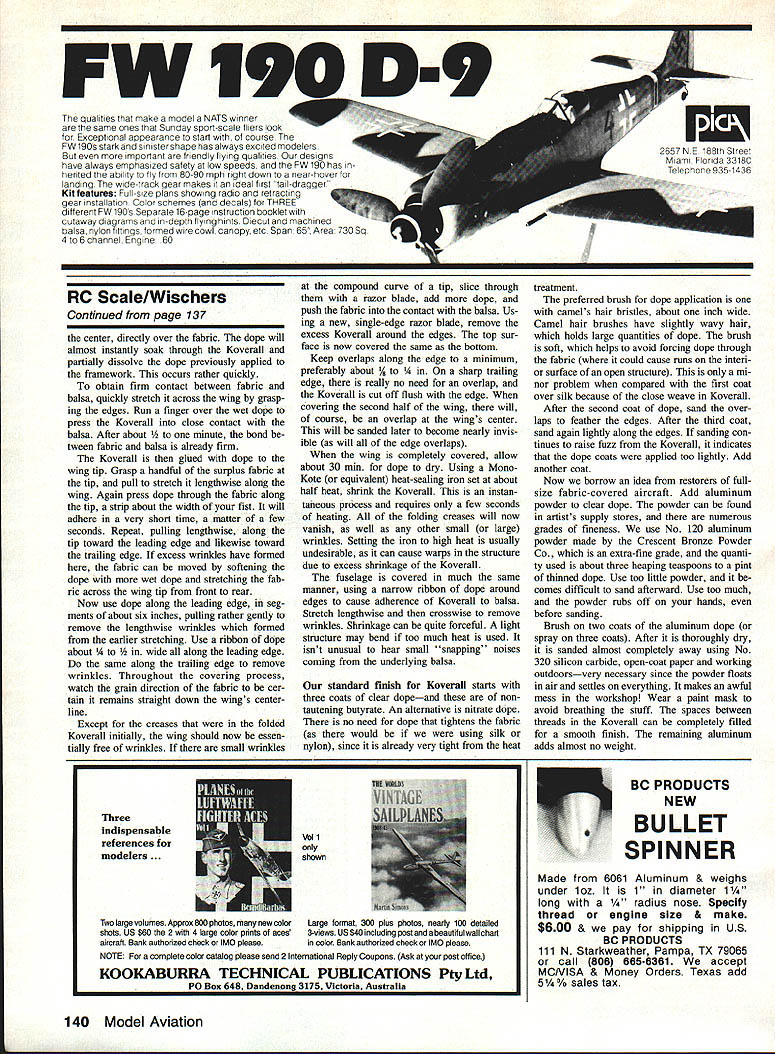
- For a row of hexagon-head bolts near the axle, Williams Bros. hub material can be drilled and tapped to accept Walthers or Morse hex screws (found in hobby shops, model-railroad section). Local hardware stores often carry small screws on rotating dispensers.
- To simulate closely spaced rivets or screws around the hub, use dots of flexible glue (R/C-56 or substitute) applied with a round toothpick:
- Form a puddle of glue on a nonabsorbent surface (metal or plastic). Make the puddle about 1/8 to 1/2 in. diameter. If too large it dries before use; if too small, the toothpick can pick up excess glue.
- Pick up a small droplet on the toothpick and transfer it to the wheel. Control rivet diameter by trimming the toothpick tip.
- If a rivet is wrong, remove and reapply immediately.
- To create the illusion of a larger wheel disc, place the circular row of glue "rivets" on the tire rather than the hub. Mask the portion of the tire that should remain black, then spray color on the disc and the adjacent narrow band of tire so a portion of the black tire appears part of the disc.
Axles and cotter pins
If documentation shows a round wheel collar fastened with a large cotter pin:
- Use a brass tube sweat-soldered over the music-wire axle; let the tube extend slightly past the axle so it can be cross-drilled to accept a cotter pin.
- Drill the wheel collar from the side and enlarge the axle hole if necessary to fit the tube.
- Tiny cotter pins can be purchased at well-stocked hardware stores, or made from soft iron or copper wire: flatten the wire with a hammer, wrap around a small drill or probe, pinch with pliers to form the cotter-pin shape. Flat ladder wire from model-railroad supplies is another source.
Koverall covering
Koverall (a Dacron polyester heat-shrinky material) is being used more often as a covering for scale models. It simulates fabric covering well, is tough, puncture-resistant, accepts paint and dope, is light, and requires minimal finish. It has no adhesive backing.
Prepping the framework
- Apply two to three coats of dope to the framework, sanding lightly between coats to remove false fuzz. Use only enough thinner to improve brushing; thinner evaporates and does not build film.
- Apply dope to all surfaces that will contact fabric, including rib edges. A sable or camel-hair brush about 1 in. wide is preferred.
Cutting and grain direction
- Cut Koverall with the grain running along the long dimension of the area to be covered (the package explains how to find the grain). Incorrect grain can cause shrink-induced warps.
Covering a wing panel
- Cut a piece about 2 in. wider and 3–4 in. longer than the panel. Cover a wing in halves, starting at the center and stretching toward the tip.
- Lay Koverall on the bottom surface. Brush a 1/8 to 1/4 in. strip of dope (thinned about 10%) across the wing at the center, directly over the fabric. The dope will soak through and bond quickly.
- To secure the tip, grasp surplus fabric at the tip and pull lengthwise along the wing, pressing the fabric with your fingers through the wet dope. Repeat toward the leading and trailing edges.
- Use dope ribbons (about 1/4 to 1/2 in. wide) along the leading and trailing edges in roughly 6 in. segments, pulling gently to remove lengthwise wrinkles. Keep grain aligned with the wing centerline.
- For compound-curved tips with small wrinkles, slice through wrinkles with a razor, add more dope, and press fabric into contact.
- Trim excess Koverall with a new single-edge razor. Minimize overlaps (preferably 1/8 to 1/4 in.). On sharp trailing edges, cut flush.
Heat shrinking and finishing
- Allow about 30 minutes for dope to dry. Use a Kote iron (or equivalent) at about half heat to shrink Koverall—this is instantaneous and takes only a few seconds. High heat can cause excess shrinkage and warp the structure.
- The fuselage is covered similarly: apply a ribbon of dope around edges, stretch lengthwise then crosswise to remove wrinkles. Be aware that shrinkage can be forceful; light structures may bend if too much heat is used.
- Standard finish: three coats of clear non-tautening dope (nitrate dope is an alternative). There is no need for tautening dope since Koverall is tightened by heat.
- Preferred brush: about 1 in. camel-hair for its capacity and softness, which helps avoid forcing dope through the fabric.
- After the second coat, sand overlaps to feather edges. After the third coat, sand lightly along edges. If sanding raises fuzz, add another coat of dope.
RC Scale / Wischers
Bob Wischer S-221 Lapham Peak Rd., Delafield, WI 53018
Model notes
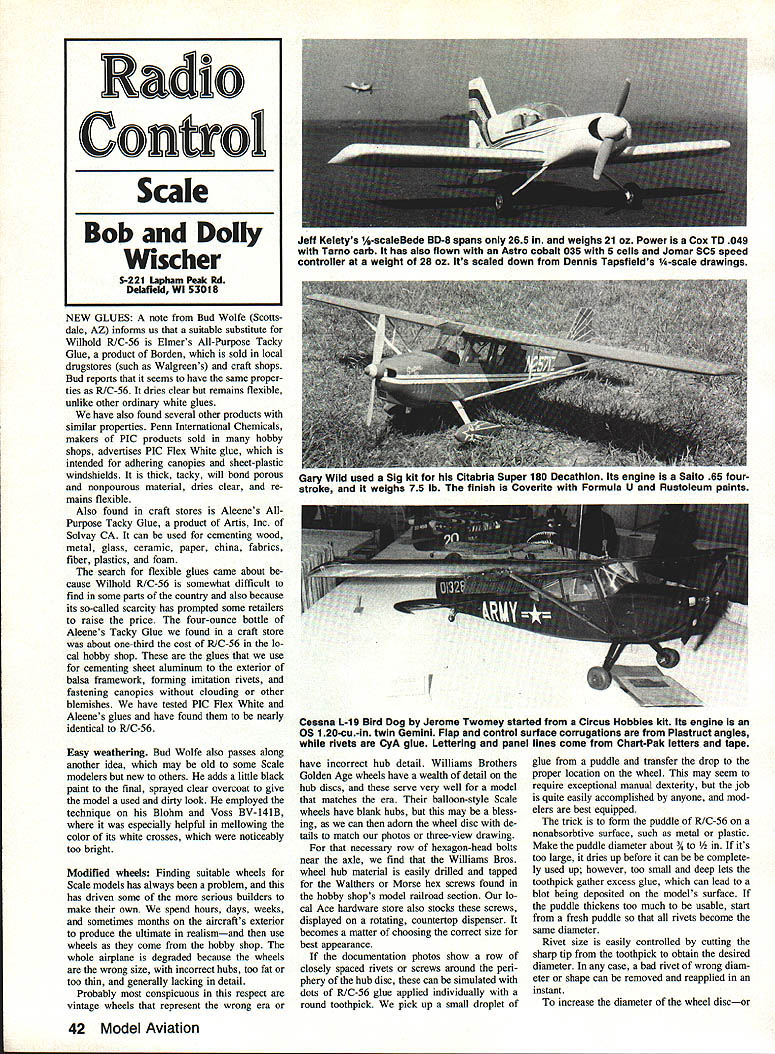
- Jeff Keletys — 1/scale Bede BD-8; span 26.5 in.; weight 21 oz. Power: Cox TD .049; Tarno carb. Has also flown with an Astro Cobalt .035 on 5 cells. Jomar SC5 speed controller. Weight 28 oz.
- Dennis Tapsfield — scaled-down drawings used.
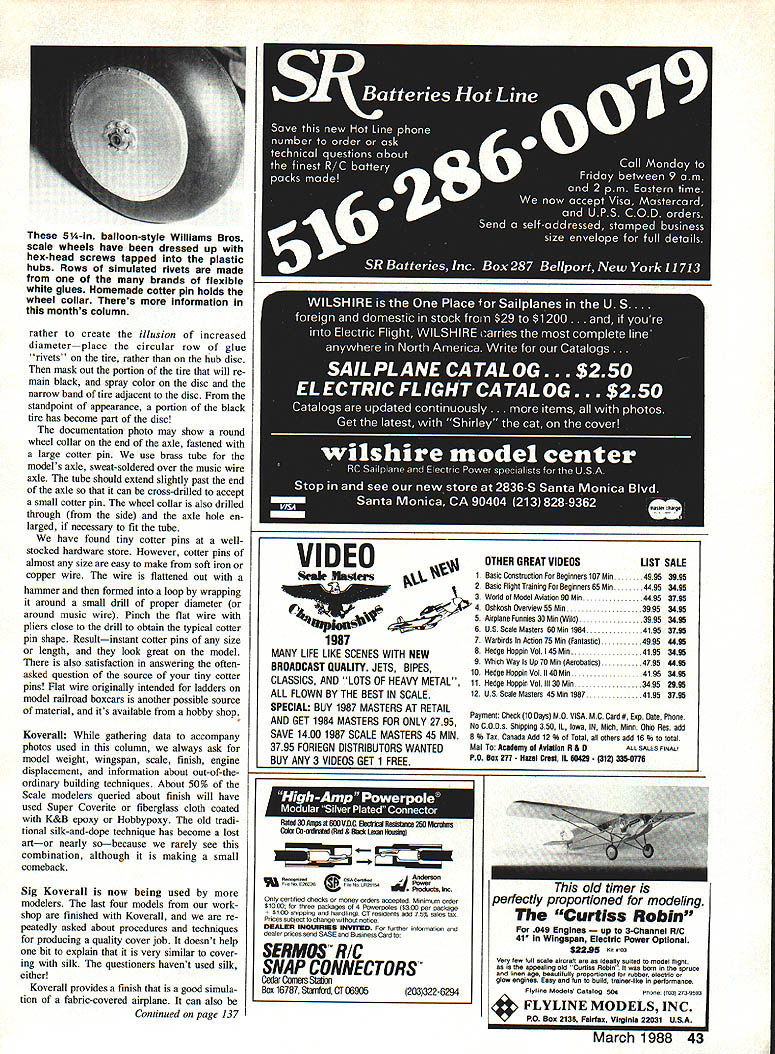
- Gary Wild — used Sig kit Citabria (Super) 1/4-scale Decathlon. Engine: Salto .65 two-stroke; weighs 7.5 lb. Finish: Coverlite, Formula U, Rustoleum paints.
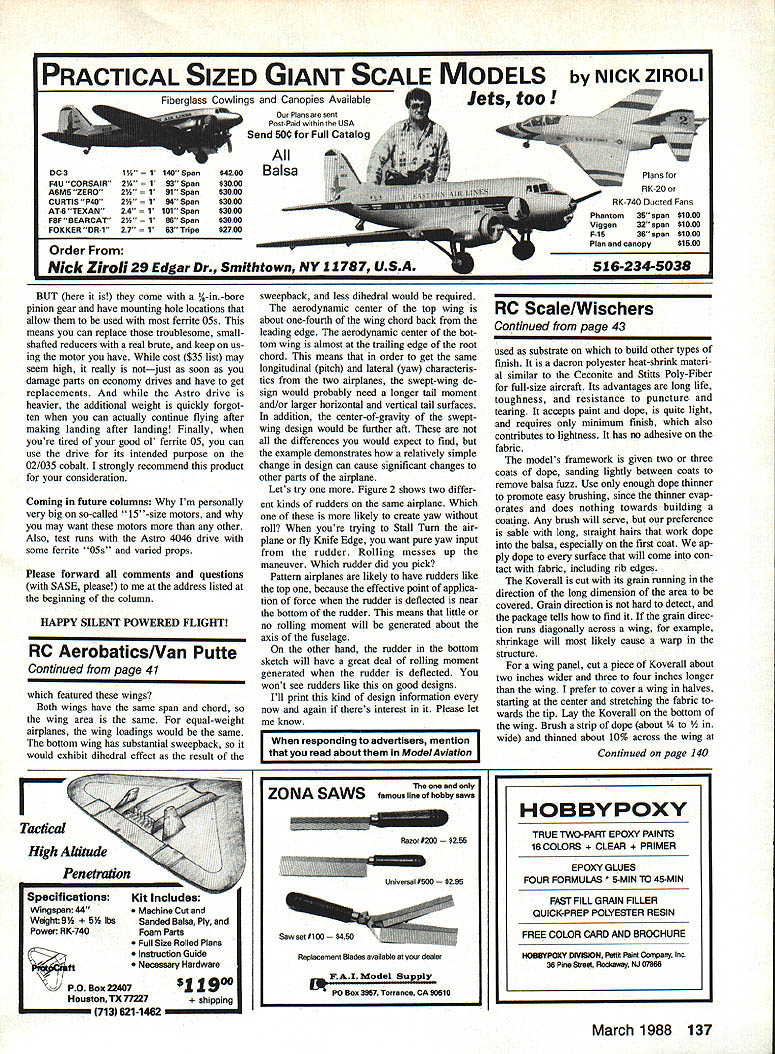
- Cessna O-19 Bird Dog — Jerome Twomey started with Circus Hobbies kit. Engine: OS .120-cu-in twin. Gemini flaps. Control-surface corrugations: Plastruct angles, rivets. CyA glue. Lettering and panel lines: Chart-Pak letters and tape to create the illusion.
Transcribed from original scans by AI. Minor OCR errors may remain.

