
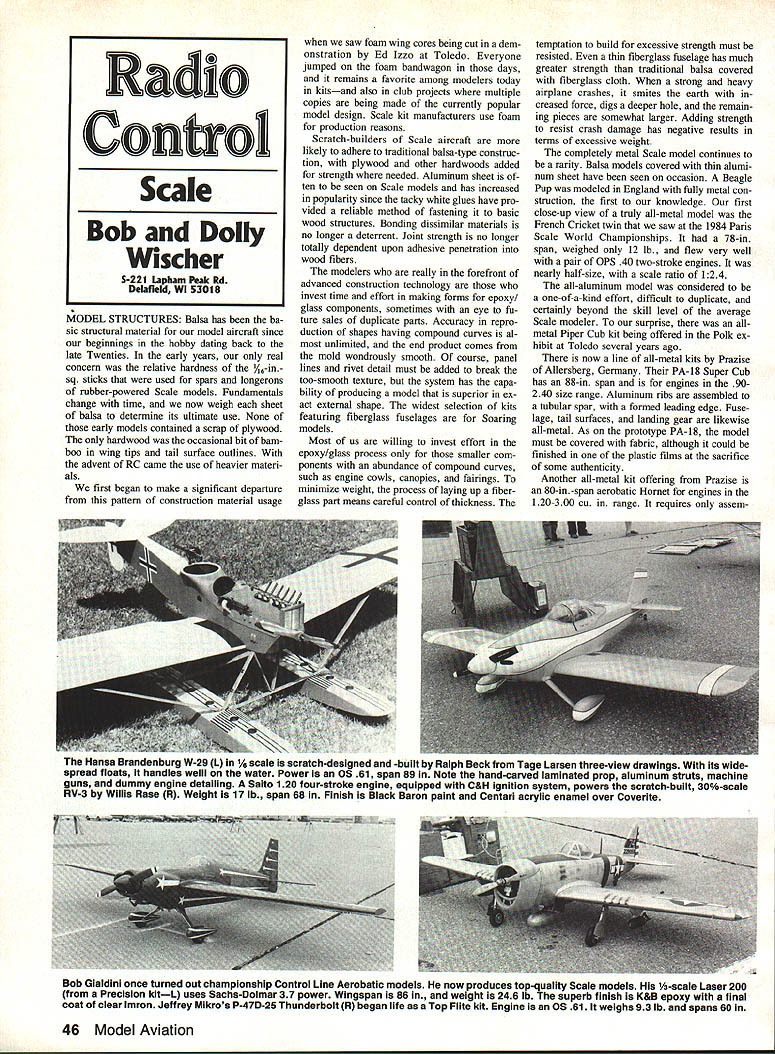
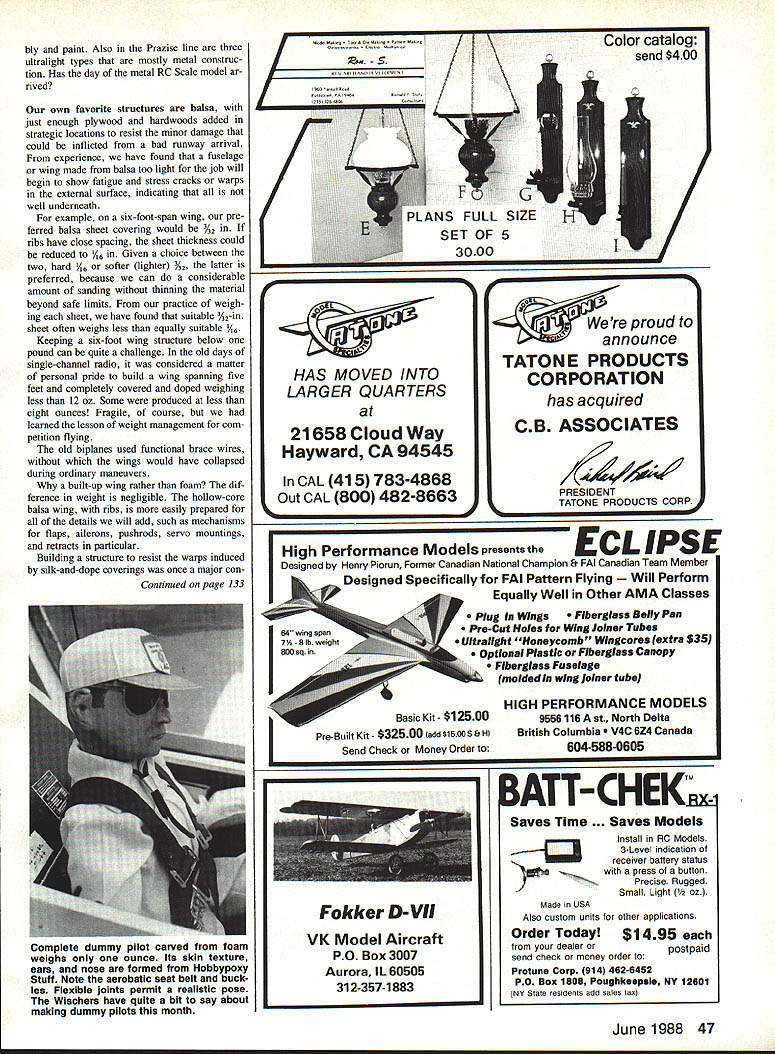
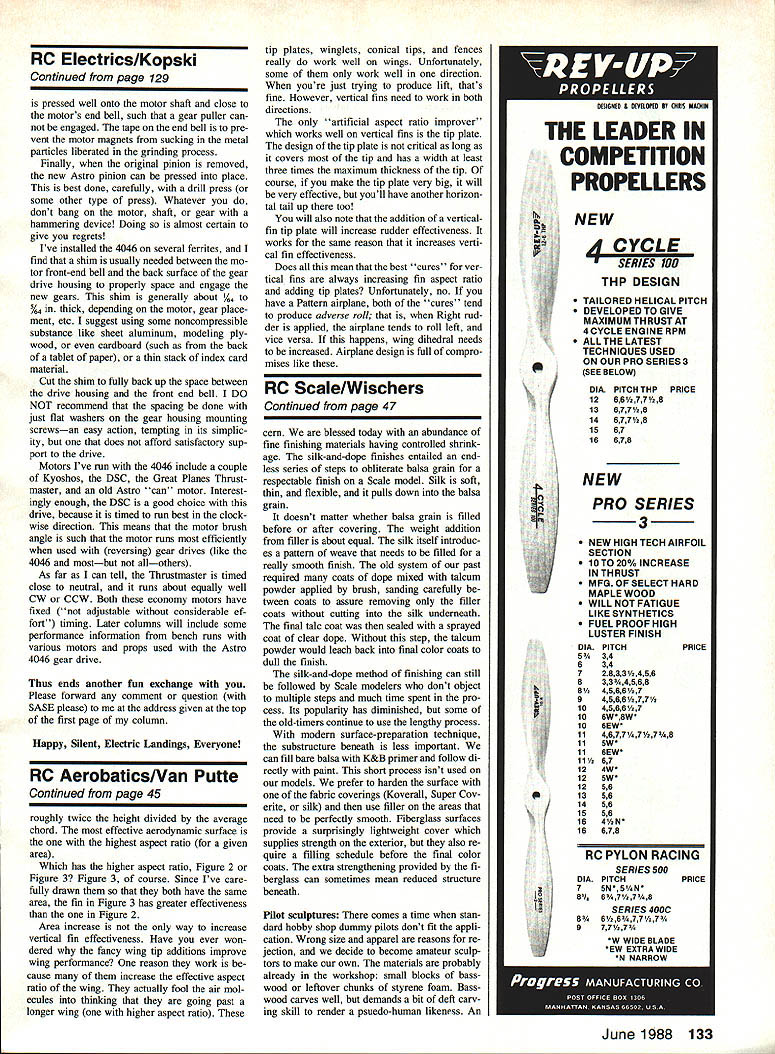
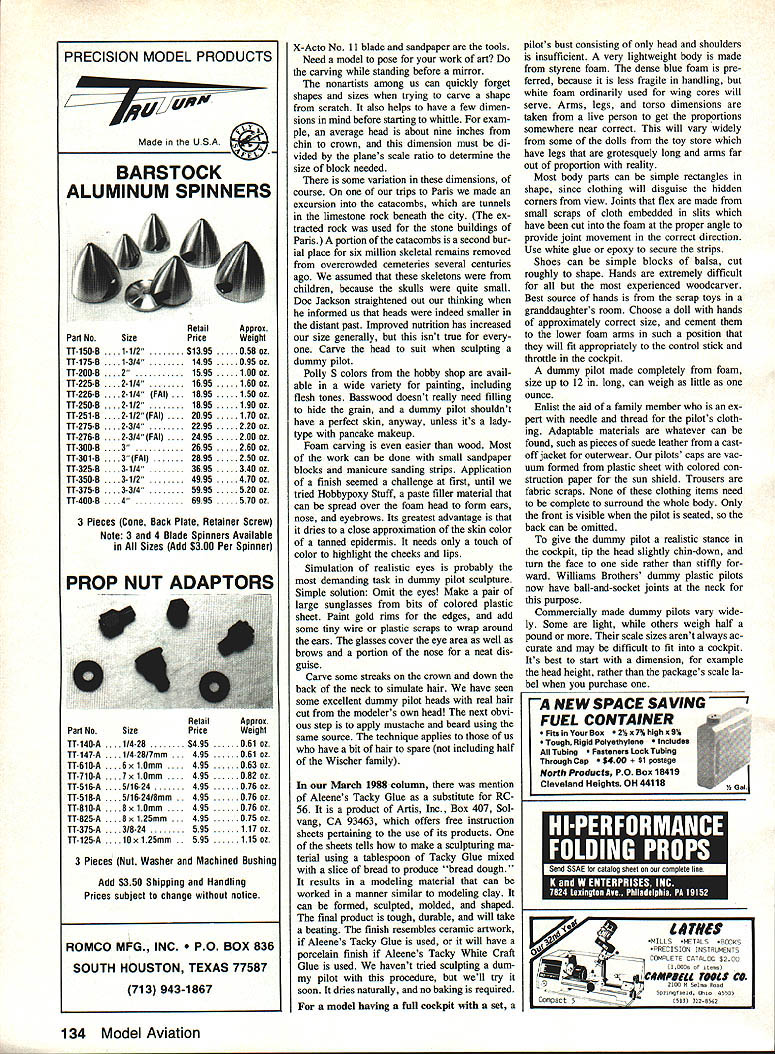
Radio Control: Scale
Bob and Dolly Wischer 5221 Lapham Peak Rd. Delafield, WI 53018
Model Structures
Balsa has been the basic structural material for our model aircraft since our beginnings in the hobby in the late 1920s. In the early years our only real concern was the relative hardness of the 1/16-in.-sq. sticks used for spars and longerons on rubber-powered scale models. Fundamentals change with time, and now we weigh each sheet of balsa to determine its ultimate use. None of those early models contained a scrap of plywood; the only hardwood was the occasional bit of bamboo in wing tips and tail-surface outlines. With the advent of RC came the use of heavier materials.
Foam and kit production
We first made a significant departure from pure balsa construction when we saw foam wing cores being cut in a demonstration by Ed Izzo at Toledo. Everyone jumped on the foam bandwagon in those days, and it remains a favorite among modelers today—in kits and in club projects where multiple copies of a popular design are required. Scale kit manufacturers use foam largely for production reasons.
Scratch-builders of scale aircraft are more likely to adhere to traditional balsa construction, adding plywood and other hardwoods for strength where needed. Aluminum sheet is seen on scale models and has increased in popularity since the advent of reliable tacky white glues. Bonding dissimilar materials is no longer a deterrent; joint strength no longer depends solely on adhesive penetration into wood fibers.
Epoxy, fiberglass and molds
Modelers at the forefront of advanced construction technology invest time and effort in making forms for epoxy/glass components, sometimes with an eye toward producing duplicate parts for sale. Accuracy in reproducing compound curves is almost unlimited, and the resulting molds deliver wondrously smooth shapes. Panel lines and rivet detail must be added to avoid a too-smooth texture, but the system can produce an externally superior model. The widest selection of kits featuring fiberglass fuselages is found in soaring models.
Most of us will invest in epoxy/glass only for smaller components with abundant compound curves—engine cowlings, canopies, and fairings. To minimize weight, laying up fiberglass requires careful control of thickness; the temptation to overbuild must be resisted. Even thin fiberglass fuselages have much greater strength than traditional balsa covered with fiberglass cloth. When a heavy airplane crashes it hits harder and leaves larger pieces; adding strength to resist crash damage often results in excessive weight.
Metal construction
Completely metal scale models remain a rarity. Balsa models covered with thin aluminum sheet have appeared occasionally. A Beagle Pup was modeled in England with fully metal construction—the first we knew of. Our first close-up view of a truly all-metal model was the French Cricket at the 1984 Paris Scale World Championships: a 78-in. span, 12-lb. model that flew well with a pair of OPS .40 two-stroke engines (nearly half-size, scale ratio 1:2.4). The all-aluminum model was a one-of-a-kind effort—difficult to duplicate and beyond the average modeler.
To our surprise, an all-metal Piper Cub kit appeared in the Polk exhibit at Toledo some years ago. There is now a line of all-metal kits by Prazise of Allersberg, Germany. Their PA-18 Super Cub has an 88-in. span and is for engines in the .90–2.40 size range: aluminum ribs assembled to a tubular spar and a formed leading edge; fuselage, tail surfaces, and landing gear are likewise metal. As on the prototype PA-18, the model must be fabric-covered (it could be finished in plastic films at the sacrifice of some authenticity).
Another all-metal offering from Prazise is an 80-in.-span aerobatic Hornet for engines in the .12–.30 cu. in. range; it requires only assembly and paint. Also in the Prazise line are three mostly-metal ultralight types. Has the day of the metal RC scale model arrived? Perhaps, but for most of us balsa with selective hardwood reinforcement remains preferred.
Preferred construction practice
Our favorite structures are balsa, with just enough plywood and hardwood added in strategic locations to resist the minor damage inflicted by a bad runway arrival. From experience, a fuselage or wing built too light will begin to show fatigue: stress cracks or warps in the external surface indicate problems underneath.
For example, on a six-foot-span wing our preferred balsa sheet covering is 3/32 in. If ribs are closely spaced the sheet thickness can be reduced to 1/16 in. Given a choice between hard 1/16 and softer (lighter) 3/32, we prefer the latter because we can sand without thinning the material beyond safe limits. From weighing each sheet we’ve found that suitable 3/32-in. sheet often weighs less than equally suitable 1/16-in.
Keeping a six-foot wing structure below one pound can be quite a challenge. In the old days of single-channel radio it was a matter of pride to build a five-foot wing, completely covered and doped, weighing less than 12 oz. Some were under eight ounces—fragile, to be sure, but they taught lessons in weight management for competition flying.
Built-up hollow-core balsa wings with ribs are preferred over solid foam for ease of adding detail: mechanisms for flaps and ailerons, pushrods, servo mountings, and retracts. The difference in weight between a built-up wing and a foam wing is often negligible.
Finishing
Building a structure to resist warps induced by silk-and-dope coverings was once a major concern. Today we are blessed with an abundance of fine finishing materials with controlled shrinkage. Silk-and-dope finishes required many steps to obliterate balsa grain and produce a respectable scale finish: silk is soft and thin and it pulls into the balsa grain.
It does not matter whether the balsa grain is filled before or after covering—the weight addition from filler is about the same. The silk itself introduces a weave pattern that needs filling for a really smooth finish. The old system involved blue or green primer coats of dope mixed with talcum powder applied by brush, sanding carefully between coats to remove only the filler without cutting into the silk underneath. The final coat was sealed with a sprayed clear dope; without this step the talcum powder could leach back into color coats and dull the finish.
The silk-and-dope method can still be followed by modelers who do not object to multiple steps and much time. Its popularity has diminished, but some old-timers swear by the results. With modern surface-preparation techniques and lightweight fillers, many time-consuming steps are unnecessary.
Pilot sculptures
There comes a time when standard hobby-shop dummy pilots don't fit the application—wrong size or apparel are common reasons for rejection. We make our own pilots.
Materials and tools
Materials include wax or plaster, small blocks of basswood, or leftover chunks of balsa. Basic wood-carving skills will produce nose, cheek, and ear shapes; finer carving renders a pseudo-human likeness. Tools: X-Acto No. 11 blade and sandpaper. If you need a model to pose for your work, carve while standing before a mirror—nonartists quickly forget shapes when carving from memory.
Have a few dimensions in mind before whittling. For example, an average adult head is about nine inches from chin to crown; divide this by the plane’s scale ratio to determine the block size.
Sizing notes
There is variation in dimensions: on one of our trips to Paris we visited the catacombs and noted that skulls seemed small. Doc Jackson explained that heads were smaller in the distant past; improved nutrition has increased sizes generally. Carve the head to suit the era and subject.
Polly S colors from the hobby shop are available in a wide variety for painting, including flesh tones. Basswood doesn’t really need filling to hide grain, and a dummy pilot shouldn’t have perfect skin unless portraying a heavily made-up character.
Foam heads and Hobbycote Stuff
Foam carving is easier than wood; most work can be done with sandpaper blocks and manicure sanding strips. Finishing foam seemed difficult until we tried Hobbycote Stuff, a paste filler that can be spread over a foam head to form ears, nose, and eyebrows. It dries to a close approximation of tanned skin and needs only a touch of color for cheeks and lips.
Simulation of realistic eyes is the most demanding task. Simple solutions:
- Omit the eyes and make large sunglasses from colored plastic sheet (paint gold rims and add tiny wires or plastic for earpieces).
- Paint simplified eyes, or use small decals.
Carve streaks on the crown and down the neck to simulate hair. We have seen excellent dummy heads with real hair cut from the modeler’s own head; mustache and beard can be added similarly.
Full bodies and clothing
For a model with a full cockpit, a pilot’s bust (head and shoulders) is insufficient. Make a very lightweight body from styrene foam—dense blue foam is preferred because it’s less fragile, but wing-core foam will do. Take torso, arm, and leg dimensions from a live person for correct proportions (toy-store dolls often have grotesquely long legs or off-scale arms).
Most body parts can be simple rectangles since clothing hides corners. Flexible joints are made from small cloth scraps embedded in slits cut into foam at proper angles; secure with white glue or epoxy. Shoes can be rough balsa blocks. Hands are extremely difficult; the best source is scrap toy hands from an old doll—select a doll with appropriately sized hands and cement them to the foam arms so they fit the control stick and throttle.
A dummy pilot made completely from foam, up to 12 in. long, can weigh as little as one ounce.
Enlist a family member skilled with needle and thread for the pilot’s clothing. Use adaptable materials: suede scraps from a castoff jacket for outerwear, fabric remnants for trousers. Caps can be vacuum-formed from plastic sheet with colored cored struts for the sun shield. Only the front of clothing needs detail; the back can be omitted when seated.
To give a realistic stance, tip the head slightly chin-down and turn the face to one side rather than straight ahead. Williams Brothers’ plastic dummy pilots now have ball-and-socket neck joints for this purpose.
Glues and modeling materials
In our March 1988 column we mentioned Aleene’s Tacky Glue as a substitute for RC-56. Aleene’s (Artis, Inc., Box 407, Solvang, CA 93463) offers free instruction sheets on its products. One sheet describes making a sculpturing material by mixing a tablespoon of Tacky Glue with a slice of bread to produce “bread dough.” This modeling material works like clay: it can be formed, sculpted, molded, and shaped. The final product is tough, durable, and resilient. The finish resembles ceramic artwork if Aleene’s Tacky Glue is used, or porcelain if Aleene’s Tacky White Craft Glue is used. It dries naturally—no baking required.
Commercial dummy pilots
Commercially made dummy pilots vary widely in weight and scale accuracy; some weigh half a pound or more. Their stated scale is not always reliable and they can be difficult to fit into a cockpit. It’s best to start with a measured dimension (for example, head height) rather than the package’s scale label when purchasing.
Model Aviation — Radio Control: Scale Bob and Dolly Wischer 5221 Lapham Peak Rd., Delafield, WI 53018
Transcribed from original scans by AI. Minor OCR errors may remain.

