

Radio Control: Scale
Bob and Dolly Wischer
S-221 Lapham Peak Rd., Delafield, WI 53018
EAA Model Show
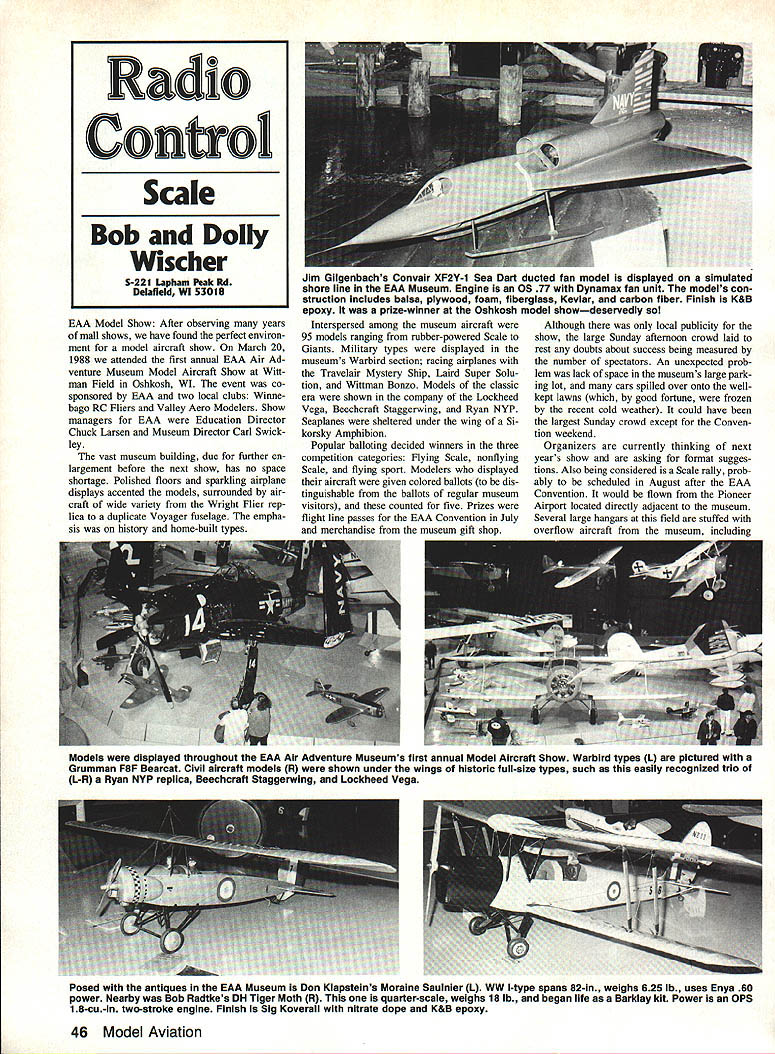
On March 20, 1988 we attended the first annual EAA Air Adventure Museum Model Aircraft Show at Wittman Field in Oshkosh, WI. The event was co-sponsored by EAA and two local clubs, Winnebago RC Fliers and Valley Aero Modelers. Show managers for EAA were Education Director Chuck Larsen and Museum Director Carl Swickley.
The vast museum building, due for further enlargement before the next show, had no shortage of space. Polished floors and sparkling airplane displays accented the models, which were surrounded by full-size aircraft of wide variety—from the Wright Flyer replica to a duplicate Voyager fuselage. The emphasis was on history and home-built types.
Interspersed among the museum aircraft were 95 models ranging from rubber-powered to Scale Giants. Military types were displayed in the museum's Warbird section; racing airplanes included the Travelair Mystery Ship, Laird Super Solution, and Wittman Bonzo. Models of the classic era were shown alongside the Lockheed Vega, Beechcraft Staggerwing, and Ryan NYP. Seaplanes were sheltered under the wing of a Sikorsky amphibian.
Popular balloting decided winners in three competition categories:
- Flying Scale
- Nonflying Scale
- Flying Sport
Modelers who displayed their aircraft were given colored ballots to distinguish them from regular museum visitors; these ballots were counted for five votes. Prizes included flight-line passes for the EAA Convention in July and merchandise from the museum gift shop.
Although publicity was local, the large Sunday-afternoon crowd laid to rest any doubts about measuring success by spectator count. An unexpected problem was lack of parking: the museum's large lot overflowed onto the well-kept lawns. By good fortune recent cold weather had frozen the ground and prevented damage; otherwise the turnout could have rivaled a Convention weekend.
Organizers are planning next year's show and asking for format suggestions. Also being considered is a Scale rally, probably scheduled in August after the EAA Convention, to be flown from the Pioneer Airport located directly adjacent to the museum. Having the hangars open to modelers would be a notable incentive to attract Scale enthusiasts. Many modelers are inspired to build airplanes after visiting collections of classics and antiques.
Hole cutter
In a previous column we mentioned making an instrument panel from sheet styrene plastic. Punching a smooth, round hole in styrene can be frustrating—an elaborate panel may have up to a dozen holes and alignment for best appearance is critical. An adjustable tool to do the job eliminates these frustrations.
Tool design
The cutting point of our tool is a sharp blade intended for use in a draftsman's compass. The cylindrical end is dimensioned to fit in place of a pencil lead and is secured with the same screw that would hold the lead. The cutter end of the blade is thin and sharp to penetrate with minimum displacement of material.
When we tried to cut styrene using the blade in a compass, it was extremely difficult to control when cutting through anything thicker; for styrene the blade must be rigidly mounted and controlled so it can't wander off its circular path.
Our solution was a homemade tool carrier. We clamped the cutter in one end of an aluminum bar using a setscrew. The bar has a rectangular cross section about .375 in. and a slot for adjustment of a center post. The slot can be made with a milling cutter or by drilling a row of closely spaced holes and grinding out the intervening material with a rat-tail file. The slot is dimensioned to fit a 10-32 thread.
The brass or steel center post, about .375 in. in diameter, was turned down and the end threaded 10-32. It could also be made from a 10-32 machine screw with a nut above the bar. None of the machining dimensions need to be exact.
Only one operation demands precision: drilling a .062-in.-diameter hole, on exact center, in the end of the post for a short length of music wire which is pressed or soldered into the hole. The music wire acts as a pilot to hold the cutter centered over the spot where the instrument is to be located in the panel.
Operation
The styrene panel is cut to shape, and the center of each instrument hole is drilled with a .062-in. hole to guide the tool's pilot. A soft-wood backing block also has a .062-in.-diameter hole drilled for the pilot.
We mount the tool in a drill press, with spindle speed adjusted as slow as possible. The cutter is gently lowered into the styrene to avoid heating the cutter tip; overheating will melt the styrene and enlarge the hole, leaving rough edges. The cutter will break through the styrene in a few seconds, at which point the cutout disc of styrene begins to rotate. Take care to avoid pressing the cutter into the wood block, as hard material shortens the cutter's life rapidly.
Other uses and maintenance
We have used the homemade hole cutter to produce clean lighting holes in balsa parts such as large wing ribs and fuselage sides, and for holes in 1/8 and 1/4 plywood—though thicker material is abrasive to the cutter's sharp point. The points are easily sharpened on an oil stone using the same technique as on a worn X-Acto blade. Over 20 years of use we remember only one sharpening.
When cutting holes in balsa, pilot holes are not needed if the music wire is sharpened to a point. A perfectly centered point can be formed by holding the wire against a Dremel cutoff disc while rotating the wire in the drill press. The point will penetrate balsa without effort. The point doesn't work as well on styrene, where drilled pilot holes are preferred for accurate location.
For very small instrument-panel holes (below a diameter of .375 in.), sharpen the end of a brass or steel tube of the appropriate diameter. Mount the tube in the drill-press chuck and use the lowest speed available to spin the tube through the styrene without overheating. Brass tube must be sharpened quite frequently. Similar tubular hole cutters from X-Acto are made from hardened steel, but we have found them in only two diameters: .187 in. and .437 in.
Tube bending (related tool notes)
Some long-used tools are very crude yet effective. For bending tubing we have a series of wood dowels, ranging in diameter from 5/32 in. to 1/2 in., grooved to closely fit various sizes of brass and aluminum tubing. The tube is first softened by annealing with heat (a kitchen stove suffices), then wrapped around the dowel and confined in the groove to produce any angle of bend without distortion or kinking. The close-fitting groove avoids flattening during bending and allows very small bend radii. If the tube work-hardens before the bend is complete, reanneal it with heat.
Steel tube is much more difficult to work; a simple grooved wood dowel won't do the job. Steel tube must be confined closely on all sides at the forming point to avoid distortion.
Scale colors
Reproducing exact prototype colors on Scale models has always been contentious. In contests, judges expect proof that a model's colors match the prototype precisely. For obscure aircraft in the antiques, classics, or military-prototype classes, documenting exact color is often nearly impossible; lack of color information can make such subjects a poor choice.
An alternative view is that modelers' choices should be unlimited and judges should accommodate subjects difficult to document. A recent FAA rules-change proposal from an I.L.K. source suggests a reasonable compromise under the heading "Judging for Fidelity to Scale and Craftsmanship." The proposal recommends reducing the K-factor for color from six to three to recognize the difficulty of proving exact color.
The rationale: actual color is difficult to prove and creates documentation problems for competitors and judges. Color photographs vary with lighting and weather; printed matter is frequently inaccurate and written descriptions vague. Color negatives processed locally seldom yield consistent or accurate color renditions. The average person may accept approximate colors, but Scale modelers demand a level of accuracy rarely present in available references.
Modelers and judges disagree on what constitutes satisfactory color documentation. Some prefer fabric swatches or original paint chips from the prototype. Others accept a color drawing from a Profile publication, even though printers' ink choices can be inaccurate. Conflicts between competitor and judge can therefore arise.
The English proposal also suggests increasing emphasis on surface texture by changing its title to "Surface Texture and Realism" and raising its K-factor from six to eight. It proposes increasing the K-factor for "Surface Detail" from seven to eight to reward modelers of complex aircraft. These increases would compensate mathematically for the loss of three points in color, keeping the total for all judging factors at 65.
Raising the award for surface detail addresses controversy over the reduction in flight bonus points for complex-prototype models. The classic example: a model that is extremely well executed with every detail present, externally and internally, but whose prototype is a simple, overall paint scheme with few markings. Despite the modeler's exceptional effort in surface detail, their work may not have been sufficiently reflected in judging. The proposal attempts to balance the chances of simple and complex models; current rules tend to favor simpler models.
Inequalities in judging standards and natural bias have made competition distasteful for some modelers. Whether rules can be written to fit the wide variety of models is doubtful, but changes like the ones proposed aim to bring more Scale modelers into contests.
Proposals have also been made to revise the judges' guide in the FAI rule book to emphasize color, scale detail, and markings. Suggested additions include guidance to:
- Consider the greater effort involved in reproducing multicolored finishes or difficult shades (such as polished metal) compared to models with only one or two basic colors.
- Reflect both the accuracy and complexity of prototype markings in the marks awarded.
- Reflect both the accuracy and quantity of scale detail present; a well-documented, highly detailed model should score proportionately higher than a model with little detail, even if the full-size prototype has few visible details.
Future Scale World Championships
The FAI Committee for International Aeromodelling (CIAM) has received two offers from national aero clubs to host the 1990 Scale World Championships. One offer is from Canada to conduct the meet at Red Deer, Alberta (between Calgary and Edmonton); this meet is expected to be for RC Scale competition only. The second offer is from Belgium for a meet at Genk, which would include both RC (F4C) and CL (F4B) Scale.
Transcribed from original scans by AI. Minor OCR errors may remain.

