
Radio Control: Scale
Bud Atkinson
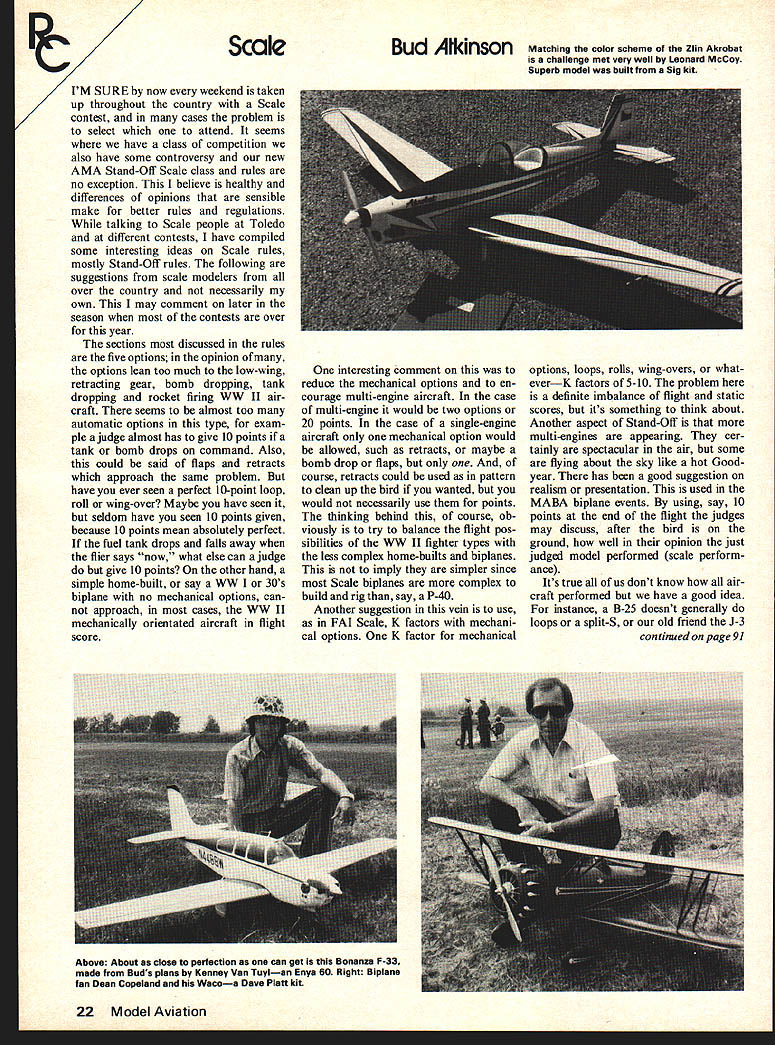
I'M SURE by now every weekend is taken up throughout the country with a Scale contest, and in many cases the problem is to select which one to attend. It seems where we have a class of competition we also have some controversy and our new AMA Stand-Off Scale class and rules are no exception. This I believe is healthy and differences of opinions that are sensible make for better rules and regulations. While talking to Scale people at Toledo and at different contests, I have compiled some interesting ideas on Scale rules, mostly Stand-Off rules. The following are suggestions from scale modelers from all over the country and not necessarily my own. This I may comment on later in the season when most of the contests are over for this year.
The sections most discussed in the rules are the five options; in the opinion of many, the options lean too much to the low-wing, retracting gear, bomb dropping, tank dropping and rocket firing WW II aircraft. There seems to be almost too many automatic options in this type, for example a judge almost has to give 10 points if a tank or bomb drops on command. Also, this could be said of flaps and retracts which approach the same problem. But have you ever seen a perfect 10-point loop, roll or wing-over? Maybe you have seen it, but seldom have you seen 10 points given, because 10 points mean absolutely perfect. If the fuel tank drops and falls away when the flier says "now," what else can a judge do but give 10 points? On the other hand, a simple home-built, or say a WW I or '30s biplane with no mechanical options, cannot approach, in most cases, the WW II mechanically orientated aircraft in flight score.
One interesting comment on this was to reduce the mechanical options and to encourage multi-engine aircraft. In the case of multi-engine it would be two options or 20 points. In the case of a single-engine aircraft only one mechanical option would be allowed, such as retracts, or maybe a bomb drop or flaps, but only one. And, of course, retracts could be used as in pattern to clean up the bird if you wanted, but you would not necessarily use them for points. The thinking behind this, of course, obviously is to try to balance the flight possibilities of the WW II fighter types with the less complex home-builts and biplanes. This is not to imply they are simpler since most Scale biplanes are more complex to build and rig than, say, a P-40.
Another suggestion in this vein is to use, as in FAI Scale, K factors with mechanical options. One K factor for mechanical options, loops, rolls, wing-overs, or whatever—K factors of 5-10. The problem here is a definite imbalance of flight and static scores, but it's something to think about. Another aspect of Stand-Off is that more multi-engines are appearing. They certainly are spectacular in the air, but some are flying about the sky like hot dogs. There has been a good suggestion on realism or presentation. This is used in the MABA biplane events. By using, say, 10 points at the end of the flight the judges may discuss, after the bird is on the ground, how well in their opinion the just-judged model performed (scale performance).
It's true all of us don't know how all aircraft performed but we have a good idea. For instance, a B-25 doesn't generally do loops or a split-S, or our old friend the J-3
Radio Control: Scale
doesn't do many outside loops. This sounds like a good suggestion. One could go a long way in taming down some of the over-reacting multi-engine aircraft, as well as single-engine aircraft, because I think realism is what we are all after in Scale.
On the subject of flight it has been suggested to put back the two flights and divided-by-two rule to obtain a better average score rather than using one score. This would encourage more flights at contests.
There seems to be a better definition on the use of three-views; this rule is rather loose and needs to be rewritten.
It has also been suggested a pilot be mandatory. If no pilot points could be lost in, say, the 10-point performance section of our rules, or full under general appearance.
Bud Atkinson, 734 N. 6th Street Terrace, Blue Springs, MO 64015.
Transcribed from original scans by AI. Minor OCR errors may remain.

