

Radio Control: Scale
Bob and Dolly Wischer S-221 Lapham Peak Rd. Delafield, WI 53018
Alternate cutter
A letter from Clyde Deatherage describes his method of making the cutting blade for the fly-cutter tool we described in our July 1988 column. The cutting blade can be made from a discarded or broken high-speed drill bit. Any size about #44 diameter (.086 in.) or larger can be used; Clyde worked with a #30 (.128 in.) drill. He suggests forming a cutting point with a blade shape by grinding both sides of the fluted end of the drill to achieve a blade thickness of about 1/32".
Grind the fluted end (not the shank), because some drills have a softer shank that won't stand up well for cutting operations. The grinding must be done very slowly — a small drill will overheat almost immediately if held against an abrasive wheel for more than a few seconds. Once the drill turns blue, the temper is gone. Grind the tip to a chisel edge and keep a cup of water handy to dip the ground end frequently to preserve the temper. Most modelers have an abundance of drills with dull or broken tips; small drills are difficult to resharpen.
FAI Paris: CIAM annual rules meeting
The CIAM (Committee for International Aeromodelling) annual rules-making meeting was held at FAI headquarters in the historic French Aero Club in central Paris. About 30 national aero clubs were represented. Not all nations have an interest in Scale modeling, so Sandy Pimenoff, CIAM president, ensures fairness in the voting by asking delegates with no special interest to indicate that they are "not voting."
South Africa, excluded from international competition for political reasons, was nevertheless vociferous at the meetings in an apparent effort to gain visibility for its modelers. Of some 18 rules-change proposals, a few met strong opposition. For example, South Africa proposed that an overshoot maneuver be performed with the final leg as steep and slow as possible, rather than the normal approach. A model attempting a steep, slow landing risks stalling as wind diminishes near the surface and interaction with the ground increases; acceptance of the proposal would have made the maneuver dangerous and likely to cause wreckage. The proposal was rejected on the basis that wreckage on the runway is undesirable. Many South African proposals were merely rewordings for clarification and most of those were accepted.
For a complete summary of actions at Paris, see the "CIAM Reports" in the "Competition Newsletter" section of this magazine. My report on the Scale actions appeared in the August 1988 issue.
RAF Pageant — Shuttleworth Collection, Old Warden
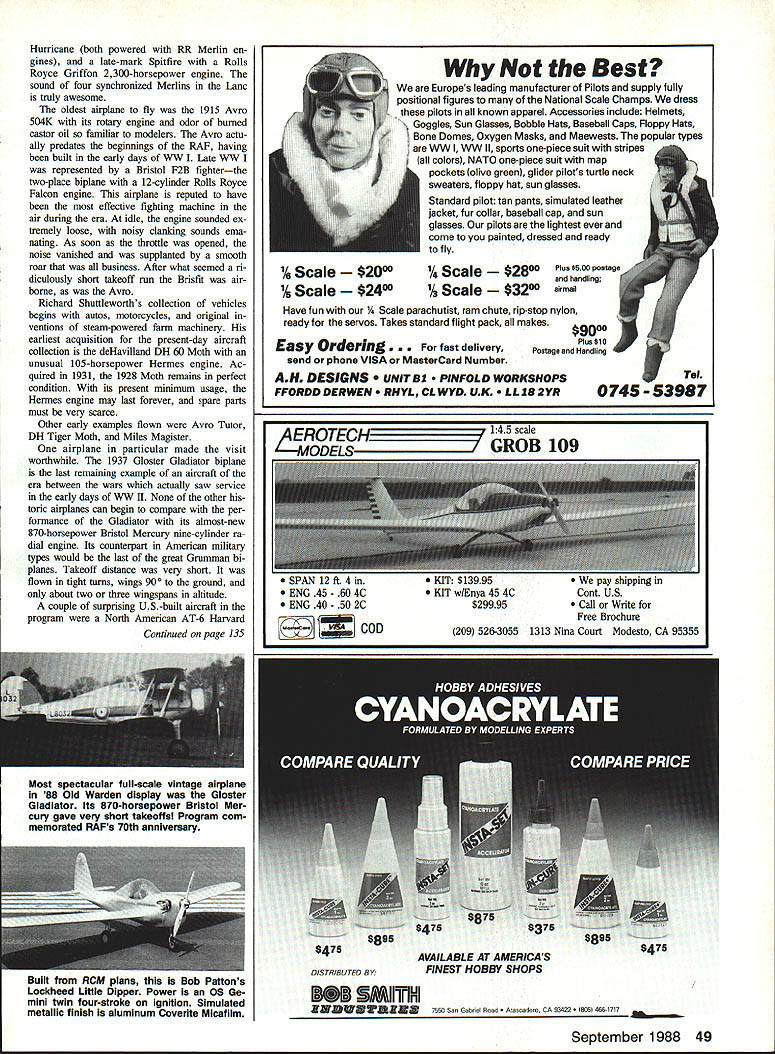
With the FAI business behind us we ferried across the Channel to revisit the Shuttleworth Collection at Old Warden Aerodrome and to attend a flying day: the Shuttleworth Salute to the Royal Air Force, marking the seventieth anniversary of the RAF. The collection is kept in mint condition with great effort to ensure accuracy of detail and markings. On flying days many prized aircraft are parked outdoors for close observation and are flown before the crowd.
The airfield layout is two elongated runways crossing each other; spectators are permitted into the apex area of the crossing. Demonstration flights sweep arcs down the runway and around the corner, and at times aircraft come very close to the spectator line. David Ogilvy, the display organizer, defended the safety of the arrangement and assured us the event conforms to Civil Aviation Authority safety requirements. He compared the arrangement with Oshkosh, where a single runway and greater separation keep aircraft farther from spectators.
The program included:
- Battle of Britain Flight: Avro Lancaster, Hawker Hurricane (both powered with Rolls‑Royce Merlin engines), and a late‑mark Spitfire with a Rolls‑Royce Griffon (about 2,300 hp).
- The 1915 Avro 504K with rotary engine (note the familiar odor of burned castor oil).
- Bristol F2B fighter (late WW I two-place biplane with a Rolls‑Royce Falcon engine).
- Early interwar types such as the de Havilland DH.60 Moth (105‑hp Hermes engine, acquired 1931, originally 1928), Avro Tutor, DH Tiger Moth, and Miles Magister.
- The 1937 Gloster Gladiator biplane (last remaining example of its type in service at the start of WW II) with an almost‑new 870‑hp Bristol Mercury radial engine — notable for very short takeoff runs and tight, steep turns.
- North American AT‑6 Harvard and Consolidated Catalina (U.S. built aircraft present).
- Fairey Swordfish (early WW II vintage) and a Sea Harrier from RNAS Yeovilton (demonstrating slow, hovering flight and high‑speed passes).
- Additional displays included a U.S. Fairchild A‑10 Thunderbolt II demonstrating maneuverability, and a Cranfield A‑1 intended for international aerobatic contests.
The sound of four synchronized Merlins in the Lancaster is particularly impressive. The Avro and Bristol displayed the distinctive behavior of their engines — loose, clanking sounds at idle that converted to a smooth roar at throttle.
Model flying in the United Kingdom
We visited three model flying sites on the trip.
- Tempsford (disused WWII air base)
- A short length of runway is preserved for RC model flying by the landowner. Tempsford is historically significant as a departure point for Westland Lysanders on clandestine missions during WWII.
- The club enforces painted divisions on the pavement indicating where a flier must stand for flight, engine start-up, or any activity with a transmitter turned on. This strict positioning helps avoid radio interference. Otherwise, the flying resembled sport flights back home. The four‑stroke engine revolution is well established there.
- Marlborough — Chris Bradford
- We flew Chris Bradford’s Sopwith Pup from a typical grass field; it was powered by an English Laser four‑stroke engine. The Marlborough Model Flying Club has a shelter house and a smooth rugby field used for Control Line flying.
- The Laser engine is notable for smooth idle and prompt acceleration without nitro. Chris owns multiple Lasers (single and twin) and collects engines. He has been a member of the U.K. World Championship Scale teams in 1984 and 1986.
- Address: 38 Barrow Close, Marlborough, Wiltshire, SN8 2BE, England.
- Merryfield — James Pelly‑Fry
- James Pelly‑Fry (author of the Vickers Wellesley article in the June 1988 issue) flies at Merryfield, a little‑used naval base with a newly paved 1½‑mile runway. The club is smaller and interference has not been a problem. A gate guard knows the local modelers, who fly undisturbed.
- Pelly‑Fry’s newest Scale model is a de Havilland Devon twin, with Brian Taylor serving as test pilot.
Another P‑51
Bob Holman reports that Brian Taylor’s newest plan is ready for distribution: a P‑51D Mustang designed to 1:6.4 scale for .60‑size two‑stroke or .75/.90 four‑stroke engines. No accurate scale drawing was available, so the model was built from measurements and photos of Mustangs at the Imperial War Museum, Duxford.
- Model weight: just under 11 lb.; required two ounces of tail ballast to balance.
- Engine: English Laser .75 four‑stroke.
- Cooling: sufficient through the chin air intake; exit air flows through scale exhaust pipes and then through the fuselage to the radiator outlet.
- Span: 69 in.
- Construction: drawing shows balsa construction; an epoxy glass fuselage will be available.
- Accessory package: detailed glass cowl, hatch, belly scoop, canopy, two drop tanks, and an aluminum spinner.
Plans from: Bob Holman Plans, P.O. Box 741, San Bernardino, CA 92402.
Paul Matt drawings
Paul and Joan Matt died last year, raising concern among Scale modelers about the fate of Paul Matt’s extensive collection of scale three‑view drawings. SunShine House, Inc., P.O. Box 2065, Terre Haute, IN 47802 has acquired all material from Historical Aviation Album (published by Paul Matt). Included are the three‑ and four‑view scale drawings as well as the last two Historical Aviation Albums (Volumes 17 and 18). SunShine House also publishes numerous books of interest to modelers in their Aviation Heritage Library series.
Competition notes / Giant Scale
- At a recent Mint Julep contest, Bill Carper’s 1/5‑scale Republic P‑47G Thunderbolt used a Super Tigre 3000 engine; finish was R&S paint over fiberglass polyester resin. Dave Platt’s retracts were used. Model weight was 23 lb.
- Hal Parenti finished first in the FAI class at the same meet with a new Piper Comanche powered by two OS .40 two‑stroke engines.
- James Pelly‑Fry’s other Scale project is a 1/5‑scale DH Demon powered by a pair of Enya .46 four‑stroke engines. The model spans 86 in., weighs 115 lb., and is constructed mostly of balsa and plywood with nylon‑covered wings (silkspan finish).
Transcribed from original scans by AI. Minor OCR errors may remain.

